








 Contact Platform Support
 Help Center
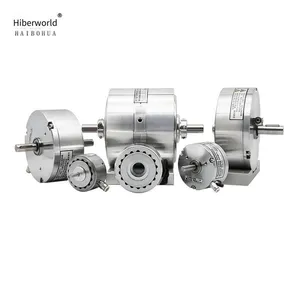
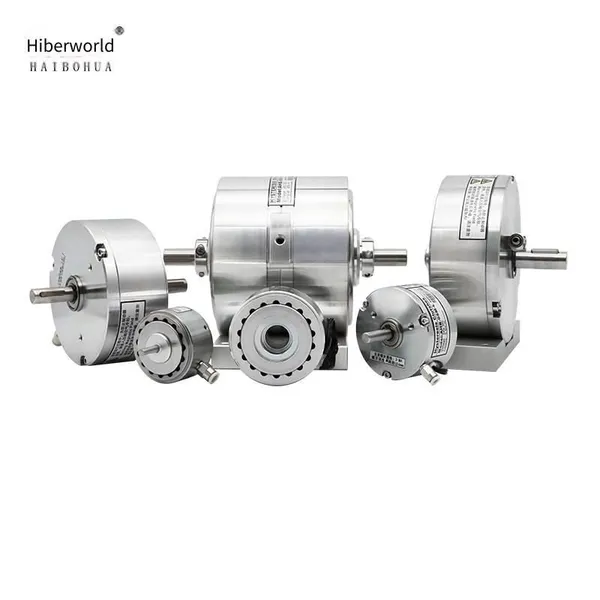
Hysteresis Brakes, Haibohua Hysteresis Dampers Ahb/hb, Manufacturer of Hysteresis Brakes





Related Products
-
 Explosion-proof Torque Sensor, Manufacturer of Dynamic Torque Sensors - Beijing HaibohuaUS$ 1153.85MOQ: 1 Set
 -
Motor Drag Test Bench, Permanent Magnet Synchronous Motor Loading Test BenchUS$ 7692.31MOQ: 1 Set
-
Ultra-small Torque Sensor, Compact Type Without Base Installation, Haibo HuaUS$ 707.69 - 738.46MOQ: 1 Piece
-
Ultra-small Torque Sensor, Compact Type Without Base Installation, Haibo HuaUS$ 707.69 - 738.46MOQ: 1 Piece
-
Hcnj-104 Miniature Ultra-small Torque Sensor for Motor Torque and Rotational Speed MeasurementUS$ 676.92 - 692.31MOQ: 1 Set
Structural features and working principles of the hysteresis brake:
The hysteresis brake consists of two parts: stator magnetic poles and a rotor made of special materials. They are fixed together through the rotor/shaft assembly but do not contact each other. It can apply the hysteresis principle in magnetism to control the torque. When the magnetic pole coil is not energized, the rotor/shaft can rotate freely on the rolling bearing. After energization, a magnetic field is generated in the gap of the stator magnetic poles, and the rotor will also produce a braking effect due to the magnetic field effect, that is, generate the corresponding torque. The torque is only related to the magnitude of the hysteresis current and has nothing to do with the rotational speed, realizing non-contact torque transmission.
Functions of the hysteresis brake:
The hysteresis brake is used as a torque load and power absorption device in the life tests of motor test platforms, drives, etc.; it is used as tension control in the unwinding and pay - off equipment of wires, cables, ropes, threads, paper, and video tapes. It is used as coupling overload protection during the start - up and loading process; it works quietly, without friction, requires no maintenance, and has a long service life; the torque is largely independent of the speed; the torque is infinitely adjustable; it has a wide speed range.
Selection of the hysteresis brake:
The hysteresis brake has a variety of parameter ranges such as torque, speed, and power. In order to select a hysteresis brake suitable for your use, you must determine the parameters such as torque, speed, and power required for the application.
Torque: The hysteresis brake can provide torque output at any speed point, including low speed and zero speed. In addition to the rated torque, all torque points during the test process must also be considered, including the stall torque and the breakdown torque. When selecting the brake specification, the key factor to consider is the torque used in the test, followed by the required power.
Speed: The commonly mentioned speed is not related to torque and power. It generally refers to the speed at which the motor can run safely under no - load (idle) or with a small torque. However, the selection of the brake should be determined by the load speed of the motor or the application.
Power: The rated power is the power that the hysteresis brake can receive and the heat generated when testing the motor under load. Generally speaking, the rated power of the hysteresis brake cannot be less than the slip power output by the motor or rotating device under test, otherwise, the brake will be burned.
Slip power calculation formula P = M*n/9.55 = F*V
P: Slip power W (watt) n: Actual speed rpm (revolutions per minute) M: Transmitted torque N.m (Newton - meter) F: Tension N (Newton) V: Belt speed m/s (meters per second). During the working process of the hysteresis brake, it consumes power to do work and converts it into heat. It has a rated allowable slip power. Exceeding this value will damage the device due to overheating.
In the occasion of wire winding processing, tension control is often used. At this time, the actual tension on the wire or strip is converted into the brake torque, which is determined by the following formula: M = F * R
F: Tension N (Newton) R: Radius of the material reel m (meter) M: Torque N.m (Newton - meter)
Please consult the sales staff for the product's external dimensionsProduct model definition of hysteresis brakes:
Example: HB - 002M - D
HB: Standard hysteresis brake LB: Hollow - shaft hysteresis brake AHB: Air - cooled hysteresis brake MHB: Matching hysteresis brake
002M: Model specification
D: Double - output shaft L: Left - output shaft R: Right - output shaft
1. HB Standard hysteresis brake
The standard hysteresis brake has two installation methods: single - output shaft and double - output shaft. It can be selected according to the usage space and installation form. It has a wide range of applications and strong universality. It is mainly used as the simulated load for the life test of high - speed winding equipment, motors, small internal combustion engines, gearboxes and other rotating devices, and the precise load for high - end sports equipment.
2. AHB Air - cooled hysteresis brake
The hysteresis brake has built - in cooling holes and is externally connected with compressed air for cooling. When the brake works for a long time, its temperature will rise sharply. The air - cooled hysteresis brake can operate continuously for a long time under the slip power.
3. LB Hollow - shaft hysteresis brake
It is assembled in a hollow and shaftless way, with mounting holes machined on the rotor surface and an embedded common - shaft installation method. It provides constant tension control for the passive unwinding of wires and is suitable for spiral winding occasions such as the tape unwinding of cable coating yarn. For example, it can be used in the production equipment of electric wires and cables, fiber - optic cables, ropes and hoses.
4. MHB Matching hysteresis brake
At multiple specific current points, the torque is the same. Only one set of control system is needed to achieve multi - axis tension control. It is mainly used in the unwinding devices for multi - roll yarns and glass fibers, and the processing machinery for cables, ropes, etc. ◆ The excitation current is basically proportional to the output torque. The transmitted torque can be controlled within the range of 5 - 100% of the rated value, and the output torque is 100% - 135% of the rated torque. A small current can control the output of a relatively large torque.
◆ Regardless of the change in the slip speed, the transmitted torque can be basically guaranteed.
◆ It can continuously slip under the allowable slip power, and there are no other wearing parts except the bearings.
◆ Non - contact torque transmission, smooth operation, wide speed range, maintenance - free and long service life.
◆ It operates quietly without friction, is maintenance - free and has a long service life.
◆ The torque is largely independent of the speed and is steplessly adjustable.
Application fields:
◆ Provide precise tension control for high - speed automatic winding machines
◆ Provide precise tension control during the winding process of various coils
◆ Be applied to the braking and load - bearing of motion mechanisms
◆ Provide precise tension control for slitting machines of paper wires, films, tapes, etc.
◆ Provide constant tension control for the fluctuating unwinding of wires
◆ Be used as the simulated load for the life test of motors, small internal combustion engines, gearboxes and other rotating devices
◆ Be applied to the multi - reel tension control system in cable arrangement production, etc.
◆ Be applied to the multi - reel force control in the production of ropes and cables
Compatible current source
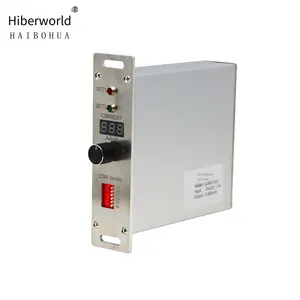
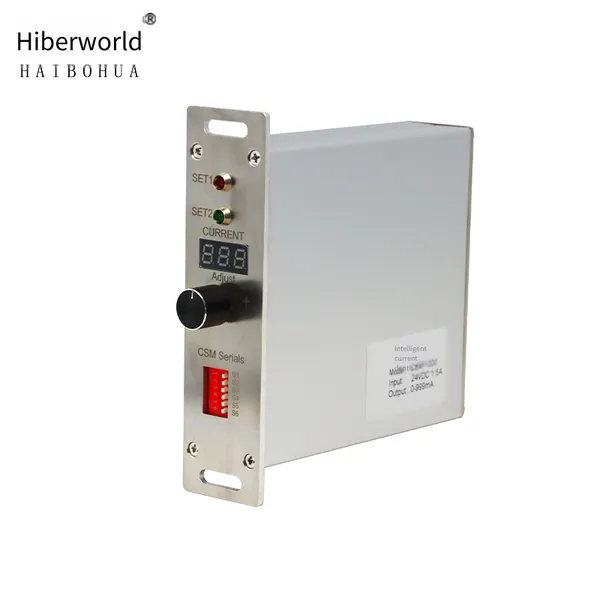
The CS-500 basic constant-current source is used in conjunction with the hysteresis brake. It has a built-in voltage and current stabilization circuit. By connecting to a DC24V voltage, it can adjust and output a stable and effective current.
For hysteresis brakes controlled by 24VDC voltage, in addition to DC voltage adjustment, we generally recommend using more detailed current control. The torque adjustment and control of the hysteresis brake are determined by adjusting the magnitude of the DC current passing through the electromagnetic coil to change the output torque. The torque is linearly related to the current value. Using a constant current source can also minimize the influence of coil resistance drift (torque fluctuation) caused by the temperature change of the brake.
Note: Regarding the residual magnetic force of the hysteresis brake, when the excitation current suddenly drops to 50% of the initial value and the rotor is not rotating, the residual magnetic force generated will cause fluctuations in the output torque (only in the case of small torque). An effective way to avoid and eliminate the residual magnetic force is to rotate the rotor while reducing the current.

Send Inquiry to This Supplier


You May Also Like
-
Hydraulic Motor Test Bench, Hydraulic Motor Test System, Beijing HaibohuaNegotiableMOQ: 0 Set
-
Hchl-202 Load Cell, Spoke Type Tension and Compression Sensor, CustomizableUS$ 69.23 - 107.69MOQ: 1 Piece
-
Hcnj-101 Dynamic Torque Sensor for Torque and Rotational Speed Measurement, Non-contact Rotary Torque SensorUS$ 523.08 - 553.85MOQ: 1 Set
-
Torque Sensor Dedicated for Bottle Valve Loading and Unloading Machine and Gas Cylinder DetectionUS$ 569.23 - 584.62MOQ: 1 Piece
-
Factory Direct Sales of Wireless Pressure Transmitters and Wireless Temperature Transmitters, Capable of Transmitting up to 3000 MetersNegotiableMOQ: 0 Unit
-
3051 Capacitive Differential Pressure Transmitter, Pressure Transmitter With Capacitive Liquid Crystal Display and Hart ProtocolUS$ 215.38 - 230.77MOQ: 1 Piece
-
3051 Differential Pressure Transmitter, Single Flange lt Type, With hc Diaphragm or Tantalum Diaphragm, Hart Protocol, Beijing Haibo HuaUS$ 261.54MOQ: 1 Piece
-
Actuator Torque Test Bench, Valve Torque Test Bench, Vertical InstallationUS$ 2769.23MOQ: 1 Set
-
Electric Motor Test Bench, Hydraulic Motor Test Bench, Haibo HuaUS$ 2769.23MOQ: 1 Set
-
Permanent Magnet Motor Test Bench and Motor Performance Testing System, Haibo HuaNegotiableMOQ: 0 Set


