








 Contact Platform Support
 Help Center
Torque Sensor Dedicated for Bottle Valve Loading and Unloading Machine and Gas Cylinder Detection



Related Products
-
 Factory Direct Sales of Wireless Pressure Transmitters and Wireless Temperature Transmitters, Capable of Transmitting up to 3000 MetersNegotiableMOQ: 0 Unit
 -
3051 Capacitive Differential Pressure Transmitter, Pressure Transmitter With Capacitive Liquid Crystal Display and Hart ProtocolUS$ 215.38 - 230.77MOQ: 1 Piece
-
3051 Differential Pressure Transmitter, Single Flange lt Type, With hc Diaphragm or Tantalum Diaphragm, Hart Protocol, Beijing Haibo HuaUS$ 261.54MOQ: 1 Piece
-
Actuator Torque Test Bench, Valve Torque Test Bench, Vertical InstallationUS$ 2769.23MOQ: 1 Set
-
Electric Motor Test Bench, Hydraulic Motor Test Bench, Haibo HuaUS$ 2769.23MOQ: 1 Set
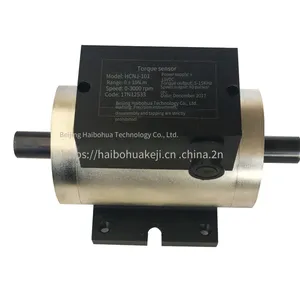
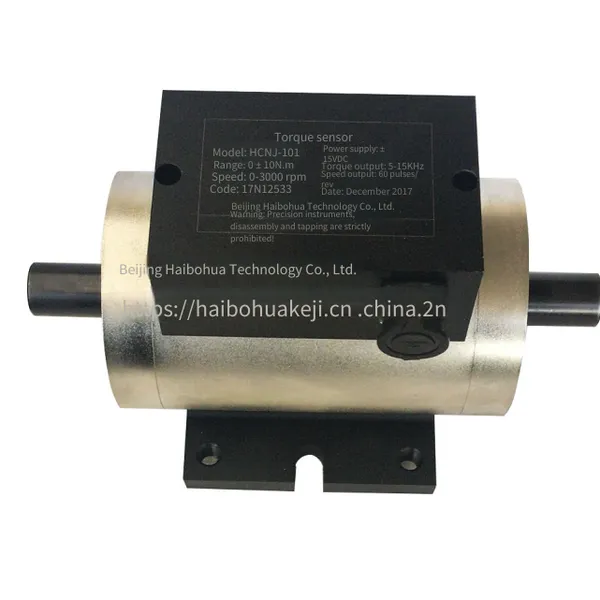
Special Torque Sensor for Bottle Valve Handling Machine is developed based on the proprietary technology of the strain bridge. It is a sensor specifically designed to measure torque and rotational speed parameters. This dynamic torque sensor uses the strain bridge electrical measurement technology. A set of toroidal transformers provides power in a non-contact manner, and a micro-power signal coupler is used to replace the toroidal transformer for non-contact signal transmission. It effectively overcomes the high-order harmonic self-interference caused by the inductive coupling signal and the mutual interference of the energy toroidal transformer to the signal toroidal transformer. At the same time, the output sharp pulse is changed to an equal square wave signal. Therefore, HCNJ-101 Standard Dynamic Torque Sensor can operate at high speed for a long time.
Product Features:
It can measure both static torque and rotational torque;
High detection accuracy, good stability, and strong anti-interference ability;
Small size, light weight, and easy to install;
It can continuously measure forward and reverse torques without repeated zero adjustment;
There are no wearing parts such as slip rings, and it can operate at high speed for a long time;
The strain elastomer has high strength and can withstand 150% of the load;
Strong anti-interference ability, can be installed at any position and in any direction;
The sensor part can be used independently without the secondary instrument and can directly form a torque measurement device with the measurement board card, PLC, or DCS.
Torque Working Principle:
As shown in the figure above, the power supply for the strain bridge is provided by a set of toroidal transformers installed on the sensor, which provides an induced voltage. After rectification and voltage regulation, it is converted into a highly stable DC voltage. This voltage is supplied to the strain bridge as the bridge voltage and also to its internal circuit as the operating voltage. The mV-level torque signal detected by the strain bridge is amplified into a V-level strong signal, then converted into a proportional square wave signal through the V/F converter, and transmitted to the external signal receiver. After demodulation, it is restored to a digital signal with the same frequency as the square wave output by the V/F converter, and the phase difference is no more than 1 microsecond, which can be ignored.
Rotational Speed Working Principle:
The code disc is integrated with the rotating body and rotates. The photoelectric switch performs gate circuit processing through the photoelectric effect and outputs a high-low level pulse signal. The pulse signal is proportional to the rotational speed. The conversion from the physical quantity of rotational speed to an electrical signal is realized.
Technical parameters:
Application fields:
Detect the output torque and power of rotating power equipment such as motors and internal combustion engines;
Detect the load torque and input power of equipment such as motors, wind power, pumps, mixers, reducers, transmissions, winches, propellers, and drilling machinery;
Detect the torque during the working process of various machining centers and automatic machine tools;
Detect the torque and efficiency transmitted by various rotating power equipment systems;
While detecting the torque, the rotational speed and shaft power can be detected;
It can be used to manufacture viscometers, electric, pneumatic, and hydraulic torque wrenches;
Installation method:
1. Measure the shaft diameter and center height of the sensor and prepare for installation.
2. Use two sets of couplings or flanges to install the sensor between the power equipment and the load.
3. Adjust the center height and coaxiality of the power equipment, load, and sensor respectively, requiring them to be less than 0.01mm, then fix them firmly, and no looseness is allowed. When using a small-range or high-speed sensor, strictly ensure the center height and coaxiality of the connection. Otherwise, measurement errors and damage to the sensor may occur.
4. When connecting, a rigid or elastic coupling can be selected. When the vibration is large or the coaxiality cannot meet the installation requirements (greater than 0.05mm and less than 0.02mm), it is recommended to use a flexible, elastic, or universal joint coupling; and it is recommended to add a rubber pad of about 10mm between the sensor base and the support frame to reduce the damage to the sensor when the installation is not concentric.
5. The power source and load equipment must be fixed firmly to avoid vibration; the support base of the sensor must have a certain strength to ensure the stability of the installation and avoid excessive vibration. Otherwise, the measurement data may be unstable and affect the measurement accuracy.
6. The coupling should be close to the shaft shoulders at both ends of the sensor. The sensor is a precision measuring instrument, and violent impacts such as impacts and beatings are strictly prohibited during installation and use.
7. It is recommended to install the sensor horizontally. When installing at other angles, please install the sensor carefully. The sensor is not allowed to bear excessive axial force and/or bending moment, otherwise it may affect the use of the sensor and even cause damage to the sensor.
Common signal types and supporting products
1. Directly send the torque frequency signal to the computer or PLD for processing;
2. Match with the XSKM torque display to directly display the torque value;
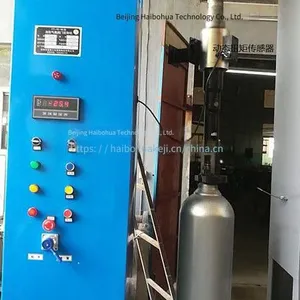
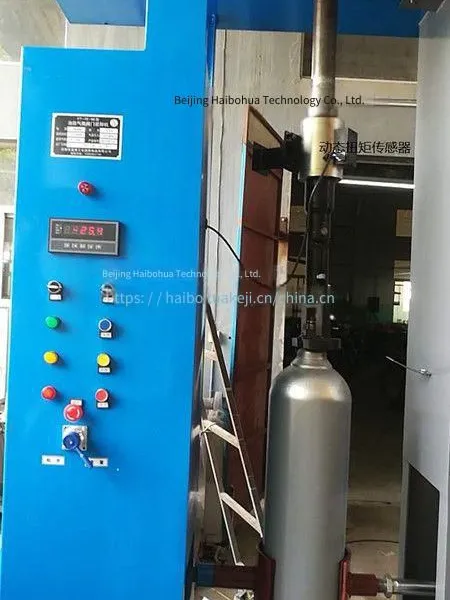
Product application site

Send Inquiry to This Supplier


You May Also Like
-
Permanent Magnet Motor Test Bench and Motor Performance Testing System, Haibo HuaNegotiableMOQ: 0 Set
-
Motor Drag Test Bench Testing SystemUS$ 2769.23MOQ: 1 Set
-
Static Torque Sensor With Through Slot, Stationary Torsion Sensor, HaibohuaUS$ 69.23 - 73.85MOQ: 1 Piece
-
Clutch Performance Test Bench, Beijing Haibo HuaNegotiableMOQ: 0 Set
-
Hchz - 101 Column Type Tension and Compression Sensor With Large Range and External Thread, Beijing HaibohuaUS$ 123.08MOQ: 1 Piece
-
Disc Torque Sensor, Double Flange Dynamic Torque Sensor, Beijing HaibohuaUS$ 707.69MOQ: 1 Piece
-
Torque Test Bench for Electric Valve ActuatorsNegotiableMOQ: 0 Set
-
Factory Performance Testing of Rock Bolt Drill Test BenchNegotiableMOQ: 0 Unit
-
Comprehensive Performance Test of Tractors, Haibo HuaNegotiableMOQ: 0 Set
-
High-speed Motor Test BenchNegotiableMOQ: 0 Unit


