








 Contact Platform Support
 Help Center
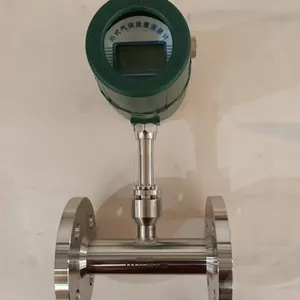
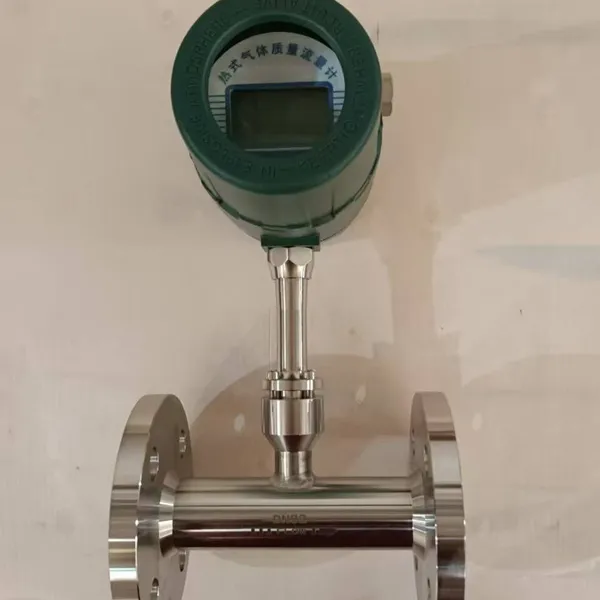
Thermal Gas Mass Flow Meter



Related Products
Working Principle
Its core principle is "heat transfer and temperature difference measurement". There are mainly two implementation methods:
-
Constant Power Method (CT): A constant power is applied to the heating unit. When the fluid flows through, it takes away heat. The flow rate is calculated by measuring the temperature difference between the heating unit and the fluid (or another sensor). The greater the temperature difference, the greater the flow rate.
-
Constant Temperature Difference Method (CTA): More common. The system dynamically adjusts the heating power to maintain a constant temperature difference between the heating unit and the temperature-sensing unit (or two temperature-sensing units). The required heating power is proportional to the mass flow rate of the fluid. By measuring this power value, the mass flow rate can be directly obtained.
Simple analogy: It's like breathing on a hot hair dryer. The greater the wind speed, the cooler the wind feels (change in temperature difference), or you need to turn up the hot air gear (change in heating power) to keep your cheeks warm (constant temperature difference).
Main Features and Advantages
-
Direct measurement of mass flow: The measurement result is not affected by changes in temperature and pressure. There is no need for an expensive temperature and pressure compensation system, which simplifies the measurement process and improves accuracy.
-
Wide range ratio: Usually up to 100:1 or even higher. It still performs excellently at extremely low flow rates, especially suitable for occasions with large flow rate changes or the need to measure small flow rates.
-
No moving parts and extremely low pressure loss: The probe has a sturdy structure, hardly generates pressure loss, has high reliability, and requires little maintenance.
-
Fast response speed.
-
Capable of measuring multiple gases: air, oxygen, nitrogen, hydrogen, biogas, natural gas, flue gas, etc. However, calibration is required according to the physical parameters (such as specific heat capacity) of different gases.
-
Flexible installation forms: there are both insertion type (suitable for medium and large pipe diameters) and pipe section type (suitable for small pipe diameters).
Structure and types
-
Probe sensor: the core part. Usually contains two (or more) platinum resistance temperature sensors (RTD):
-
Heating/reference sensor: heated to maintain the temperature difference.
-
Temperature sensor: senses the fluid temperature.
-
Transmitter/converter: processes the sensor signals, calculates and displays the mass flow, and outputs standard signals.
-
Installation components: the insertion type uses a ball valve mounting seat for easy installation and maintenance under pressure.
Application scenarios
-
Compressed air/gas measurement and leakage detection: pneumatic systems in factories, gas production metering of air compressors.
-
Combustion Control: Gas/combustion air flow control for boilers and kilns.
-
Environmental Monitoring: Flue gas and exhaust gas emission monitoring (CEMS).
-
New Energy and Chemical Industry: Flow measurement of biogas, hydrogen, coalbed methane, and reaction gases.
-
Semiconductor and Pharmaceutical Industry: Flow measurement of high-purity process gases and fume hoods/exhaust ducts (VAV control).
-
Scientific Research and Experiments: Occasions requiring precise gas mass flow.
Usage Restrictions and Precautions
-
Sensitive to gas composition changes: The instrument is calibrated for specific gases (or mixed gases with fixed components). If the gas composition changes significantly, it must be recalibrated; otherwise, large errors will occur. Because its principle is based on the thermal conductivity coefficient and specific heat capacity of the gas.
-
Not suitable for dirty, liquid-containing, or wet-saturated gases: Dust, oil, and droplets will adhere to the probe surface, forming an "insulation layer", which seriously affects the measurement accuracy and may even damage the sensor.
-
Requirements for installation: It is necessary to ensure a stable flow field at the measurement point. Usually, a straight pipe section before (10D - 20D) and a straight pipe section after (5D) are required, especially when the pipe diameter is large or the flow field is complex.
-
Lower range limit: Although it can measure extremely low flow velocities, when the flow velocity drops to a certain level (the heat is mainly carried away by gas conduction rather than convection), the measurement becomes difficult.
Key points for model selection
-
Gas medium and components: Must be clear! This is the basis for model selection and calibration.
-
Flow range: Specify the minimum, normal, and maximum flow rates (under working conditions, Nm³/h or kg/h).
-
Process conditions: Pipe size, gas temperature, pressure, humidity, and cleanliness.
-
Accuracy requirements: In general working conditions, the accuracy is between ±1.0% ~ ±2.5% FS or the read value.
-
Output and communication requirements: 4 - 20mA, pulse, and field buses such as HART, MODBUS, PROFIBUS, etc.
-
Explosion-proof and protection levels: Select according to the installation area (hazardous area, outdoors, etc.).
Summary: Thermal gas mass flowmeters have occupied an important position in the field of clean, stable-component gas flow measurement due to their outstanding advantages of directly measuring mass flow, wide range ratio, and low pressure loss. The key to their successful application lies in ensuring relatively fixed gas components and avoiding use in dirty and multi-liquid environments.
If you have specific gas media and working condition parameters, I can provide more specific model selection references.

Send Inquiry to This Supplier


You May Also Like
-
 Electromagnetic FlowmeterUS$ 960MOQ: 1 Unit
 -
Orifice Plate FlowmeterUS$ 3400MOQ: 1 Set
-
Insertion Electromagnetic FlowmeterUS$ 760MOQ: 1 Set
-
Liquid Turbine FlowmeterUS$ 2650MOQ: 1 Unit
-
Insertion Liquid Turbine Flow MeterUS$ 860MOQ: 1 Set
-
Thermal Gas Mass Flow MeterUS$ 850 - 1,000MOQ: 1 Set
-
Thermal Gas Mass Flow MeterNegotiableMOQ: 5 Units
-
Thermal Gas Mass Flow MeterUS$ 2360MOQ: 1 Set
-
Thermal Gas Mass Flow MeterUS$ 200 - 500MOQ: 1 Set
-
Digital Plug in Compressed Air Thermal Mass Flow Sensor Thermal Gas Mass Flow MeterUS$ 350 - 1900MOQ: 1 Set


