








 Contact Platform Support
 Help Center
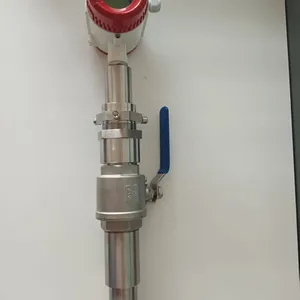
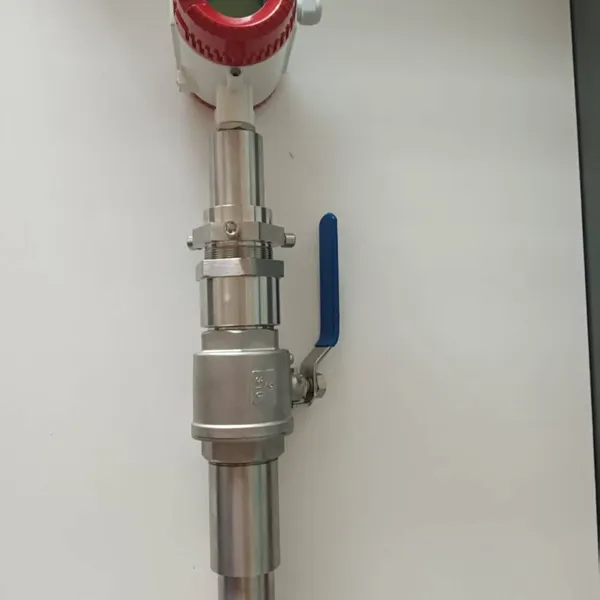
Insertion Liquid Turbine Flow Meter



Related Products
Hello! Let me introduce the Insertion Liquid Turbine Flowmeter to you:
The Insertion Liquid Turbine Flowmeter is a flow measurement instrument based on the turbine rotation principle. Different from the full-pipe turbine flowmeter, its sensor is "inserted" into the pipeline through a mounting seat, and the overall flow in the pipeline is estimated by measuring the flow velocity at a local point in the fluid. Its core working principle is the Faraday's Law of Electromagnetic Induction (but in fact, the turbine flowmeter uses the fluid kinetic energy to drive the impeller to rotate, and converts the rotation speed of the impeller into an electrical pulse signal through a magnetoelectric converter, which is different from the principle of the electromagnetic flowmeter. There may be an error here. Correction: The working principle of the insertion turbine flowmeter is that the fluid kinetic energy drives the impeller to rotate, and the rotation speed of the impeller is converted into an electrical pulse signal through a magnetoelectric converter, and the signal frequency is proportional to the flow velocity.).
Main Features and Advantages
-
Convenient Installation and Maintenance: There is no need to cut off the main pipeline. Usually, the hot tapping technology is used for installation. It is especially suitable for large-diameter (DN200 and above) pipelines, which can save a lot of costs and downtime.
-
High Cost-effectiveness: For large-diameter pipelines, its cost is much lower than that of full-pipe flowmeters of the same caliber.
-
Wide Application Range: It can measure a variety of clean or basically clean single-phase Newtonian fluids such as water, petroleum, chemical liquids, and cryogenic liquids.
-
Multiple Output Signals: It can output pulse signals and 4-20mA analog signals, and supports communication protocols such as HART and MODBUS, which is easy to integrate into the control system.
Structure and Composition
-
Insertion Rod/Probe: The part inserted into the pipeline is equipped with a turbine impeller at the front end.
-
Magnetoelectric converter / Signal detector: Converts the mechanical rotation of the impeller into electrical pulse signals.
-
Mounting base (ball valve, connector): Ensures installation, disassembly, and maintenance can be completed without stopping production.
-
Converter (integrator): Processes pulse signals, displays instantaneous flow and cumulative flow, and outputs standard signals.
Installation requirements and limitations
-
Sensitive to flow velocity distribution: The measurement accuracy is greatly affected by the flow velocity distribution (flow field) inside the pipeline. To ensure accuracy, the requirements of front straight pipe section (usually more than 10D) and rear straight pipe section (more than 5D) must be met, or a flow field rectifier should be equipped when the flow field is uneven.
-
Selection of measurement points: The insertion depth is usually 1/8, 1/4, or 1/2 of the inner diameter of the pipeline (selected according to the theoretical flow velocity distribution diagram). For large-diameter pipelines, double-point or multi-point insertion (such as "double probes" or "pitot tubes") is sometimes used to obtain the average flow velocity and improve accuracy.
-
Requirements for fluid conditions: Can only measure clean or basically clean liquids. Particles, fibers, or bubbles in the fluid can wear the impeller, cause entanglement, or affect the rotation speed, resulting in measurement errors or damage.
-
Relatively low accuracy: Since the full-pipe flow is deduced from point flow velocity measurement, its typical accuracy is between ±1.0% ~ ±2.5% R, which is lower than that of high-precision full-pipe turbines or positive displacement flowmeters of the same specification, but it is sufficient to meet the auxiliary metering requirements of many process monitoring and trade handovers.
Typical Application Scenarios
-
Water supply network, raw water/circulating water metering (large diameter)
-
Raw water and refined oil main pipelines in the petroleum and chemical industries
-
Circulating water metering in the heating network of the heating system
-
Inlet and outlet water flow monitoring in sewage treatment plants
-
Large-flow liquid metering in energy management
Key Points for Selection and Installation
-
Clarify parameters: Fluid properties (corrosiveness, viscosity), temperature, pressure, minimum/common/flow rate, pipe size and material.
-
Accuracy requirements: Determine the required accuracy level according to the application scenario (process control or trade settlement).
-
Installation conditions: Whether the site can meet the requirements of sufficient straight pipe sections, and whether there is vibration or electromagnetic interference.
-
Maintenance considerations: Whether it is convenient to remove and inspect or clean the probe regularly.
Summary: The plug-in liquid turbine flowmeter is an economical and practical solution in the field of large-diameter, clean liquid flow measurement. It has outstanding advantages in installation convenience and cost, but users need to fully understand its requirements for installation conditions and fluid cleanliness to ensure its long-term stable and reliable operation.
If you have specific application working conditions (such as pipe diameter, medium, flow range), I can provide you with a more specific analysis.

Send Inquiry to This Supplier


You May Also Like
-
 Intelligent Vortex FlowmeterUS$ 1050MOQ: 1 Unit
 -
Electromagnetic FlowmeterUS$ 960MOQ: 1 Unit
-
Orifice Plate FlowmeterUS$ 3400MOQ: 1 Set
-
Insertion Electromagnetic FlowmeterUS$ 760MOQ: 1 Set
-
Liquid Turbine FlowmeterUS$ 2650MOQ: 1 Unit
-
Insertion Liquid Turbine Flow MeterUS$ 860MOQ: 1 Set
-
DN50 Turbine Flowmeter With PTFE Bearings for Chemical ProcessingNegotiableMOQ: 1 Piece
-
Insert Type Turbine FlowmeterUS$ 200 - 2,000MOQ: 1 Unit
-
DWM 2000 Electromagnetic Insertion-type Flowmeter for Flow Monitoring of Conductive MediaNegotiableMOQ: 1 Piece
-
Turbine FlowmeterNegotiableMOQ: 1 Piece


