








 Contact Platform Support
 Help Center
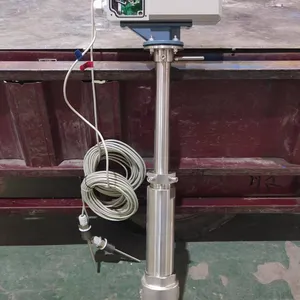
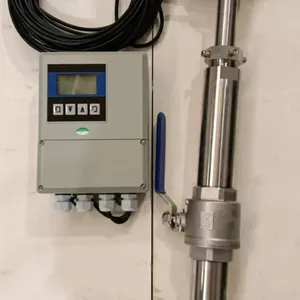
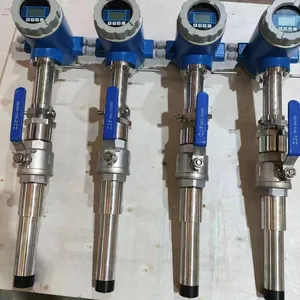
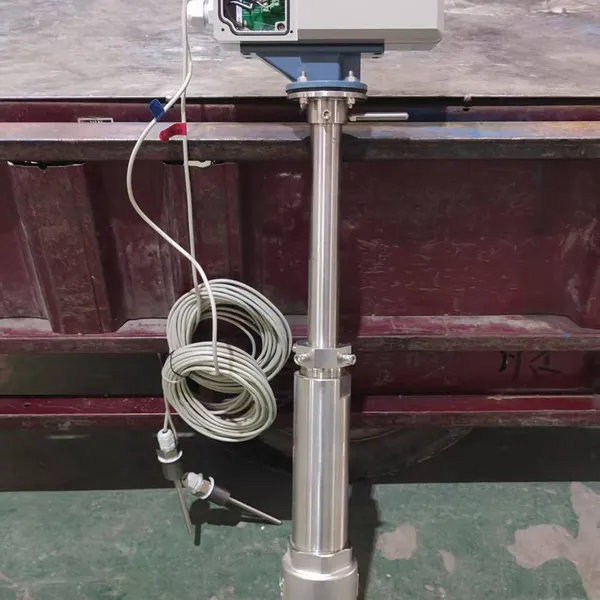
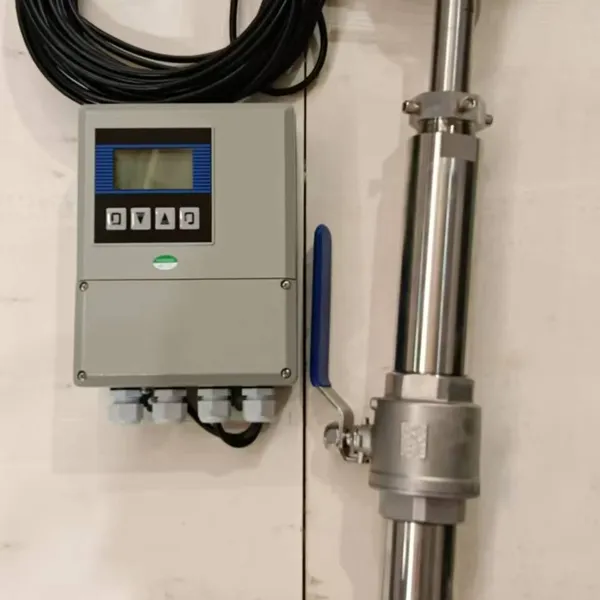
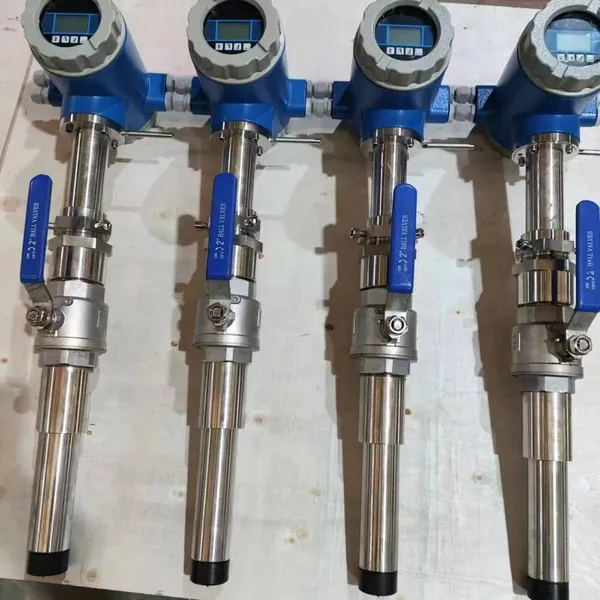
Insertion Electromagnetic Flowmeter



Related Products
The insertion electromagnetic flowmeter is a flow measurement instrument designed based on Faraday's law of electromagnetic induction, mainly used to measure the volume flow of conductive fluids in pipelines. It measures by inserting a probe into the pipeline, and is particularly suitable for flow monitoring of large-diameter pipelines.
Main Features
Convenient installation and maintenance: Its advantage lies in that it can be installed, disassembled and maintained without shutting off the flow (requiring the cooperation of a special ball valve), greatly reducing the impact on the production process.
Cost advantage: For large-diameter pipelines, its manufacturing cost and installation cost are much lower than those of traditional pipeline electromagnetic flowmeters.
Extremely small pressure loss: The probe has a simple structure, with little obstruction to fluid flow and almost no pressure loss.
Sturdy structure: The sensor has no moving parts, is fully solid-state encapsulated, resistant to vibration and has a long service life.
Measurement is not affected by physical properties: The measurement result is not affected by changes in physical parameters such as fluid temperature, pressure, density and viscosity.
Working Principle
Its working principle is the same as that of traditional electromagnetic flowmeters, and the core process is as follows:
Generate a magnetic field: After the excitation coil in the sensor probe is energized, a magnetic field perpendicular to the fluid flow direction is generated around it.
Induced electromotive force: When the conductive fluid (with a conductivity greater than 5 µS/cm) flows through the magnetic field area, it cuts the magnetic field lines. According to the law of electromagnetic induction, an induced electromotive force is generated in the direction perpendicular to both the fluid flow direction and the magnetic field direction.
Signal detection: Two detection electrodes on the probe contact the fluid to pick up this weak induced voltage signal.
Flow calculation: The magnitude of the induced electromotive force is proportional to the fluid flow velocity. The instrument converts the measured point flow velocity into the average flow velocity of the entire pipeline through an algorithm, and then calculates the volume flow in combination with the known inner diameter of the pipeline.
️ Precautions for Installation and Use
Correct installation is the key to ensuring measurement accuracy.
Straight pipe section requirements: To ensure a stable flow field, the installation point needs to meet certain straight pipe section requirements. It is generally recommended that the upstream straight pipe section is not less than 5 - 10 times the pipe diameter (D), and the downstream is not less than 2 - 5D.
Insertion depth: The insertion depth directly affects the measurement accuracy and must be strictly implemented in accordance with the specifications. Usually, for smaller pipe diameters (such as DN400 and below), it is inserted to the center of the pipeline (1/2D), and for larger pipe diameters (such as above DN450), it may be inserted to a depth of 1/4D.
Installation method:
Vertical installation: The angle between the sensor axis and the vertical diameter of the pipe cross-section is less than 5°. It is suitable for clean media.
Inclined installation: The sensor axis forms a 45° angle with the pipe axis. It has low water resistance and is not easy to entangle impurities. It is suitable for liquids containing impurities.
Medium requirements: The measured medium must be conductive (conductivity > 5 µS/cm), and the pipe must always be filled with fluid. An unfilled pipe will cause serious measurement inaccuracies.
Flow direction consistency: When installing, it is necessary to ensure that the flow direction mark on the sensor is consistent with the actual fluid flow direction.
Summary of advantages and disadvantages
Advantages
It is a cost-effective choice for large-diameter pipe measurement, and installation and maintenance are extremely convenient.
It has no moving parts, high reliability, and extremely low pressure loss.
The measurement is not affected by the physical parameters of the fluid, and it has a wide range ratio.
Disadvantages
Relatively low measurement accuracy: As a point measurement instrument, its accuracy (usually 0.5% - 1.0 grade) is lower than that of a full-pipe electromagnetic flowmeter, and it depends on the accuracy of the flow velocity distribution model.
It has requirements for the straight pipe section: Although the requirements are lower than those of the orifice plate, a certain straight pipe section still needs to be ensured to obtain a stable flow field.
It is only suitable for conductive fluids: It cannot measure non-conductive media such as oils and gases.

Send Inquiry to This Supplier


You May Also Like
-
 Insertion Vortex FlowmeterUS$ 1800MOQ: 1 Unit
 -
Intelligent Turbine Flow MeterUS$ 2250MOQ: 1 Unit
-
Intelligent Vortex FlowmeterUS$ 1050MOQ: 1 Unit
-
Electromagnetic FlowmeterUS$ 960MOQ: 1 Unit
-
Orifice Plate FlowmeterUS$ 3400MOQ: 1 Set
-
DWM 2000 Electromagnetic Insertion-type Flowmeter for Flow Monitoring of Conductive MediaNegotiableMOQ: 1 Piece
-
Insertion Electromagnetic FlowmeterUS$ 500 - 800MOQ: 1 Set
-
Insertion Electromagnetic FlowmeterUS$ 760MOQ: 1 Set
-
Insertion Electromagnetic FlowmeterNegotiableMOQ: 1 Piece
-
Insertion Electromagnetic Flowmeter Insertion Type Electromagnetic FlowmeterUS$ 50 - 500MOQ: 10 Pieces


