








 Contact Platform Support
 Help Center
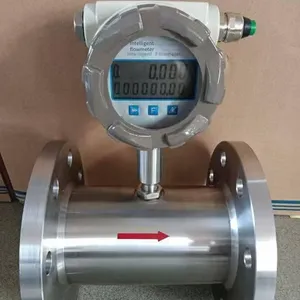
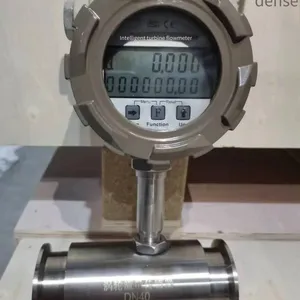
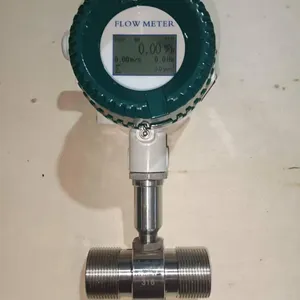
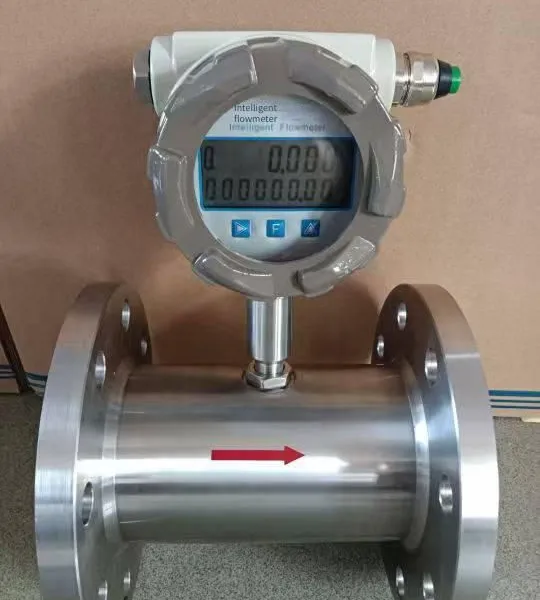
Liquid Turbine Flowmeter





Related Products
Turbine flowmeters are high-precision velocity-type flowmeters. They sense the average flow velocity of the fluid through a multi-bladed rotor (turbine) and derive the flow rate or total volume accordingly. Together with positive displacement flowmeters and Coriolis mass flowmeters, they are known as the three types of flowmeters with high repeatability and accuracy, and are preferentially selected for trade settlement.
Main Features
High precision and repeatability: Generally, the accuracy can reach ±1%R or ±0.5%R, and the high-precision models can even reach ±0.2%R. Its repeatability is very good, and the short-term repeatability can reach 0.05% ~ 0.2%.
Output frequency signal: The output is a pulse frequency signal, with no zero drift, strong anti-interference ability, and it is easy to connect with a computer system for total volume measurement.
Wide rangeability: It has a wide range of flow rates. For small and medium-sized diameters, it is usually 10:1, and for medium and large diameters, it can reach 20:1.
Compact structure: The flowmeter has a compact and lightweight structure, large flow capacity, and relatively convenient installation and maintenance.
Suitable for high pressure: There is no need to drill holes on the meter body, making it easy to manufacture high-pressure meters.
Working Principle
The working principle of the turbine flowmeter can be divided into the following steps:
Fluid propulsion: When the fluid flows through the sensor housing, it impacts the blades at a certain angle to the flow direction, generating a rotational torque. After overcoming the frictional torque and fluid resistance, the blades start to rotate.
Stable rotation speed: After the torque is balanced, the rotation speed tends to be stable. Within a certain flow range, the rotation speed of the impeller is proportional to the flow velocity of the fluid.
Signal detection: Since the impeller has magnetic conductivity, when it rotates, it periodically changes the magnetic resistance of the magnetic circuit of the signal detector composed of a permanent magnet and a coil, thereby inducing an electrical pulse signal at both ends of the coil.
Signal processing: After the pulse signal is amplified and shaped by an amplifier, it forms a continuous rectangular pulse wave. The pulse frequency is proportional to the instantaneous flow rate of the fluid, so that the instantaneous flow rate and the cumulative total volume can be calculated.
️ Installation and Usage Precautions
To ensure the measurement accuracy and service life of the turbine flowmeter, the installation and usage specifications must be strictly followed.
Medium requirements: It is suitable for clean, low-viscosity liquids or gases. It is not suitable for fluids containing particulate impurities, high viscosity, easy to scale, or with strong pulsation. On newly laid pipelines, it is recommended to install a filter upstream of the flowmeter.
Flow direction consistency: During installation, the flow direction of the fluid must be consistent with the flow direction arrow marked on the flowmeter housing. Otherwise, it may lead to measurement errors or even damage the instrument.
Straight pipe section requirements: To obtain a stable flow field, sufficient straight pipe sections must be left before and after the flowmeter. Usually, the length of the upstream straight pipe section is required to be at least 10 - 20 times the pipe diameter, and the downstream is at least 5 times.
Avoid impact: When starting up, the valve should be opened slowly to avoid water hammer or air hammer impacting the impeller.
Regular maintenance: The bearings and impellers inside the instrument are easily worn parts and need regular inspection and maintenance. The upstream filter should be cleaned regularly.
Summary of advantages and disadvantages
Advantages
High accuracy, belonging to the most accurate category among all flowmeters.
Good repeatability, no zero - point drift, and strong anti - interference ability.
Compact structure, light weight, and small pressure loss.
Disadvantages
Movable parts: The turbine and bearings will wear, affecting the long - term accuracy, and requiring regular maintenance and calibration.
High requirements for the medium: The measured medium must be clean and free of particles. Otherwise, it will accelerate wear or jam the impeller.
Not suitable for high - viscosity fluids: High - viscosity fluids will affect the rotation of the impeller, resulting in inaccurate measurement.

Send Inquiry to This Supplier


You May Also Like
-
 Intelligent Turbine Flow MeterUS$ 2250MOQ: 1 Unit
 -
Intelligent Vortex FlowmeterUS$ 1050MOQ: 1 Unit
-
Electromagnetic FlowmeterUS$ 960MOQ: 1 Unit
-
Orifice Plate FlowmeterUS$ 3400MOQ: 1 Set
-
Insertion Electromagnetic FlowmeterUS$ 760MOQ: 1 Set
-
Smart Liquid Turbine Flow Meter for Water Treatment Pipeline AccessoriesNegotiableMOQ: 1 Piece
-
Liquid Flow Meters/turbine Flow MeterUS$ 6 - 7MOQ: 20 Pieces
-
GPI Turbine Flow MeterNegotiableMOQ: 1 Piece
-
Target Flow Meter for Rapeseed Oil Turbine Flow MeterUS$ 300 - 5,000MOQ: 1 Set
-
Smart Turbine Flow MeterNegotiableMOQ: 5 Units


