








 Contact Platform Support
 Help Center
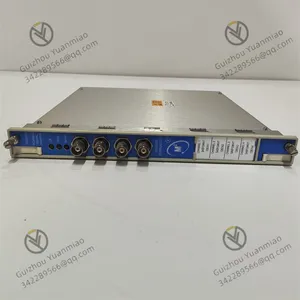
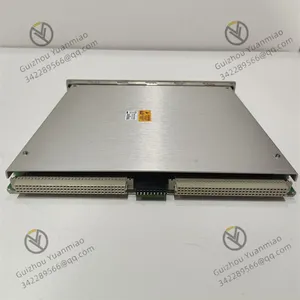
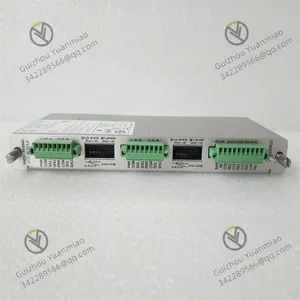
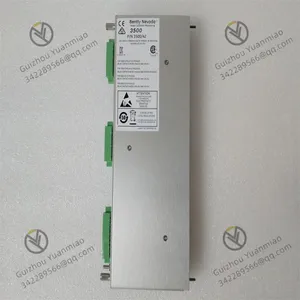
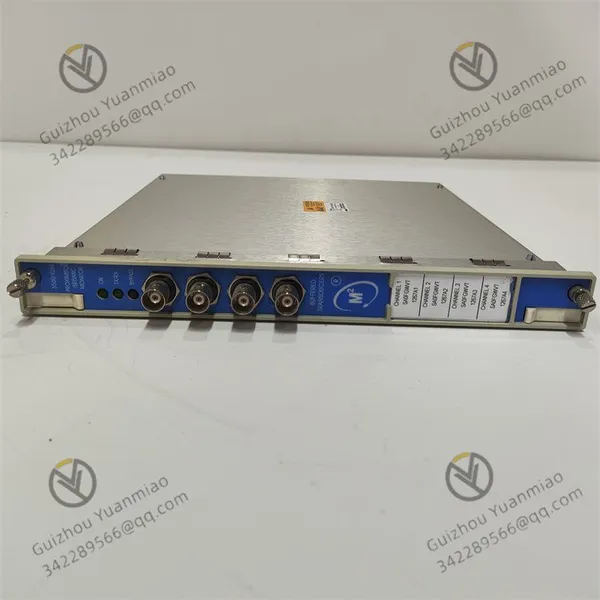
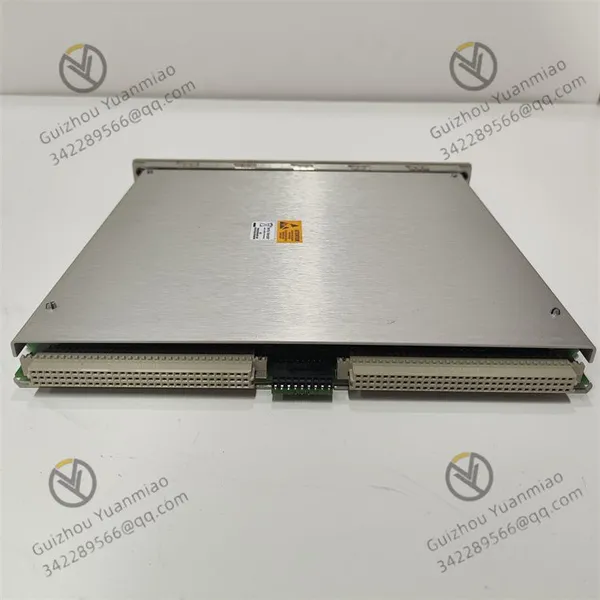
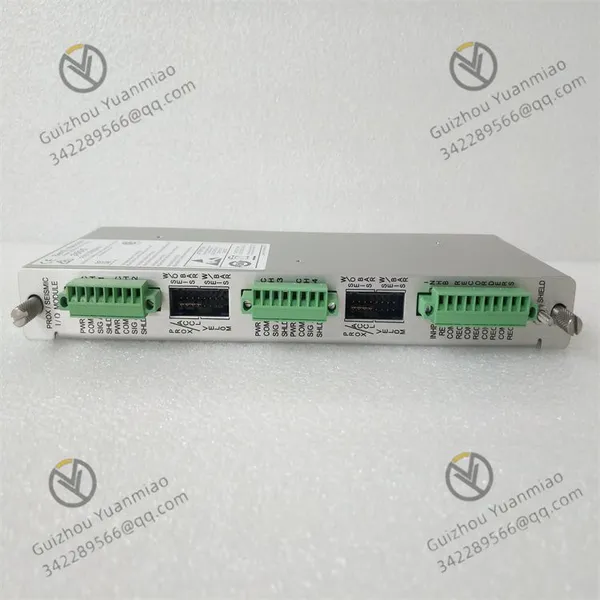
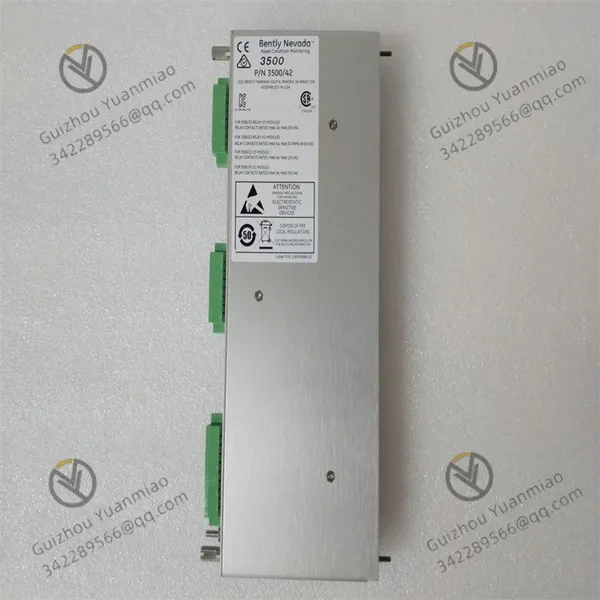
Bently Nevada 3500/42 Monitor Module




Related Products
-
 Bently Nevada 3500/45 Displacement Monitoring ModuleNegotiableMOQ: 1 Piece
 -
Bentley Nevada 3500/53 Overspeed Detection ModuleNegotiableMOQ: 1 Piece
-
Bently Nevada 3500/92 Communication Gateway ModuleNegotiableMOQ: 1 Piece
-
Bently Nevada 3500/93 Display Interface I/O ModuleNegotiableMOQ: 1 Piece
-
Bently Nevada 3500/94 Display Device MonitorNegotiableMOQ: 1 Piece
Bently Nevada 3500/42 monitor module
I. Overview
3500/42 is the vibration monitoring module in the Bently Nevada 3500 series, focusing on the vibration state analysis
of rotating machinery. Unlike the 350/40 module (which focuses on displacement parameters), its channel type takes
vibration energy parameters as the core, and assesses equipment failures through signals such as acceleration, velocity,
and absolute vibration. It is suitable for machinery sensitive to vibration, such as gearboxes, fans, and pumps.
Ii. Core Channel Types and Technical Analysis
1. Acceleration
Monitoring purpose: To measure the vibration acceleration of mechanical components (unit: g or m/s²), reflecting
high-frequency vibration characteristics (such as bearing failure, gear meshing impact).
Sensor type:
Piezoelectric Accelerometer (Piezoelectric accelerometer) uses the piezoelectric effect to convert mechanical vibration
into a charge signal, and the response frequency can reach over 10kHz;
IEPE (Integrated Electronic Piezoelectric) sensor: Built-in charge amplifier, output voltage signal (such as ±5V), strong
anti-interference ability.
Measurement principle:
The sensor converts the acceleration signal into an electrical signal, which is filtered by the 3500/42 module (such as
high-pass filtering to remove low-frequency noise) and amplified, and then outputs the peak value, effective value or
time-domain waveform of the acceleration.
Key parameters:
Measurement range: 0-50g (customizable for higher ranges)
Frequency response: 1Hz to 10kHz (typical value)
Application scenarios: High-frequency fault diagnosis such as bearing outer rings and gear tooth surface damage.
2. Velocity
Monitoring purpose: To measure the vibration velocity of mechanical components (unit: mm/s or in/s), reflecting
medium and low frequency vibration energy (such as rotor imbalance, mechanical loosening).
Sensor type:
Magnetoelectric Velocity sensor (Velocity Pickup) : It generates a voltage signal proportional to the velocity by the coil
cutting the magnetic field lines, with a frequency response range of 10Hz to 1kHz.
Or it can be derived from the integration of acceleration signals (with an integrated circuit built into the 3500/42
module).
Measurement principle:
The magnetoelectric sensor directly outputs the speed signal;
The acceleration signal is integrated once to obtain the velocity (time-domain integration or frequency-domain
integration), and the module can eliminate the DC offset error.
Key parameters:
Measurement range: 0-250mm/s (effective value)
Industry standards: Vibration evaluation standards such as ISO 10816 take the effective value of velocity as the
benchmark;
Application scenarios: Analysis of medium and low-frequency faults such as unbalanced motor rotors and loose
foundations.
3. Absolute Shaft Vibration
Monitoring objective: To measure the absolute vibration of the rotor relative to a fixed reference frame (unit: μm or
mil), comprehensively reflecting the superimposed effect of rotor vibration and bearing housing vibration, which is
closer to the actual operating state than radial vibration (relative vibration).
Sensor type:
Combined sensor: Composed of an eddy current sensor (for measuring the relative vibration of the rotor) and an
acceleration sensor (for measuring the absolute vibration of the bearing housing), the absolute vibration is calculated
through the vector summation function of the 3500/42 module.
Or directly use a non-contact absolute vibration sensor (such as a laser Doppler vibrometer, which requires additional
configuration).
Measurement principle:
The eddy current sensor acquires the displacement signal (relative vibration) of the rotor relative to the bearing.
The acceleration sensor acquires the absolute vibration velocity signal of the bearing housing and converts it into
displacement through integration.
The module calculates through phase synchronization and superimposes the vectors of the two to obtain the absolute
vibration displacement of the shaft (peak-to-peak value or RMS value).
Key parameters:
Measurement range: 0-500μm (peak-to-peak value)
Phase accuracy: Error ≤5°, ensuring the accuracy of vector synthesis;
Application scenarios: Full-state vibration assessment of large rotating machinery such as steam turbines and
compressors to avoid monitoring errors caused by bearing housing vibration.
Iii. Technical Characteristics of the 3500/42 Module
Signal processing function:
It is equipped with multi-order filtering (low-pass, high-pass, band-pass), which can screen signals based on the fault
frequency range (such as bearing fault characteristic frequencies BPFI, BPFO).
Supports FFT spectrum analysis, outputs vibration spectrum diagrams, and locates the main vibration frequency (such
as 1X, 2X rotational speed frequencies).
Configuration and Output:
Each module typically supports 4 to 8 channels and can be independently configured as acceleration, velocity or
absolute vibration modes.
Output signal: 4~20mA (engineering value), ±10V (original signal), compatible with PLC/DCS systems and portable
vibration analyzers.
Fault diagnosis support:
Calculate the characteristic parameters such as vibration Velocity (RMS) and Kurtosis in real time to identify early faults;
Support trend analysis, draw vibration amplitude-time curves through historical data, and predict the deterioration
trend of equipment.
Iv. Precautions for Project Implementation
Sensor installation:
The acceleration sensor needs to be rigidly fixed (such as by magnetic attraction or bolt installation) to avoid
resonance affecting the measurement.
When measuring absolute vibration, the installation positions of the eddy current and acceleration sensors should be
close (≤50mm) to ensure phase consistency.
Parameter configuration:
The acceleration channel needs to be set with an appropriate high-pass filtering frequency (such as 10Hz, to filter out
mechanical low-frequency jitter).
The absolute vibration channel needs to calibrate the phase difference between the eddy current and the acceleration
signal (usually adjusted through on-site dynamic balance tests).
Standard reference:
Vibration evaluation refers to specifications such as ISO 10816 (speed) and API 670 (Requirements for Mechanical
Protection systems), and the alarm/shutdown threshold is set.
The 3500/42 module provides a complete solution from fault early warning to condition assessment for rotating
machinery through multi-dimensional vibration parameter monitoring, especially having irreplaceable advantages in
high-frequency fault diagnosis and absolute vibration analysis. In practical applications, it is necessary to rationally
select the channel type and sensor configuration in combination with the equipment type and fault mechanism to
achieve precise monitoring and protection.

Send Inquiry to This Supplier



You May Also Like
-
Bently Nevada 3500/95 Display Device MonitorNegotiableMOQ: 1 Piece
-
Bently Nevada 3500/50-01-00-01 Rotational Speed Measurement ModuleNegotiableMOQ: 1 Piece
-
BENTLY 3500/70 Expansion Monitoring ModuleNegotiableMOQ: 1 Piece
-
BENTLY 3500/72M Dual-channel Vibration Monitoring ModuleNegotiableMOQ: 1 Piece
-
Bently 3500/05-01-02-00-00-00 Framework ModuleNegotiableMOQ: 1 Piece
-
Bently 3500/54 Overspeed Detection ModuleNegotiableMOQ: 1 Piece
-
BENTLY 3500/60-01-00 Temperature Monitoring ModuleNegotiableMOQ: 1 Piece
-
BENTLY 3500/15-05-00-00 3500 Series Core Power ModuleNegotiableMOQ: 1 Piece
-
BENTLY 3500/15-02-02-00 AC Power Input ModuleNegotiableMOQ: 1 Piece
-
BENTLY 60M100-00 Condition Monitor SystemNegotiableMOQ: 1 Piece


