Contact Platform Support
 Help Center
Low Interference, High Buffering Efficiency: the Key Role of CHES 103-47-9 in Molecular Biology



Related Products
-
 Introduction to Biological Buffer CAPSO 73463-39-5US$ 58.8 - 66.8MOQ: 500 Kilograms
 -
Introduction to Piperazine Buffer POPSO (CAS No. 68189-43-5)US$ 53.8 - 58.8MOQ: 500 Kilograms
-
Preparation and Advantages of Tris Acetate TAE as a Biological BufferUS$ 30.6 - 36.6MOQ: 500 Kilograms
-
Application of TAPSO 68399-81-5 Biological Buffer in DNA/RNA ExtractionUS$ 76.6 - 86.6MOQ: 500 Kilograms
-
Basic Information of Biological Buffer N - (2-acetamido) -2-aminoethanesulfonic Acid (ACES)US$ 30.6 - 66.6MOQ: 500 Kilograms
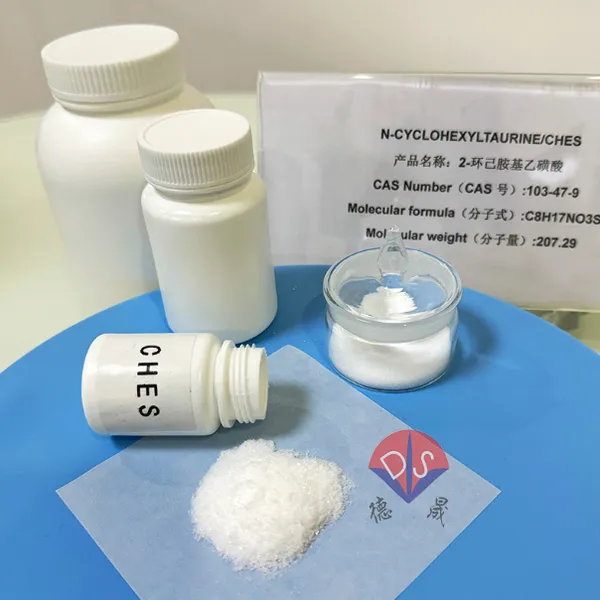
In the rapidly changing field of molecular biology research, precise control of experimental conditions is the key to achieving reliable scientific research results. Among them, the stable adjustment of pH value is particularly important, as it directly affects the activity, stability, and interactions of biomolecules. In this context, 2-cyclohexylamine ethanesulfonic acid (CHES) plays an irreplaceable role in molecular biology experiments as an efficient and low interference biological buffer with its unique physicochemical properties.
1、 The basic characteristics of CHES: stability and compatibility
CHES, The chemical formula is C8H17NO4S, which is an organic compound with a cyclic structure. Its most notable feature is its excellent buffering ability over a wide pH range, which means it can effectively resist pH fluctuations caused by external factors and provide a stable microenvironment for experiments. In addition, CHES has good water solubility and is not prone to non-specific interactions with other biomolecules. This low interference ensures the accuracy and reproducibility of experimental results.
2、 Low interference: Protecting the activity of biomolecules
In molecular biology experiments, such as protein purification, enzyme activity determination, DNA/RNA manipulation, etc., maintaining the activity of biomolecules is crucial. The low interference characteristics of CHES make it an ideal choice. It does not form unnecessary complexes with biomolecules such as proteins and nucleic acids, thus avoiding problems such as protein precipitation, enzyme activity inhibition, or DNA degradation caused by buffering agents. This "invisible" buffering effect provides researchers with an almost "pure" experimental platform, which helps to reveal the true interaction mechanisms between biomolecules.
3、 High buffering efficiency: precise regulation of pH value
Efficient buffering efficiency is another highlight of CHES. In complex biological reaction systems, even small changes in pH can have a significant impact on experimental results. CHES, through its proton acceptance and release ability, can quickly respond to acid-base changes in the system and maintain a constant pH value. Especially in experiments that require precise pH adjustment, such as enzymatic reaction kinetics research and optimization of cell culture conditions, the high buffering efficiency of CHES ensures precise control of experimental conditions, providing strong support for revealing the mysteries of life activities.
4、 Wide application: from basic research to clinical application
Thanks to its unique performance, CHES has a wide range of applications in the field of molecular biology. In basic research, it is commonly used in electrophoresis buffer, cell culture medium, and protein crystallization experiments, which helps to improve resolution, promote cell growth, and optimize crystal formation. In the field of clinical diagnosis, CHES, as a buffer component, participates in the construction of more sensitive and accurate detection platforms, providing technical support for early detection and precise treatment of diseases.
Hubei Xindesheng Material Technology Co., Ltd., as a biological buffer manufacturer with 20 years of R&D and production experience, currently sells a complete range of biological buffers including TRIS, BICINE, CAPS, MOPS, HEPES, etc. in addition to CHES. In addition, Hubei Xindesheng has a professional technical team and advanced production equipment to provide customized services for small batch products to customers. If you have any recent purchasing needs, please click on the official website to learn more details or contact me!

Send Inquiry to This Supplier


You May Also Like
-
The pH Range of N - (2-acetamido) -2-iminodiacetic Acid (ADA) BufferUS$ 30.6 - 36.6MOQ: 500 Kilograms
-
HEPBS Biological Buffer is a Powerful Assistant in Cell Culture and Cosmetics ManufacturingUS$ 53.8 - 58.8MOQ: 500 Kilograms
-
You Can't Help but Know About the Applications of CHAPS BufferUS$ 53.8 - 900MOQ: 500 Kilograms
-
Introduction and Application of Biological Buffer BIS Tris Propane 64431-96-5US$ 178 - 196MOQ: 500 Kilograms
-
Biological Buffer Piperazine-1,4-diethylsulfonic Acid Monosodium Salt PIPES-NA Basic InformationUS$ 49.8 - 56.8MOQ: 500 Kilograms
-
Exploration of Buffer Performance and Stability of PIPES-K2 108321-27-3US$ 108.8 - 118.8MOQ: 500 Kilograms
-
2- (N-morpholine) Ethanesulfonic Acid Monohydrate MES MonohydrateUS$ 24.8 - 30.8MOQ: 500 Kilograms
-
Characteristics and Use of TES Chemical Reagent as a Biological BufferUS$ 16.8 - 182.8MOQ: 500 Kilograms
-
The Importance of BIS-TRIS HCl in Electrophoresis, Extraction, Separation, and Purification ProcessesUS$ 146.8 - 168.8MOQ: 500 Kilograms
-
3- (N-morpholine) Propanesulfonic Acid Half Sodium Salt MOPS Half Sodium SaltUS$ 80.8 - 89.8MOQ: 500 Kilograms