








 Contact Platform Support
 Help Center
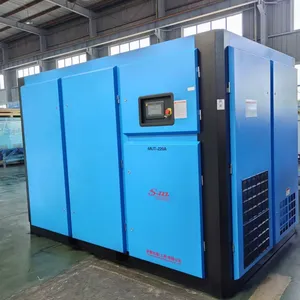
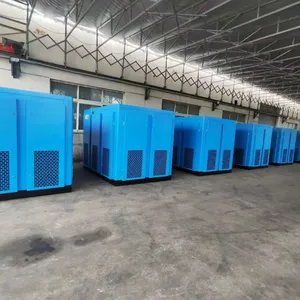
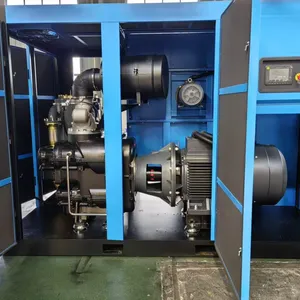
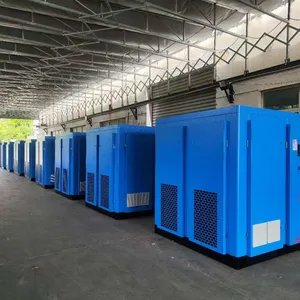
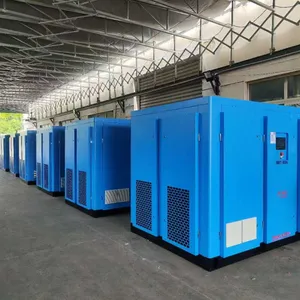
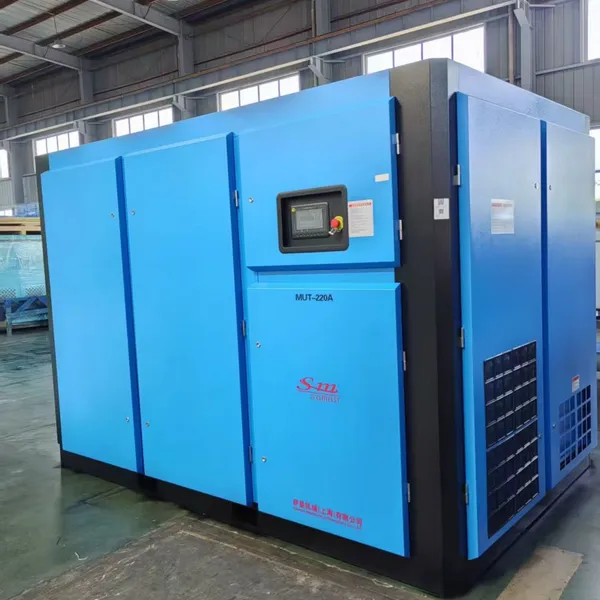
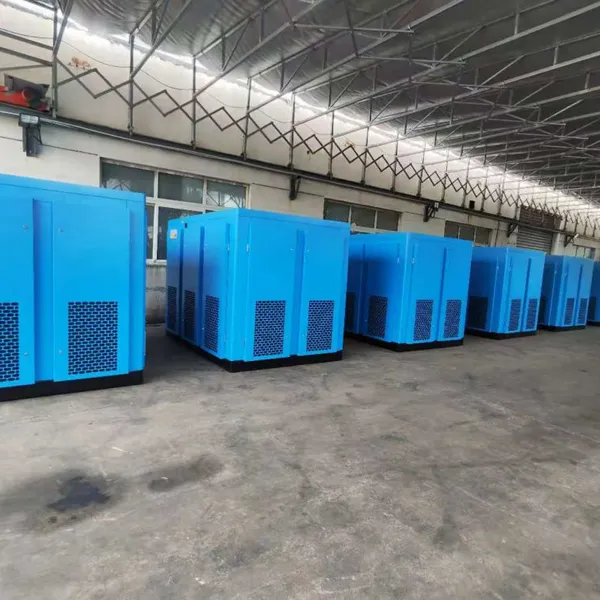
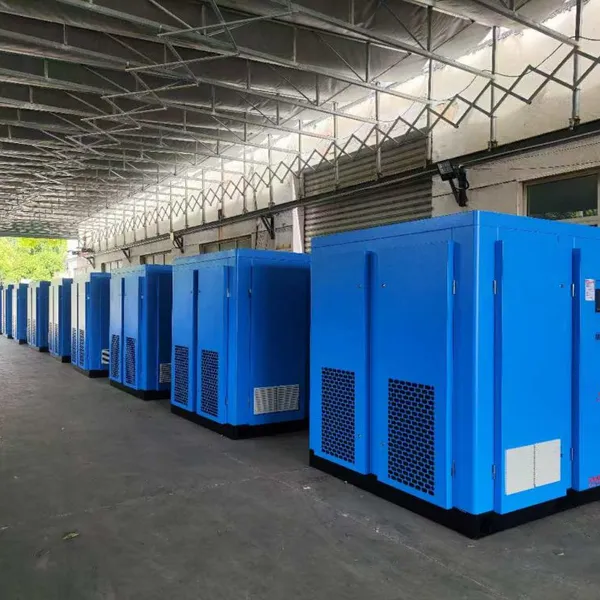
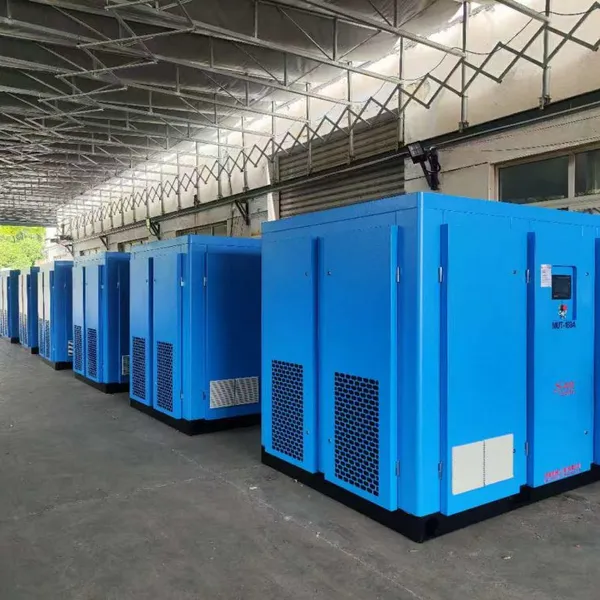
Saman Two-stage Permanent Magnet Variable-frequency Screw Air Compressor MUT-180A, With a Power of 132KW and a Flow Rate of 27 Cubic Meters.

Product Spotlights


Related Products
-
 Saman Dual-stage Permanent Magnet Variable-frequency Air Compressor MUT-150A, Featuring High Gas Output, Low Rotational Speed and Low Noise.NegotiableMOQ: 1 Piece
 -
Saman Permanent Magnet Variable-frequency Screw Air Compressor, Highly Efficient and Energy-savingNegotiableMOQ: 1 Piece
-
Saman Two-stage Permanent Magnet Variable-frequency Screw Air Compressor MUT-180A - Energy-saving and Environmentally FriendlyNegotiableMOQ: 1 Piece
-
MUT-180A Saman Two-stage Permanent Magnet Variable-frequency Air Compressor, With a Power of 132KWNegotiableMOQ: 1 Piece
-
MUT-220A Saman Two-stage Permanent Magnet Variable-frequency Screw Air Compressor With High Output CapacityNegotiableMOQ: 1 Piece
The two-stage compression permanent magnet variable frequency screw air compressor is the current mainstream air compression equipment in the industrial field, which is highly efficient, energy-saving and stable. The core lies in achieving nearly isothermal compression through two-stage staged compression + inter-stage cooling + permanent magnet synchronous variable frequency drive. Compared with single-stage models, it saves 15%-35% energy and increases the air volume by 10%-20%.
I. Core Definition and Positioning
Full name: Two-stage Permanent Magnet Variable Frequency Screw Air Compressor
Core combination: Two-stage compression main unit + Permanent Magnet Synchronous Motor (PMSM) + Variable Frequency Control System
Positioning: Mid-to-high-end energy-saving air compressor, replacing traditional single-stage industrial frequency / variable frequency models, suitable for medium-high pressure, continuous and stable gas usage scenarios of 7–13 bar.
II. Working Principle (Core Process)
1. Air Pre-treatment
Air passes through an efficient air filter for dust removal, water removal and oil removal, and then enters the first compression chamber.
2. First Compression (Low-pressure Stage)
The permanent magnet motor directly drives the first pair of male and female rotors to mesh, initially compressing the ambient pressure air (≈1 bar) to 3–5 bar (compression ratio ≈ 3:1).
During the compression process, lubrication, sealing and cooling are carried out, with the exhaust temperature approximately 100–120℃.
3. Inter-stage Cooling (Energy-saving Key)
The exhaust gas from the first stage enters the oil-gas separator + inter-stage cooler, and is fully thermally exchanged with the cooling oil / cooling liquid, with the temperature reduced to 40–60℃ (close to the ambient temperature).
Function: Significantly reduces the power consumption of the second stage compression, approaching isothermal compression (the lowest theoretical energy consumption).
4. Second Compression (High-pressure Stage)
The cooled gas enters the second rotor for further compression to 7–13 bar (commonly 8–10 bar), with a compression ratio ≈ 2.5–3:1.
The total pressure ratio of the two stages is ≈ 8–13:1, but the single-stage pressure ratio is much lower (≈ 8:1), resulting in less leakage and higher efficiency.
5. Post-treatment and Gas Supply
The second-stage exhaust gas passes through oil-gas separation, post-cooling and precise filtration, and outputs clean and stable compressed air.
The variable frequency system adjusts the motor speed (30–100% load) in real time to match the fluctuations in gas usage and provides constant pressure supply without waste from venting.
III. Core Structure Composition
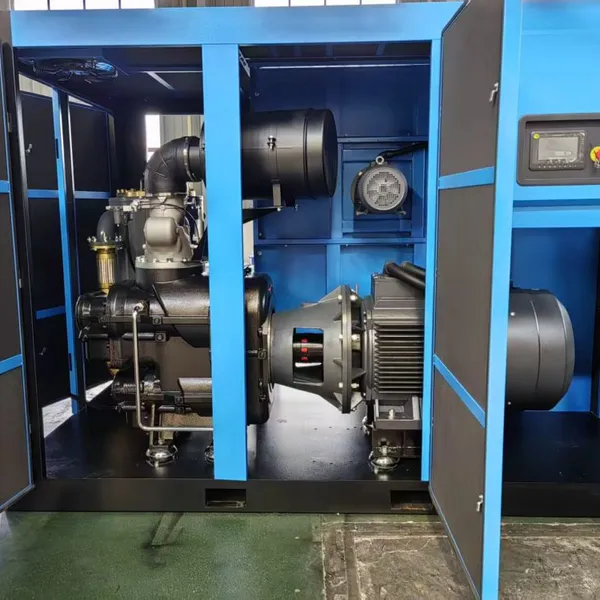
1. Compression Main Unit (Core)
Two-stage screw rotors: Two pairs of independent male and female rotors (first stage large, second stage small), using efficient profiles (such as 5:6 tooth shape), and pressure equalization design.
Transmission method: Permanent magnet motor direct drive (no gearbox / coupling), transmission efficiency ≈ 100%, no mechanical loss.
Casing: Integrated casting, strong rigidity, low vibration and low noise.
2. Permanent Magnet Synchronous Motor (PMSM)
Efficiency: Rated efficiency ≥ 96%, power factor ≈ 0.98, 9% higher than asynchronous motors, still efficient at low frequency (below 50%).
Characteristics: Start torque ≈ 3 times rated torque, response time
Protection: IP55 protection, F-class insulation, 180℃ high-temperature resistant permanent magnet, built-in temperature protection.
3. Variable Frequency Control System
Controller: PLC + 7-inch touch screen, supports remote monitoring, fault diagnosis, energy consumption analysis, and IoT access.
Drive: Dual frequency / vector frequency converter, wide voltage compatibility, strong overload capacity, complete protection.
4. Cooling and Oil Gas System
Inter-stage cooler: Large heat exchange area, low loss design, ensuring cooling effect.
Oil-gas tank: Large capacity, low flow rate design, high separation efficiency, low pressure loss, and less foam. Lubrication System: High-precision oil pump + temperature control valve, ensuring balance of lubrication and cooling under different working conditions.
5. Auxiliary System
Intake valve, minimum pressure valve, safety valve, discharge valve, pressure/temperature sensors, etc.
IV. Core Technical Advantages (Compared to Single-stage / Frequency-controlled)
1. Ultra-energy-saving (Most prominent)
Two-stage compression: Single-stage pressure ratio is low, leakage is small, volumetric efficiency is increased by 10–15%, approaching isothermal compression, power consumption is reduced by 15–25%.
Permanent magnet variable frequency: No excitation loss, light-load efficiency is 15% higher than asynchronous variable frequency, and 30–38% more energy-efficient than ordinary frequency-controlled machines.
Example: 90 kW two-stage permanent magnet variable frequency machine, air volume ≈ 16–18 m³/min, equivalent to 110–132 kW single-stage machine, annual electricity savings ≈ 10–15 thousand kWh (6000 hours calculated).
2. Stable air volume and pressure
Variable frequency speed regulation from 0 to 100%, pressure fluctuation ≤ ±0.1 bar, no frequent loading/unloading / venting.
At the same power level, air volume is 13–18% higher than single-stage, meeting the requirements for large flow and fluctuating gas usage.
3. Reliability and lifespan
Low rotational speed, low compression ratio design, rotor and bearing load is small, host lifespan is extended by 30–50%.
Inter-stage cooling reduces the overall temperature of the machine, reduces oil aging and seal failure, and extends the maintenance period.
4. Low noise and environmental protection
Integrated structure + vibration reduction design, noise ≤ 72–78 dB(A), 3–5 dB lower than single-stage.
Oil-gas separation efficiency ≥ 99.99%, exhaust oil content ≤ 3 ppm, meets environmental protection standards.
5. Intelligent operation and maintenance
Real-time monitoring of pressure, temperature, current, energy consumption, operating duration, automatic warning / shutdown protection.
Support remote control, data upload, energy consumption analysis, reducing management costs.
V. Technical Parameters (Typical Specifications)
Table
Parameter Item Typical Range Remarks
Power 30–350 kW (40–470 HP) Mainstream 75–250 kW
Exhaust Pressure 7–13 bar Common 8/10 bar
Exhaust Volume 5–60 m³/min Higher than single-stage at the same power level by 10–20%
Motor Efficiency ≥96% Permanent magnet synchronous motor
Noise 72–78 dB(A) 1 meter distance
Exhaust Oil Content ≤3 ppm Precise filtration after
Adjustment Range 30–100% Variable frequency continuous adjustment
VI. Applicable Industries and Scenarios
Manufacturing: Automobile, mechanical processing, electronics, textiles, tires, hardware (stable high pressure, large flow).
Food and medicine: Sensitive to air quality / temperature, avoid high temperatures causing oil contamination.
Energy and chemical: Cement, power, chemical, metallurgy (continuous operation, high reliability).
Large-scale engineering: Mines, tunnels, ships, infrastructure (outdoor / harsh environment).
Energy conservation renovation: Replace old single-stage frequency-controlled machines to reduce electricity costs and improve efficiency.
VII. Selection and Installation Key Points
1. Selection Core
Air volume matching: According to the maximum gas usage × 1.2–1.3 coefficient, priority to select two-stage permanent magnet variable frequency.
Pressure level: 7–10 bar select conventional models, 10–13 bar select high-pressure two-stage.
Load fluctuation: Fluctuation ≥ 30%, must select variable frequency; continuous full load, can select two-stage frequency-controlled.
2. Installation and Maintenance
Good ventilation, clean environment, temperature ≤ 40℃, away from dust / corrosive gases.
Regularly replace air filter, oil filter, oil-gas separator, lubricating oil, clean cooler.
Monitor exhaust temperature (≤ 95℃), oil pressure, motor temperature, avoid overheating shutdown.
VIII. Comparison with Single-stage Models (Core Differences)
Table Comparison item Two-stage compression permanent magnet variable frequency One-stage industrial frequency / variable frequency
Compression method Two-stage pressure reduction + inter-stage cooling One-stage direct compression
Single-stage pressure ratio ≈3:1 (low) ≈8:1 (high)
Energy consumption 15–35% energy saving Higher (baseline)
Air volume 10–20% higher than the same power level Higher
Exhaust temperature Low (≈80℃) High (≈100–110℃)
Life expectancy Long (lead plane≈8–10 000 hours) Medium (≈5–6 000 hours)
Noise Low (72–78 dB) Medium-high (75–82 dB)
Investment Higher (+20–30%) Lower
Return period 1.5–3 years (energy saving payback) Long
IX. Summary
The two-stage compression permanent magnet variable frequency screw air compressor is the optimal solution for energy efficiency and performance. Through the "two-stage pressure reduction + inter-stage cooling + permanent magnet direct drive + variable frequency speed control" four technologies, it achieves low energy consumption, high air volume, stable pressure, long life expectancy, and low noise. It is the preferred choice for upgrading industrial compressed air systems. The initial investment is slightly higher, but it can pay back through energy saving within 1.5–3 years, and the long-term overall cost is lower.

Send Inquiry to This Supplier

You May Also Like
-
Two-stage Compression Energy-saving Screw Permanent Magnet Variable-frequency Screw Air CompressorNegotiableMOQ: 1 Piece
-
Two-stage Permanent Magnet Variable-frequency Screw Air Compressor, Low Rotational Speed and High Gas Output CapacityNegotiableMOQ: 1 Piece
-
Air Compressor Parts, Air Filter, Oil Filter, Oil Separation Core, Sensor, Frequency ConverterNegotiableMOQ: 1 Piece
-
Saman MW-5.5 Oil-free Vortex Air Compressor, Class 0 Level, Pure Oil-free, Ultra-quiet, Highly Energy-efficient, Low Maintenance, Stable and ReliableNegotiableMOQ: 1 Piece
-
Saman Screw Air Compressor, Permanent Magnet Variable Frequency, High-efficiency Double-stage Air CompressorNegotiableMOQ: 1 Piece
-
Saman Water-lubricated/dry-type Oil-free Screw Air Compressor, With Zero Oil ContentNegotiableMOQ: 1 Piece
-
The Saman Screw Air Compressor is Widely Used and Can be Applied to Any Industry, Such as Food, Machinery, Healthcare, Industry, Mining, Etc.NegotiableMOQ: 1 Piece
-
Saman MW-2.2 Oil-free Vortex Air Compressor, Featuring High Output Capacity, Low Noise and Small Footprint.NegotiableMOQ: 1 Piece
-
Saman Screw Air Compressor MV Permanent Magnet Variable Frequency Series, With Flow Rates Ranging From 1m³ to 60m³NegotiableMOQ: 1 Piece
-
Screw Air Compressor Three Filters, Air Compressor Air Filter, Air Compressor Oil Filter, Air Compressor Oil-gas Separator CoreNegotiableMOQ: 1 Piece


