








 Contact Platform Support
 Help Center
Local Fan, Local Ventilation Fan, Mine-used Local Ventilation Fan


Related Products
-
 Low Noise Metro Construction FanNegotiableMOQ: 1 Piece
 -
Variable-Pitch Long-Shaft FanNegotiableMOQ: 1 Set
-
Energy-saving Intelligent Permanent Magnet Ventilator for Tunnel ConstructionNegotiableMOQ: 1 Piece
-
Subway Axial Flow Fire and Smoke Exhaust FanNegotiableMOQ: 1 Piece
-
Axial Flow Fire and Smoke Exhaust FanNegotiableMOQ: 1 Piece
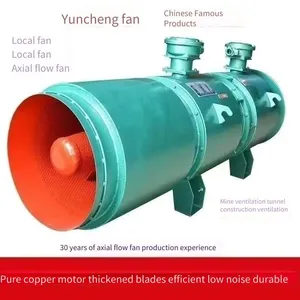
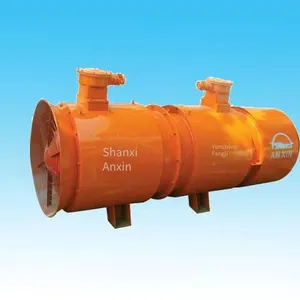
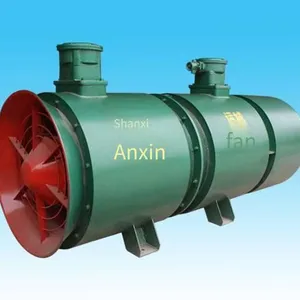
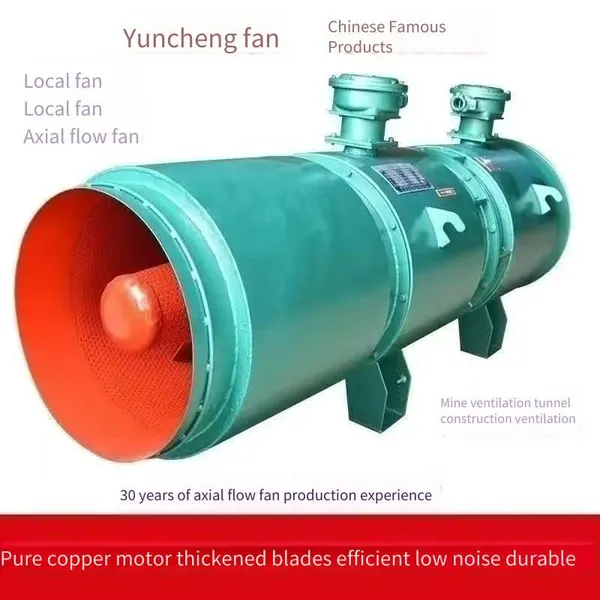
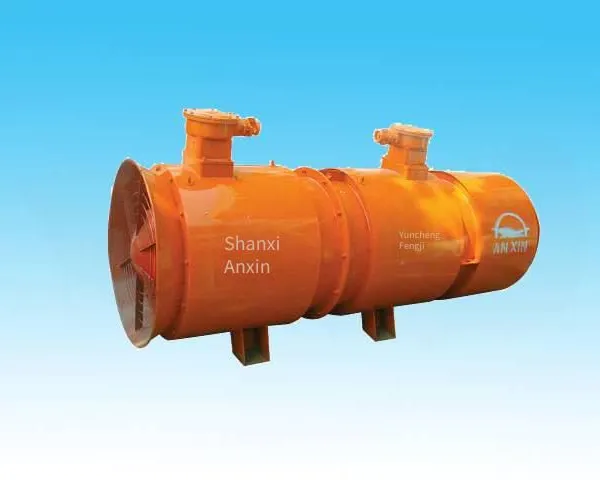
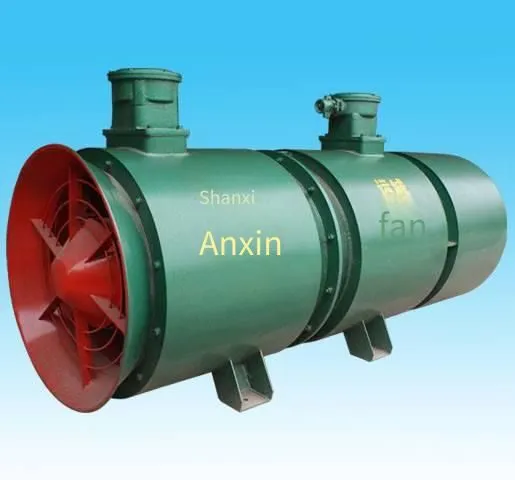
1. Overview: The FBD series of mine-used explosion-proof forced-in counter-rotating axial local ventilators (hereinafter referred to as ventilators) comply with the standards of MT222 - 2007 "Technical Conditions for Counter-rotating Local Ventilators" and Q/YAF001 - 2011 "FBD Series Mine-used Explosion-proof Forced-in Counter-rotating Axial Local Ventilators". They are suitable for local ventilation in underground coal mines with gas, coal dust, and other explosive and dangerous environments, and are used in conjunction with positive-pressure air ducts. They can also be used as ventilation equipment for tunnel construction.
The specific introduction is as follows: (1) The ventilator adopts computational fluid dynamics for multi-objective overall optimization design of the fan. The blades are made of the FMIA airfoil of aero-engines, which makes the high-efficiency operating area of the fan large. The ventilator has the characteristics of compact structure, large air volume, high air pressure, long air supply distance, high efficiency, energy saving, and low noise.
(2) The ventilator is directly driven by two special explosion-proof motors of the YBF2 series for the fan to drive the impellers. To extend the service life of the fan, the motor bearings are selected from the Swedish SKF series bearings. (Add a photo of the bearings)
(3) According to different user needs, there are 3 types of silencers to choose from; a) Ordinary air outlet silencer; (Add a photo) b) Combined silencer for the air inlet and air outlet; (Add a photo) c) Combined silencer for side air intake, air inlet, and air outlet. (Add a photo) The third type (c) of combined silencer adds a side air intake component. Without affecting the air intake volume, it changes the airflow direction of the air inlet, refracts the noise, and significantly reduces the noise in combination with the inlet and outlet silencers. After being tested by the National Mine Equipment Testing Center, its noise value is 20 - 30 decibels lower than that of ordinary ventilators.
(4) The explosion-proof type of the ventilator and the motor is explosion-proof, and the explosion-proof mark is: ExdbI.
(5) The working voltage is 380V/660V, 660V/1140V, and does not exceed ±5% of the rated value. The voltage frequency is 50HZ. For the ventilators used underground, the air supply volume in the roadway should be greater than the working air volume of the ventilator. The foundation for installing the ventilator should be firm, and there should be no water dripping around. The height of the air inlet edge of the ventilator from the ground or the top wall should be no less than 0.3m. The air duct used should be able to withstand the pressure of the ventilator, and the diameter of the air duct should not be less than the diameter of the impeller.
(6) Service life The service life is not less than 5a, and the safe operation time before the first major overhaul is not less than 13000h.
2. Structural characteristics, working principle, and technical parameters
(1) The ventilator consists of a collector, a motor, a first-stage fan, a second-stage fan, a motor, a silencer, etc. (Figure 1 is equipped with an ordinary silencer; Figure 2 is equipped with inlet and outlet silencers; Figure 3 is equipped with a combined silencer for side air intake). The structural parts of the ventilator shell are all welded with steel plates, the inner cylinder is welded with perforated steel plates, and the inner lining is made of sound-absorbing materials. The motor is connected in the air duct with bolts through the flange spigot. The motor shell and the perforated steel plate serve as the inner air duct, and the two-stage impellers rotate counter to each other at the same speed.
3. Installation and commissioning
(1) Before assembly, the radial clearance between the blade tip and the inner cylinder of the casing must be checked. The radial clearance should be between 1.5‰ and 3.5‰ of the impeller diameter and not less than 1mm. There is no allowable axial clearance after the assembly of each casing.
(2) The rotation direction of the impeller must conform to the direction indicated by the sign on the casing.
(3) The ventilator must be managed and operated by a special person.
(4) The installation and use of the ventilator must comply with the relevant provisions of the "Coal Mine Safety Regulations", and the inner and outer grounding wires must be firmly connected as required before operation.
(5) The stripped and connected bare end of the lead wire connector of the motor should not be more than 1.5mm, and the motor should be installed according to the requirements of the motor operation manual. The six connection terminals in the motor junction box can be suitable for two different voltages when changing the connection method (see Figure 2). The phase sequence U, V, W of the motor needs to correspond to the phase sequence A, B, C of the connected external power supply. The rotation direction of the motor should be clockwise when viewed from the shaft extension end; otherwise, the motor will reverse.
4. Use and operation
(1) Preparation and inspection before use: a) The cold-state insulation resistance between the motor stator winding and the base should be measured, which must be higher than 50MΩ. If it does not meet the requirements, drying treatment should be carried out. b) Check whether there is a safety mark and the explosion-proof certificate number. c) All explosion-proof surface parts should have no cracks and defects that affect the explosion-proof performance (new motors that have not been disassembled do not need to be checked). d) The introduced cable core wires must be firmly fixed with connection pressing plates or bow-shaped washers to prevent the cable from moving. e) Check whether all the tightening and fastening parts of the ventilator are complete and firm, whether the connection is reliable, whether the trial operation is flexible, whether there are any noises, abnormal sounds or impact sounds, whether the rotation direction of the impeller is correct, and whether the grounding wire is well connected.
(2) Instructions during use: a) To ensure the long-term safe operation of the ventilator, attention should be paid to the correct use and regular maintenance. b) When starting, first turn on the first-stage ventilator in sequence, and then start the second-stage ventilator after running for 5 seconds. c) During operation, regularly check whether the sound is normal and whether there is any looseness at the connection. d) The maintenance of the motor should be carried out according to the provisions in the motor operation manual. e) The motor bearings should be checked at least once every 6 months. If the bearing grease is found to be deteriorated or leaking, it must be replaced in time. Before replacement, the bearings must be cleaned with gasoline. The lubricating grease should be ZL - 3 lithium-based grease (Sy142 - 75), and the filling amount should be 1/2 of the net volume of the bearing chamber. (For the 180000 series sealed bearings, there is no need to replace the lubricating grease within the service life.) f) The bearing clearance during use should be within the allowable range, the bearing temperature during operation should not exceed the allowable value, and the sound should be normal. When the bearings are worn or damaged, new bearings should be replaced. g) If the motor gets damp, drying treatment must be carried out. h) After using for a period of time, due to the coal dust blocking the sound - absorbing holes, high - pressure air flow must be used for flushing; otherwise, the noise of the ventilator will increase. i) The ventilator should be inspected once a month, and all parts of the machine should be inspected. j) When the ventilator is not in use, it should be placed in a well - ventilated and dry place to prevent moisture corrosion and other losses.

Send Inquiry to This Supplier


You May Also Like
-
Axial Flow Ventilator Specially Used for the Construction of Large-section TunnelsNegotiableMOQ: 1 Unit
-
Axial Flow Ventilator Specially Used for Small Cross-section Tunnel ConstructionNegotiableMOQ: 1 Unit
-
Frequency Conversion Energy-saving Ventilation Fan Specially Used for Tunnel Construction, Tunnel Construction Fan Sdf(p)NegotiableMOQ: 1 Unit
-
Explosion-proof Axial-flow Local Ventilator, Mine-used Local Fan (fb Series Local Fans)NegotiableMOQ: 2 Units
-
Mine Explosion-proof Extraction Type Counter-rotating Axial Flow Ventilator (main Fans of Fbcdz Series)NegotiableMOQ: 1 Unit
-
Intelligent Local Fan Ventilation System, Intelligent Local FanNegotiableMOQ: 1 Set
-
Mine Explosion-Proof Extraction-Type Counter-Rotating Axial Flow Main VentilatorNegotiableMOQ: 1 Piece
-
Environmental-friendly Low-noise Mine Axial Flow Local VentilatorNegotiableMOQ: 1 Piece
-
Tunnel Operating Jet FanNegotiableMOQ: 1 Piece
-
Steel Mill High-speed Wire Transport Conveyor Air Cooling FanNegotiableMOQ: 1 Piece

