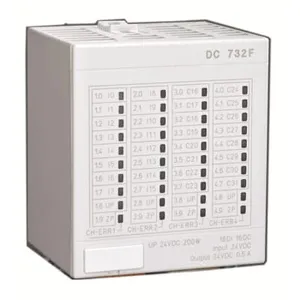
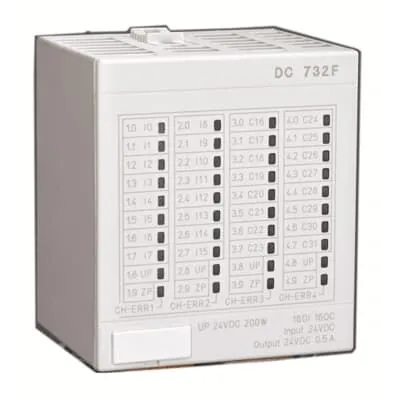
I. Overview
The ABB DC732F 3BDH000375R0005 is a high-performance communication interface module, serving as a core interconnection component of the ABB Advant OCS (Open Control System) series. It is specifically designed to enable high-speed data interaction between the control system and various on-site industrial intelligent devices, third-party systems, as well as remote monitoring platforms. Its core positioning is "the interconnection hub and protocol conversion gateway of industrial control networks". By integrating a multi-protocol processing engine, high-bandwidth communication interfaces, redundant fault-tolerant circuits, and industrial-grade anti-interference design, it realizes cross-protocol transmission, real-time forwarding, and reliable interaction of information such as control commands, process data, and equipment status. It is widely applicable to scenarios including interconnection of large-scale Distributed Control Systems (DCS), access of intelligent devices, and cross-system data sharing in fields like chemical engineering, electric power, metallurgy, and building materials.
With its core advantages of "multi-protocol compatibility, high-speed transmission, redundant reliability, and flexible expansion", this module fully meets the strict requirements of industrial control for communication interface modules, such as "diverse protocol adaptation, efficient data transmission, and stable long-term operation". It performs excellently in typical application scenarios:
In the chemical industry, it is used in the DCS interconnection system of large-scale coal chemical production equipment, enabling cross-protocol communication between ABB Advant OCS controllers and Siemens S7 series PLCs. With a transmission rate of 100Mbps and data latency ≤3ms, it ensures coordinated control among different subsystems.
In the electric power industry, it is adapted to the unit monitoring system of thermal power plants, connecting DCS controllers with intelligent devices such as generator protection devices and excitation systems. It supports IEC 61850 protocol access, realizing real-time collection of equipment status data and accurate issuance of control commands, with a fault response time ≤5ms.
In the metallurgy industry, it is applied to the cross-system data sharing platform of steel production lines, linking the production control DCS and the enterprise MES system. Through protocol conversion, it achieves bidirectional interaction between production process parameters and production management data, with a data transmission bit error rate ≤10⁻¹⁰, ensuring the accuracy of production scheduling.
The hardware architecture adopts an industrial-grade solution of "multi-protocol processing core + high-speed communication interface unit + redundant power supply and bus circuit". Its core consists of a high-performance embedded processor, multi-protocol communication chips, signal isolation and conversion circuits, redundant bus interfaces, and fault diagnosis circuits. The module adopts a standard 19-inch rack-mounted design, compatible with ABB Advant OCS series standard cabinets, and supports hot swapping, allowing module replacement and maintenance without shutting down the system. In terms of core configuration, it is equipped with 2 Ethernet interfaces, 1 Profibus-DP master interface, 1 Profibus-DP slave interface, and 1 RS485 serial interface. It supports various mainstream industrial communication protocols including IEC 61850, Modbus RTU/TCP, Profibus-DP, and Ethernet/IP. The master-slave mode and protocol type can be flexibly configured via software. The communication rate can be adaptively adjusted from 9.6kbps to 100Mbps according to the protocol type, meeting the high-speed data transmission requirements of different scenarios. For the industrial-grade reinforced design, it uses components with a wide temperature range (-20℃~65℃), adopts double-layer PCB boards and a metal shielding enclosure (with shielding effectiveness ≥85dB), and has built-in surge protection (±2kV), overvoltage protection, and EMC filtering circuits. It complies with international industrial standards such as IEC 61010-1 and IEC 61000-4-2/4/5, and can operate stably in harsh industrial on-site environments with strong electromagnetic interference and high/low temperature fluctuations.
II. Technical Parameters

III. Functional Features
1. Multi-Protocol Compatibility and Flexible Conversion for Diverse Interconnection Scenarios
The module has a built-in high-performance multi-protocol processing engine, supporting various mainstream industrial communication protocols such as IEC 61850, Modbus RTU/TCP, Profibus-DP, Ethernet/IP, and ABB proprietary communication protocol. Through the ABB Control Builder Advant software, the protocol type, master-slave mode, and communication parameters of each interface can be flexibly configured. Cross-protocol interconnection between devices from different manufacturers and different systems can be realized without replacing hardware. For example:
In the scenario of interconnecting a chemical enterprise's DCS with intelligent instruments, the Profibus-DP master interface can be configured to connect to on-site Siemens Profibus-DP intelligent instruments, and the Ethernet interface can be configured with Modbus TCP protocol to communicate with the ABB Advant OCS controller. The module automatically completes bidirectional conversion between Profibus-DP and Modbus TCP protocols, enabling real-time upload of instrument data to the controller and accurate issuance of control commands.
In the scenario of an IEC 61850 intelligent substation in the electric power industry, the Ethernet interface can be configured with IEC 61850 protocol to connect to devices such as protection devices and intelligent terminals, and the Profibus-DP slave interface communicates with the DCS controller, realizing seamless interaction between substation equipment data and the DCS system.
In addition, the module supports online modification and saving of protocol parameters, which take effect without restarting the module, adapting to the flexible adjustment needs of on-site equipment.
2. Multi-Interface Configuration and High-Speed Transmission to Ensure Data Interaction Efficiency
The module integrates a rich interface configuration including 2 Ethernet interfaces, 1 Profibus-DP master interface, 1 Profibus-DP slave interface, and 1 RS485 serial interface. It can connect to different types of industrial equipment and systems simultaneously, realizing multi-link parallel data transmission. In terms of high-speed transmission performance:
The Ethernet interface supports 10/100Mbps auto-adaptive rate with a transmission latency ≤3ms, which can meet the high-speed transmission needs of massive data, such as the interaction of production data between the enterprise MES system and the DCS system.
The Profibus-DP interface supports a maximum communication rate of 12Mbps with a transmission latency ≤5ms, adapting to real-time communication scenarios of distributed on-site equipment, such as the interconnection of multiple PLCs and DCS controllers in a metallurgical production line.
The RS485 interface supports a maximum rate of 115.2kbps, which can connect to traditional serial intelligent instruments, realizing compatible access to old equipment.
The module has a built-in 16KB receive buffer and 16KB transmit buffer, which can cache bursty massive data to avoid data loss and ensure the continuity of data transmission. It supports data frame priority setting, allowing key data such as control commands and fault alarms to be set to high priority to ensure the priority transmission of key information. For example, fault signals from generator protection devices in the power system can be preferentially uploaded to the DCS controller with a response time ≤5ms, gaining time for fault handling.
3. Full-Link Redundant Design to Improve System Operation Reliability
The module adopts a dual redundancy design of communication redundancy and power supply redundancy, minimizing the risk of communication interruption caused by single-point faults and ensuring the continuous operation of the industrial control network. In terms of communication redundancy:
The 2 Ethernet interfaces support link redundancy backup and can be configured in master-standby mode or load balancing mode. In master-standby mode, if the main Ethernet link has faults such as interruption or packet loss, the module can automatically switch to the standby link within 50ms, and data transmission is not interrupted during the switching process. In load balancing mode, the two Ethernet links transmit data simultaneously to increase data transmission bandwidth.
The Profibus-DP interface supports master-slave redundancy configuration. If the master interface fails, it can quickly switch to the slave interface for operation (redundancy logic needs to be configured in advance).
In terms of power supply redundancy, a dual-channel redundant DC 24V power supply design is adopted. The two power supplies can be connected independently. If the main power supply has faults such as voltage abnormality or interruption, the standby power supply can automatically switch within 1ms. During the switching process, the module operation is not affected, and the communication status remains stable. In critical industrial scenarios such as chemical engineering and electric power, the redundancy design enables the module to achieve a communication reliability of over 99.995%, significantly reducing production losses caused by communication faults.
4. Full-Link Diagnosis and Fault Early Warning to Simplify Operation and Maintenance Management
It integrates a full-link diagnosis function of "interface-level diagnosis + protocol-level diagnosis + module-level diagnosis". Through the combination of hardware monitoring and software verification, it realizes real-time fault detection, accurate positioning, and rapid reporting.
At the interface level: Each communication interface supports link on-off detection and signal strength monitoring. When the Ethernet link is disconnected, the module automatically reports the link fault and marks the faulty interface. When a Profibus-DP slave device is offline, the master interface immediately detects and reports the device offline information.
At the protocol level: It real-time monitors the integrity of protocol data frames and the correctness of verification. When problems such as protocol errors or data frame loss occur, it immediately reports the fault information and records details such as the content and timestamp of the faulty data frame, facilitating the analysis of fault causes.
At the module level: It real-time monitors key parameters such as the operation status of the internal core processor, power supply voltage, and internal temperature. When the power supply voltage is lower than 20.4V or higher than 27.6V, or the internal temperature exceeds 70℃, it immediately reports a power fault or overheating fault, and takes protective measures such as derated operation and cutting off non-critical interfaces.
All fault information can be viewed through the ABB Control Builder Advant software, which supports fault log export and historical fault traceability, providing complete data support for operation and maintenance personnel to quickly locate fault points and shorten fault handling time.
5. Industrial-Grade Reinforced Protection for Adaptation to Harsh On-Site Environments
It adopts an industrial-grade reinforced design of "full-interface isolation + enhanced electromagnetic protection + wide temperature adaptation", ensuring the module's stable operation in harsh industrial on-site environments with strong electromagnetic interference and high/low temperature fluctuations. In terms of isolation design:
Photoelectric isolation technology is adopted between all communication interfaces, with an isolation voltage of up to 2kVrms, which can effectively block signal crosstalk between different interfaces and prevent the overall communication abnormality of the module caused by the fault of a single external device.
Photoelectric isolation is also adopted between the module and the controller bus to prevent strong electrical signals on-site from intruding into the core of the control system, ensuring the safety of the control system.
In terms of electromagnetic protection:
The module uses a metal shielding enclosure with a shielding effectiveness of ≥85dB (10kHz~1GHz), which can effectively resist external electromagnetic radiation interference.
It has a built-in EMC filtering circuit that can filter out high-frequency interference in the 10kHz~1GHz frequency band, complying with the IEC 61000-4-3 radiation immunity standard (20V/m).
A built-in ±2kV surge suppressor can resist transient surge impacts and protect communication interface chips from damage.
In terms of wide temperature adaptation, components with a wide temperature range of -20℃~65℃ are selected, enabling stable operation in industrial on-site environments with high/low temperature fluctuations, such as unheated workshops in northern winter and high-temperature outdoor control cabinets in southern summer.
6. Hot Swapping and Convenient Configuration to Reduce Deployment and Maintenance Costs
It supports hot swapping and full graphical configuration, significantly reducing the module's deployment and maintenance costs. The hot swapping function allows the module to be plugged and unplugged while the system is powered on, enabling operation and maintenance personnel to replace faulty modules without interrupting the production line operation:
Before plugging or unplugging, the module is set to the "standby" state via the controller, and the module automatically saves the current communication parameters, protocol configuration, and link status.
After plugging in, the module automatically restores power supply, loads historical configuration parameters, and quickly restores the communication link. The entire process takes ≤5 seconds, avoiding the hours of downtime loss caused by traditional module replacement.
In terms of configuration, it supports the ABB Control Builder Advant full graphical configuration software. Through intuitive drag-and-drop operations, users can complete operations such as protocol configuration of each interface of the module, communication rate setting, redundancy logic configuration, and diagnosis function enabling, without writing underlying code. The software has a built-in dedicated configuration template for the module, which automatically identifies the module model and order number. Operation and maintenance personnel can directly select the corresponding protocol type, set master-slave parameters, configure redundant links, etc. After configuration, the parameters can be downloaded to the module with one click, and the software automatically verifies the rationality of the parameters to avoid parameter setting errors. In addition, the software supports online firmware upgrade of the module. The latest firmware version can be downloaded to the module via Ethernet. During the upgrade process, the module remains in the standby state and automatically restarts to resume operation after the upgrade is completed, avoiding system downtime caused by firmware upgrade.









 Contact Platform Support
 Help Center