Contact Platform Support
 Help Center
Multiple Applications of CHES Buffer in Biological Research


Related Products
-
 What Factors Determine the Performance of Biological Buffer TRIS 77-86-1US$ 8.6 - 13.8MOQ: 100 Kilograms
 -
Storage Conditions for Tris HCl Buffer 1185-53-1US$ 13.6 - 16.8MOQ: 100 Kilograms
-
99% of Customers Choose Bicine Buffer ManufacturerUS$ 18.8 - 26.8MOQ: 100 Kilograms
-
Application of Biological Buffer CAPS 1135-40-6 in Diagnostic KitUS$ 22.8 - 26.8MOQ: 100 Kilograms
-
Why Choose MOPS Buffer Produced and Developed by Desheng?US$ 26.6 - 32.8MOQ: 500 Kilograms
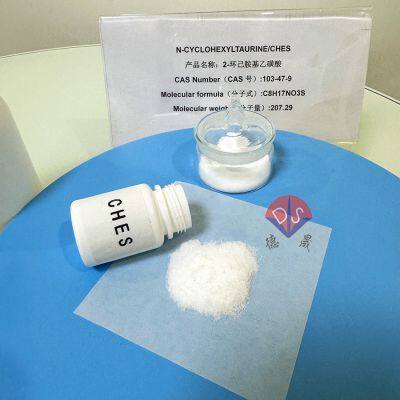
CHES (2-cyclohexylamineethanesulfonic acid) plays a crucial role as a buffering agent in the field of biological research. Its unique chemical properties endow it with a wide range of applications in enzymatic reactions, capillary electrophoresis, and the study of enzymatic processes above physiological pH. Below, we will delve into the characteristics of CHES buffer, its applications in various experiments, and its unique value in various solutions containing metal ions.
Properties of CHES buffer solution
CHES is an organic base with strong buffering capacity and a molecular formula of C4H10N2O4S. This unique structure enables it to maintain stable pH values over a wide range of pH values. It has high solubility, is easily soluble in water, and is not easy to crystallize. CHES belongs to non coordinating buffering agents, so it does not form chelating complexes with metal ions in solution. This characteristic has unique advantages when dealing with solutions containing metal ions.
Application of CHES buffer in enzymatic reactions
1. Enzymatic reaction buffer: CHES can serve as an important component of enzymatic reaction buffer, used to stabilize the pH value of the reaction system. Due to its low conductivity and absence of ionic groups, it does not interfere with the participation of metal ions in the reaction. In addition, CHES can provide a certain hydrophobic environment, which is conducive to the catalytic activity of enzymes.
2. Capillary electrophoresis samples and running buffer: CHES can serve as one of the components of capillary electrophoresis samples and running buffer, providing a stable pH environment. Due to its low conductivity, it does not interfere with the electrophoresis process and improves the separation efficiency of the sample.
3. Research on enzymatic processes above physiological pH: CHES can be used to study enzymatic processes above physiological pH. Due to its strong buffering capacity, it can maintain a stable pH value within a high pH range, making it suitable for studying enzymatic processes that require high pH values. Meanwhile, CHES can also provide a certain hydrophobic environment, which is conducive to the catalytic activity of enzymes.
4. Multiple solutions containing metal ions: CHES can be used in various solutions containing metal ions. Due to its absence of ionic groups, it does not interfere with the participation of metal ions in reactions, and it can also provide a certain hydrophobic environment, which is conducive to the catalysis of metal ions.
Precautions for operation in experiments
1. Strictly control pH: When using CHES buffer in experiments, it is necessary to accurately control its pH, as any changes in pH can interfere with the experimental process.
2. Avoid contamination: When preparing and using CHES buffer, it is necessary to prevent contamination by impurities and microorganisms, and strict aseptic operation measures should be taken.
3. Storage conditions: CHES should be stored in a cool and dry place, away from direct sunlight and high temperatures. Suggest ready to use, long-term storage can easily breed bacteria and reduce its performance.
4. Usage: When using CHES, follow the instructions or professional advice to avoid direct contact with sensitive areas such as eyes or skin. Wear laboratory protective equipment, follow the operating steps, and strictly control all parameters.
CHES buffer provides multiple applications for biological research due to its unique non coordinated buffering properties. Users should fully understand its properties and operational precautions during the experiment to ensure the accuracy and reliability of the experimental data.
At present, there are not many manufacturers of CHES in the market, and prices vary. If you want to purchase high-quality CHES, you need to choose carefully. Not only do you need to weigh the price, but more importantly, you need to consider the qualifications and experience of the suppliers.
As an advantageous manufacturer of biological buffering agents, Desheng has been committed to researching and producing high-quality buffering agent raw materials. The CHES supplied adopts advanced production processes and high-quality raw materials, with good chemical stability and a wide pH range. It can maintain stability under high temperature conditions without interfering with the participation of metal ions in reactions, and it is easily soluble in water, quickly dissolved, and evenly distributed. There are different specifications of CHES available to meet the needs of customers for different applications. If you have any relevant intentions, please feel free to click on the website to contact us for purchase!

Send Inquiry to This Supplier


You May Also Like
-
High Quality Supply Channel for Biological Buffer TAPS 29915-38-6US$ 66.8 - 76.8MOQ: 500 Kilograms
-
The Buffering Range of GOOD'S Buffer EPPS 16052-06-5US$ 56.8 - 68.8MOQ: 500 Kilograms
-
Introduction to the Use of Biological Buffer MOPSO Buffer (CAS Number 68399-77-9)US$ 28.8 - 39.8MOQ: 500 Kilograms
-
HEPES Buffer for Cell Culture 7365-45-9US$ 26.6 - 32.8MOQ: 500 Kilograms
-
Precautions for Using PIPES Buffer SolutionUS$ 26.6 - 32.8MOQ: 500 Kilograms
-
Introduction to the Use of Biological Buffer BES CAS Number 10191-18-1US$ 42.8 - 50.8MOQ: 500 Kilograms
-
The Use of 3- [N, N-di (hydroxyethyl) Amino] -2-hydroxypropanesulfonic Acid DIPSO 68399-80-4US$ 42.8 - 50.8MOQ: 500 Kilograms
-
Exploring the Synthesis Method of the Biological Buffering Agent Sodium 2-cyclohexylamineethanesulfonate (CHES Na)US$ 66.6MOQ: 500 Kilograms
-
Low Interference, High Buffering Efficiency: the Key Role of CHES 103-47-9 in Molecular BiologyUS$ 30.8 - 40.8MOQ: 500 Kilograms
-
Introduction to Biological Buffer CAPSO 73463-39-5US$ 58.8 - 66.8MOQ: 500 Kilograms