Contact Platform Support
 Help Center
Application of Biological Buffer TAPS 29915-38-6 in Enzyme Activity Research


Related Products
-
 The Advantage of High Purity of EPPS Powder 16052-06-5 Raw Materials for Biological Buffering AgentsUS$ 56.8 - 68.8MOQ: 500 Kilograms
 -
Advantages of MOPSO Buffer 68399-77-9 in Low-temperature Biochemical WorkUS$ 28.8 - 39.8MOQ: 500 Kilograms
-
What Does HEPES Buffer 7365-45-9 do for Cell CultureUS$ 26.6 - 32.8MOQ: 500 Kilograms
-
Application of Biological Buffer PIPES 5625-37-6 in Biochemical ResearchUS$ 26.6 - 32.8MOQ: 500 Kilograms
-
How to Determine and Choose a BES Buffer 10191-18-1 Manufacturer for ProcurementUS$ 42.8 - 50.8MOQ: 500 Kilograms
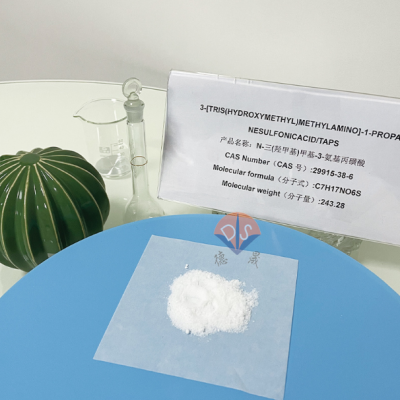
In the fields of biochemistry and molecular biology, enzyme activity research has always been an important cornerstone for exploring the mysteries of life, understanding biological processes, and developing new drugs and therapeutic methods. Enzymes, as proteins that catalyze chemical reactions in living organisms, are influenced by various factors, among which pH value is a crucial parameter. In order to precisely control experimental conditions and ensure that enzymes perform their catalytic functions at their optimal state, scientists have developed various biological buffering agents, among which TAPS plays a crucial role in enzyme activity research due to its unique buffering performance and wide application prospects.
The buffering characteristics and advantages of TAPS
TAPS, as an efficient biological buffering agent, is endowed with excellent buffering capacity and stability due to its sulfonic acid groups and multiple hydroxyl groups in its chemical structure. Within a specific pH range, TAPS can effectively neutralize hydrogen ions or hydroxide ions in a solution, maintaining a relatively constant pH environment. This is crucial for enzymes, as their structure and function are highly dependent on the surrounding microenvironment, especially pH value. Even small pH fluctuations can cause conformational changes in enzymes, thereby affecting their catalytic activity.
Compared to other common buffering agents, TAPS has several significant advantages. Firstly, it has a large buffering capacity and can provide stable buffering effects over a wide pH range, which is particularly important for enzyme activity research that requires precise pH control. Secondly, TAPS has high solubility and can maintain clear and transparent solutions even at higher concentrations, making it easy to observe and record experimental results. In addition, TAPS has good chemical stability and is not easily reactive with other compounds, thereby reducing interference factors in experiments.
Application of TAPS in Enzyme Activity Research
1. Stable enzyme structure and activity: In enzyme activity measurement experiments, the primary role of TAPS is to provide a stable pH environment to protect enzyme molecules from external acid-base changes. By maintaining an appropriate pH value, TAPS can maintain the three-dimensional structure and active site conformation of the enzyme, ensuring that the enzyme can function normally during the catalytic process. This is of great significance for accurately measuring enzyme activity, studying enzyme catalytic mechanisms, and exploring enzyme regulatory mechanisms.
2. Optimize enzyme activity measurement conditions: Enzyme activity measurement usually requires specific temperature and pH conditions. TAPS, as a buffering agent, has a buffering range that matches the optimal pH value for the activity of many enzymes, making experimental conditions closer to physiological states. By adjusting the concentration and pH value of TAPS, the conditions for enzyme activity determination can be further optimized, improving the accuracy and sensitivity of the experiment.
3. Promoting enzyme catalyzed reactions: In addition to acting as buffering agents, TAPS has also been found to directly promote the catalytic reactions of certain enzymes. This may be related to the interaction between TAPS and enzyme molecules, which promotes the wider application value of TAPS in enzyme activity research.
4. Support for complex experimental systems: In complex experimental systems involving multiple enzymes and substrates, the buffering effect of TAPS is also indispensable. It can maintain the pH stability of the entire reaction system, ensuring that various enzymes and substrates interact under optimal conditions, thereby revealing the complex metabolic pathways and regulatory mechanisms within the organism.
Precautions
Although TAPS has performed well in enzyme activity research, the following points still need to be noted in practical applications: firstly, the appropriate concentration and pH value of TAPS should be selected according to specific experimental needs to avoid adverse effects on experimental results; Secondly, in experimental systems containing metal ions, the chelation effect between TAPS and metal ions needs to be considered, and corresponding measures can be taken to intervene if necessary.
Hubei Xindesheng Material Technology, as a manufacturer of biological buffering agents, has rich experience in research and development and production. Currently, there are dozens of biological buffering agents on sale, with excellent product performance and affordable prices. Businesses in need can click on Desheng's official website for inquiries!

Send Inquiry to This Supplier


You May Also Like
-
Biological Buffer DIPSO (68399-80-4) Detailed Description for Quick UnderstandingUS$ 42.8 - 50.8MOQ: 500 Kilograms
-
Multiple Applications of CHES Buffer in Biological ResearchUS$ 30.8 - 40.8MOQ: 500 Kilograms
-
What Factors Determine the Performance of Biological Buffer TRIS 77-86-1US$ 8.6 - 13.8MOQ: 100 Kilograms
-
Storage Conditions for Tris HCl Buffer 1185-53-1US$ 13.6 - 16.8MOQ: 100 Kilograms
-
99% of Customers Choose Bicine Buffer ManufacturerUS$ 18.8 - 26.8MOQ: 100 Kilograms
-
Application of Biological Buffer CAPS 1135-40-6 in Diagnostic KitUS$ 22.8 - 26.8MOQ: 100 Kilograms
-
Why Choose MOPS Buffer Produced and Developed by Desheng?US$ 26.6 - 32.8MOQ: 500 Kilograms
-
High Quality Supply Channel for Biological Buffer TAPS 29915-38-6US$ 66.8 - 76.8MOQ: 500 Kilograms
-
The Buffering Range of GOOD'S Buffer EPPS 16052-06-5US$ 56.8 - 68.8MOQ: 500 Kilograms
-
Introduction to the Use of Biological Buffer MOPSO Buffer (CAS Number 68399-77-9)US$ 28.8 - 39.8MOQ: 500 Kilograms