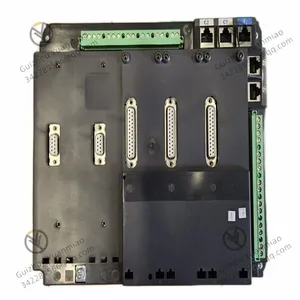
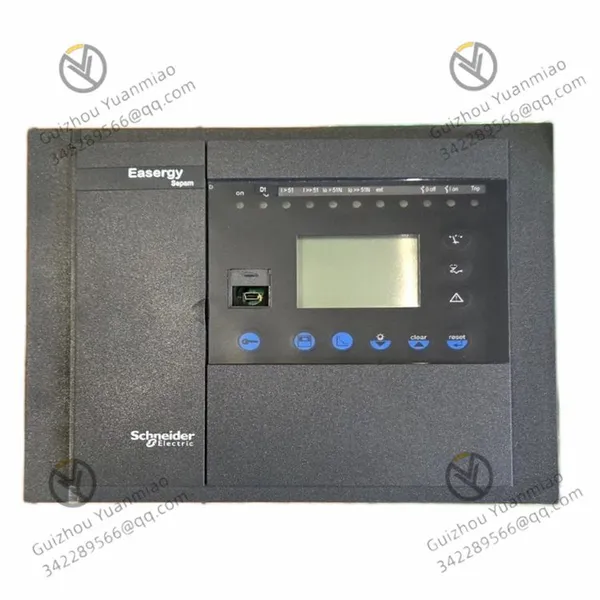
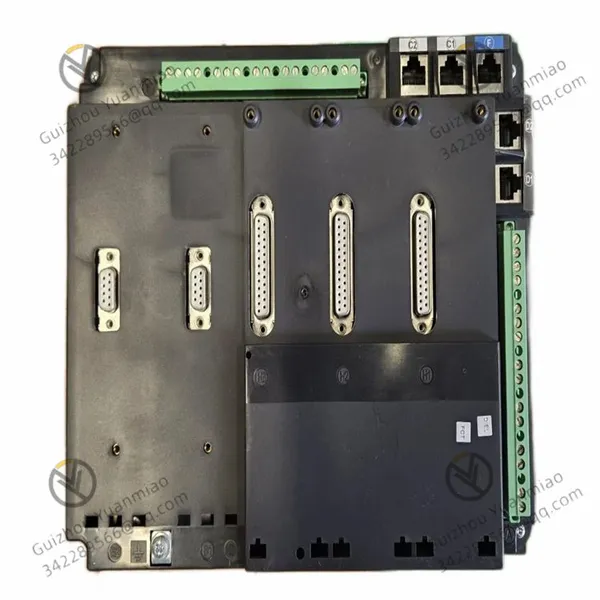
Schneider SEP363 Monitoring and Analysis Module
Working Principle
Data Acquisition: The module collects voltage and current signals in the power system through devices such as voltage and current transformers. These signals reflect the operating status of the power system, such as load size and voltage level. At the same time, the module also receives other relevant signals, such as switch quantity signals like the opening and closing status of circuit breakers and equipment fault signals, providing a basis for subsequent analysis and judgment.
Signal Processing and Analysis: The collected analog signals are converted into digital signals through analog-to-digital conversion and sent to the microprocessor inside the module. The microprocessor processes and analyzes these signals according to preset algorithms and programs, calculates various electrical parameters such as power, frequency, and power factor. It then compares the calculation results with the pre-set protection settings to determine whether the power system is in a normal operating state. For example, when the detected current value exceeds the overcurrent protection setting, the module will judge that there may be a short-circuit fault.
Protection Action Execution: If the analysis judges that there is a fault or abnormality in the power system, the module will drive the internal relays and other executive components to act according to the preset protection strategy. For example, in the case of an overcurrent fault, the module will issue a trip command, causing the relevant circuit breaker to trip through the control circuit, cutting off the fault circuit to protect the power equipment from damage. At the same time, the module will also send out an alarm signal, prompting the operator of the fault type and location through indicators, displays, or communication interfaces.
Communication and Interaction: The SEP363 module supports multiple communication protocols, such as Modbus, and can communicate with other devices through RS485 interface or Ethernet interface. It can upload the collected data and fault information to the substation automation system or other monitoring equipment to realize remote monitoring and management. At the same time, it can also receive commands from the superior control system, such as modifying protection settings and controlling the opening and closing of circuit breakers, to meet different operation and control needs.
Human-Machine Interface Function: The module is equipped with a display screen with a certain resolution (such as 128×64 pixels), which can display real-time measurement data, protection settings, equipment operating status, and fault alarm information, etc., facilitating on-site operators to intuitively understand the operation of the power system and the working status of the module. It also allows parameter setting and function configuration through the human-machine interface.

Functional Features: The SEP363 module can collect various electrical quantities, including 2 groups of three-phase currents, 2 groups of zero-sequence currents, 2 groups of three-phase voltages, and 1 group of zero-sequence voltages. It can accurately measure parameters such as phase current, line voltage, frequency, power, and power factor, and can also monitor temperature with a measurement range of -30℃ to +200℃. It has multiple protection functions such as overcurrent, overvoltage, undervoltage, and ground fault. When an abnormality is detected, it can quickly drive the relay to act and cut off the fault circuit. It supports multiple communication protocols, can upload monitoring data and status information to the monitoring system, and can also receive remote control commands to realize remote monitoring. The module is equipped with a 128×64 pixel display screen, which can display real-time measurement data, protection settings, equipment operating status, and fault alarm information, etc., facilitating operation and maintenance.
Technical Parameters:
Display Resolution: 128×64 pixels.
Power Supply: 24VDC, with an allowable deviation of -20%/+10% (i.e., 19.2–26.4VDC). The current is 21mA/24VDC at 20℃ and 30mA/19.2VDC at 60℃.
Operating Temperature: -40℃ to +85℃, and the front panel operating temperature is -10℃ to +55℃.
Protection Rating: The part of the housing beyond the shield is IP4X, other parts of the module are IP3X, and the connector is IP2X.
Mechanical Characteristics: The size is approximately 8.97cm×26.4cm×22.2cm, the weight is 3.62kg, the installation method is fixed installation, and panel mounting is supported.
Application Scenarios:
Industrial Automation Equipment: Suitable for various small and medium-sized automation equipment and instruments, such as marking machines, engraving machines, cutting machines, etc. It has a good application effect in equipment where users expect low noise, high stability, and high precision.
Hydraulic and Pneumatic Control Systems: Can be used in hydraulic and pneumatic control systems to monitor and control the operating status of the system.
Liquid Level Measurement and Control: Can be applied to liquid level measurement and control scenarios to realize accurate monitoring of liquid level and related control functions.
Power-Related Fields: Can be used for power station operation inspection, thermal power units, etc., and is also applicable to constant pressure water supply systems in building automation, as well as industrial process detection and control links.