Material
Other, Global universal model
Condition
Other, Global universal model
Task
Other, Global universal model
Mathematical Model
Other, Global universal model
Signal
Other, Global universal model
Customized
Non-Customized
Structure
Other, Global universal model
Dimensions
152mm×152mm×25.4mm
Operating Temperature
-40°C to +85°C
Weight
0.6kg
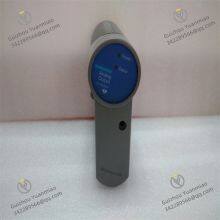
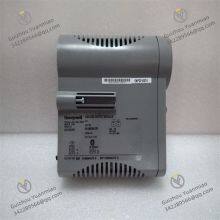
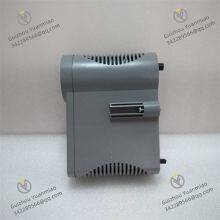
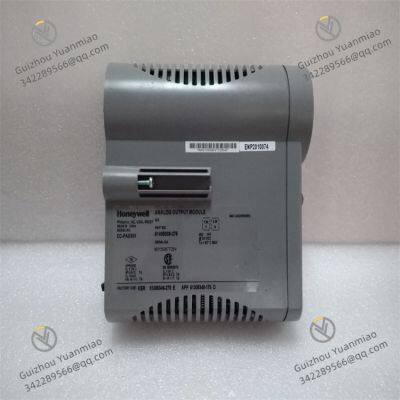
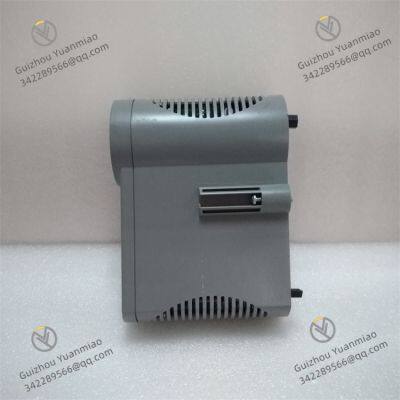
Honeywell CC-PAOX01
Features
High Precision
Capable of accurately converting digital signals into analog signals, ensuring output stability and reliability to meet the high-precision analog control requirements of various industrial automation control systems.
High Stability
Adopting high-quality materials and manufacturing processes, and undergoing strict testing and inspection, it ensures the product can operate stably for a long time in different industrial environments.
Multiple Channel Configurations
Typically equipped with multiple independent channels, each of which can be individually configured for different input signals and output corresponding analog signals, providing flexible configuration options for complex industrial control scenarios.
Easy to Use
With a simple design, it is easy to operate and maintain, allowing for quick and convenient installation and debugging, which helps reduce engineering implementation and maintenance costs.
Seamless Integration
As a product in Honeywell's automation instrumentation product line, it can be seamlessly integrated with other automation instrumentation products, thereby improving the reliability and stability of the entire control system.
Technical Parameters
Number of Channels
Usually available in different configurations such as 16 channels (e.g., model 51405039-275) and 4 channels (e.g., versions with HART protocol).
Output Signals
Common output signals are 4-20mA DC, and there are also versions supporting multiple voltage or current output types, such as 0-10V, 4-20mA, etc., to adapt to different external devices.
Communication Protocols
Some models support the HART communication protocol, allowing bidirectional communication and advanced diagnostic functions. Additionally, they may support communication protocols such as Honeywell C-Series.
Operating Temperature
The operating temperature range is generally -40°C to +85°C, enabling adaptation to harsh industrial environments.
Power Supply
Usually powered by a 24V DC power supply.
Module Dimensions
For example, the dimensions are 152mm×152mm×25.4mm (6 inches×6 inches×1 inch), and the module features a compact design to save installation space.
Weight
Approximately 0.6kg (1.25 lbs).
Output Load Capacity
For example, with a 24V power supply, the load capacity can reach 800 ohms, and the maximum output compatible voltage is 16V.
Output Ripple
At the power line frequency, the peak-to-peak value on a 250Ω load is less than 100mV.
Response Time
Can stabilize within 1% of the final value within 80ms.


Working Principle of Honeywell CC-PAOX01I. Core Function Positioning and System Architecture
CC-PAOX01 belongs to Honeywell's analog output module in the field of industrial automation, mainly used for converting digital signals into standard analog signals (such as current, voltage) to drive field actuators (such as valves, motors) or transmit to instruments for display and control. Its working principle is based on the closed-loop logic of "digital signal processing→digital-to-analog conversion→signal conditioning→output control," adapting to industrial automation architectures such as DCS (Distributed Control System) and PLC (Programmable Logic Controller).
II. Core Process of Signal Processing and Conversion
Digital Signal Input and Processing
Communication Reception: Receives digital instructions (such as output values, parameter configurations) from controllers (such as PLCs) through RS-485 (Modbus RTU) or Ethernet (Modbus TCP) interfaces. The communication protocol supports data verification and error correction to ensure the reliability of instruction transmission.
Data Parsing: The internal microprocessor (MCU) of the module parses the digital signals and converts them into target values for corresponding output channels (e.g., 4-20mA corresponds to digital quantity 0-65535, 16-bit resolution).
Digital-to-Analog Conversion (DAC) and Signal Generation
16-bit DAC Conversion: Uses a high-precision digital-to-analog converter (such as a 16-bit DAC chip) to convert digital quantities into analog electrical signals, with a resolution of 0.0015% of full scale (e.g., for 4-20mA output, the minimum step is approximately 0.032mA), ensuring output accuracy (±0.1% of full scale at 25°C).
Signal Type Selection: Generates current signals (4-20mA, 0-20mA) or voltage signals (0-10V, 1-5V, etc.) according to configurations. Current signals have strong anti-interference capabilities and are suitable for long-distance transmission (load ≤500Ω), while voltage signals are adapted to high-impedance devices (load ≥10kΩ).
Signal Conditioning and Driving
Amplification and Filtering: Amplifies the weak signals output by the DAC through operational amplifiers, and suppresses high-frequency noise using RC filter circuits to ensure smooth and stable signals.
Load Driving and Protection: The output circuit has short-circuit and overload protection (such as current-limiting resistors, overvoltage protection diodes) to avoid module damage caused by actuator failures (such as valve jams); some models support the "fault hold" function, which automatically maintains the last valid output when anomalies are detected to prevent sudden changes in process parameters (such as out-of-control flow).
III. Industrial-Grade Reliability Design and Self-Diagnosis Mechanism
Anti-Interference and Environmental Adaptation
Electrical Isolation: Photoelectric isolation or magnetic isolation technology (isolation voltage ≥500VAC) is used between communication interfaces, power supplies, and output channels to prevent on-site electromagnetic interference (such as motor start/stop, frequency converters) from affecting signal accuracy, in compliance with EN 61000 electromagnetic compatibility standards.
Wide Temperature Design: The operating temperature range is -40°C~70°C, and the fanless heat dissipation structure adapts to high-temperature (such as metallurgical workshops) or low-temperature (such as cold storage) environments, meeting the vibration resistance test requirements of IEC 60068.
Real-Time Monitoring and Fault Handling
Self-Diagnosis Logic: The microprocessor real-time monitors the DAC output value, channel load status, and communication link, and feeds back fault information (such as output over-limit, disconnection) through LED indicators (such as channel anomalies, communication failures) and communication interfaces.
Hot-Swapping Support: Some models support hot-swapping. When replacing modules, the system automatically cuts off the faulty channel to avoid affecting other channels, reducing downtime maintenance time (suitable for continuous production scenarios).
IV. Communication and Configuration Flexibility
Protocol Compatibility and Data Interaction
Multi-Protocol Adaptation: Standard configuration with Modbus RTU protocol, communicating with controllers through RS-485 interface (up to 1200 meters); optional Ethernet interface (Modbus TCP), with communication response time ≤10ms, supporting high-speed data transmission (such as real-time monitoring by SCADA systems).
Remote Parameter Configuration: Remotely modify output ranges, linearization parameters, or enable digital filtering (suppress signal fluctuations) through supporting software (such as Honeywell Experion) without on-site manual adjustment.
Nonlinear Compensation and Scaling
Linear/Nonlinear Processing: For special process requirements (such as thermocouple temperature signal compensation, flowmeter nonlinear characteristics), the module supports custom output scaling algorithms, achieving nonlinear curve fitting through software configuration to ensure that output signals correspond to actual physical quantities.
V. Technical Differences from Similar Products (Comparing with CC-PAON01)
| Parameter Dimension | CC-PAON01 | CC-PAOX01 |
|---|
| Core Upgrade Points | Basic analog output module | May add edge computing functions or higher integration |
| Communication Interfaces | Standard RS-485, optional Ethernet | May support industrial protocols such as OPC UA, Profinet |
| Channel Expansion | 8/16 channels | May support 32 channels or mixed signal output (such as current + voltage) |
| Protection Level | Some models with IP65 | May standard with IP65, adapting to outdoor or humid environments |
| Intelligent Features | Basic self-diagnosis | May integrate AI fault prediction or adaptive filtering |
VI. Typical Application Scenarios
Temperature Control of Chemical Reactors: The PLC calculates the target heating power based on temperature sensor data, and controls the opening of the electric control valve through the 4-20mA signal output by CC-PAOX01. The module real-time monitors whether the output current is over-limit. If the valve is stuck, it triggers fault holding to prevent the reactor temperature from getting out of control.
Flow Regulation in Sewage Treatment: The SCADA system sends flow set values to the module through Ethernet. The module converts digital quantities into 0-10V voltage signals to drive the frequency converter, while using nonlinear scaling functions to compensate for the nonlinear errors of the flowmeter, ensuring that the actual flow matches the set value.