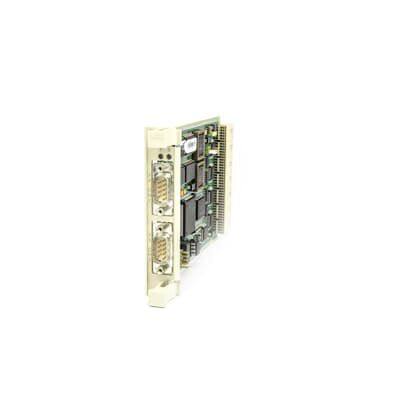
Material
Other, Global universal model
Condition
Other, Global universal model
Task
Other, Global universal model
Mathematical Model
Other, Global universal model
Signal
Other, Global universal model
Customized
Non-Customized
Structure
Other, Global universal model
Operating Temperature
-20℃ to +60℃
Relative Humidity
5%-95% (non-condensing)
Dimensions
80mm × 180mm × 65mm
I. Overview
The ABB CI531 3BSE003825R1 is a compact interface module designed for compact serial communication, with its core positioning as an "efficient data interaction link between ABB AC 800M controllers and small-to-medium-sized serial device clusters". Its core value lies in establishing a streamlined serial data transmission network of "AC 800M Controller - Distributed Serial Meters - Third-party Small PLCs" through the high-stability design of a single RS-485 interface, in-depth adaptation of core serial protocols, and a lightweight architecture. It provides an integrated solution of "precise protocol adaptation + stable data transmission + low-cost deployment" for industries such as water treatment, food processing, and small-to-medium-sized manufacturing that have concentrated serial communication needs and limited space. This addresses the core pain points in industrial systems, including small-scale interconnection of serial devices, large space occupation, and high deployment costs.
As a lightweight serial communication component of the ABB AC 800M controller, its key advantage over multi-interface serial modules lies in the "balance between streamlined architecture and high reliability":
It adopts a single RS-485 interface design, featuring a compact size and low power consumption, making it suitable for control cabinet scenarios with limited space (e.g., control cabinets for small production lines).
It focuses on the in-depth optimization of the core Modbus RTU protocol, with communication stability and data processing efficiency comparable to high-end modules. Meanwhile, it supports interface electrical isolation and industrial-grade anti-interference design to ensure reliable communication for small-to-medium-sized device clusters.
Whether for collecting data from 10 temperature controllers in a food processing line or controlling 8 frequency converters in a water treatment station, its streamlined design and stable performance can meet serial communication needs at a low cost.
II. Technical Specifications
(I) Communication Performance Specifications
(II) Safety and Reliability Specifications
(III) Environmental and Physical Specifications

III. Functional Features
(I) Streamlined Architecture and Precise Adaptation to Reduce Deployment Costs
Compact Design for Limited Space: With a streamlined width of 80mm, it is only 80% the size of ordinary multi-interface modules, allowing flexible deployment in small control cabinets (e.g., 200mm-wide control cabinets for food processing lines). Meanwhile, its low power consumption (≤4W) eliminates the need for additional heat dissipation devices, reducing the heat dissipation cost of control cabinets. For example, in a beverage filling line, the CI531, along with the AC 800M controller and 2 PLCs, is installed in a 300mm-wide control cabinet, increasing space utilization by 30%.
In-depth Modbus RTU Optimization: Focusing on the optimization of core functions of the Modbus RTU protocol, it supports fast register address mapping (e.g., mapping the "0x0001" register of Slave 1 to the "AI_01" variable of the AC 800M) and batch data reading/writing (capable of reading data from 32 registers at a time). Its data processing efficiency is 20% higher than that of ordinary modules. In a water treatment station, by batch reading the operating current (from 32 registers) of 8 frequency converters, the data refresh cycle is shortened to 100ms, meeting real-time monitoring needs.
(II) High-stability Communication and Anti-interference for Harsh Scenarios
Interface Isolation and Long-distance Transmission: The 2000Vrms electrical isolation prevents ground loop interference (e.g., ground potential differences between frequency converters and meters in workshops), and the 1000m repeater-free transmission is suitable for cross-workshop communication in small-to-medium-sized factories (e.g., between the raw material workshop and filling workshop of a food factory, 800m apart). Configuring a 120Ω termination resistor can further reduce signal reflection during long-distance transmission, ensuring stable data transmission (bit error rate ≤10⁻⁹).
Industrial-grade Environmental Resistance: The wide temperature range of -20℃ to +60℃ covers northern winter workshops (-15℃) and southern summer high-temperature environments (55℃). Its anti-interference capability against ±6kV ESD contact discharge and ±4kV EFT burst can resist electromagnetic interference from motors and heating equipment in food processing workshops, ensuring stable data collection from temperature controllers (collection error ≤±0.5℃).
(III) In-depth AC 800M Integration to Simplify System Configuration
Seamless Connection and Rapid Configuration: It can be directly inserted into the AC 800M controller rack and communicate with the controller via the internal bus, without additional wiring. Compatible with Control Builder M software, it has built-in Modbus RTU configuration templates (e.g., "Frequency Converter Monitoring Template", "Meter Data Collection Template"). Engineers only need to select a template and associate slave addresses to complete the configuration of 16 slaves within 15 minutes, improving configuration efficiency by 50%. For example, in a small machinery factory, the communication configuration of 10 motor frequency converters is quickly completed using templates, without the need to write protocol code.
System 800xA Linked Monitoring: It supports uploading RS-485 interface status (e.g., bus load rate, number of online slaves) and slave fault information (e.g., "Slave 5 CRC Check Error") to the System 800xA HMI. Maintenance personnel can remotely monitor the communication status through a visual interface without on-site device-by-device troubleshooting, reducing fault handling time to 25 minutes.
(IV) Flexible Maintenance and Diagnosis to Reduce Management Costs
Local and Remote Debugging: It supports remote modification of interface parameters (e.g., communication rate, parity method) and export of Modbus communication logs (including request frames, response frames, and error codes) via the AC 800M controller. The module has a built-in "bus scanning tool", which can scan online slaves on the bus with one click via Control Builder M to quickly identify unresponsive devices (e.g., "Slave 8 Offline"), avoiding the tedious process of manual point-by-point troubleshooting.
Visual Fault Feedback: The panel indicators clearly distinguish fault types. A yellow light on the RS-485 interface indicates bus communication abnormality (e.g., disconnection), and a red light on the slave status indicator indicates a fault in the corresponding group of slaves (e.g., "Red light on for Slaves 1-8 Group"). Maintenance personnel can locate the fault range within 10 minutes using the indicators. For example, a water treatment station quickly detected that the 3rd frequency converter was offline via the indicators, reducing fault troubleshooting time from 1 hour to 15 minutes.
IV. Application Scenarios
Food Processing: Production Line Temperature and Speed Monitoring
In a small biscuit production line, the AC 800M controller connects to 12 RS-485 temperature controllers (distributed in the oven and cooling section, 100-500m apart) and 4 frequency converters (controlling conveyor belt speed) via the CI531 module. The CI531 collects temperature data (accuracy ±0.5℃) and frequency converter speed (accuracy ±1rpm) through the Modbus RTU protocol, with a data refresh cycle of 200ms. Its streamlined size is suitable for the compact control cabinet (300mm wide) of the production line, and its low-power design eliminates the need for additional heat dissipation, ensuring continuous operation of the production line (operation rate ≥98%).
Water Treatment: Frequency Converter Control for Small-to-Medium-sized Pump Stations
In a community sewage treatment pump station, the AC 800M controller connects to 8 RS-485 frequency converters (controlling sewage pumps, 200-800m apart) via the CI531 module. It uses the Modbus RTU master mode to issue speed commands (e.g., "30Hz") and collect the current and fault status of the frequency converters. It supports bus redundancy configuration (2 CI531 modules), and the backup module takes over within 200ms if one module fails, avoiding the risk of sewage overflow caused by pump station shutdown. The communication bit error rate is ≤10⁻⁹, ensuring stable operation of the water pumps (speed fluctuation ≤±0.3Hz).
Small-to-Medium-sized Manufacturing: Machine Tool Equipment Status Collection
In a small mechanical processing workshop, the AC 800M controller connects to 16 RS-485 intelligent meters of old lathes (collecting spindle speed and cutting temperature) via the CI531 module. The CI531 reads meter data in batches (32 registers at a time) through the Modbus RTU protocol, with a data refresh cycle of 150ms. It remotely monitors equipment status via the System 800xA HMI and automatically alarms in case of anomalies (e.g., "Spindle Speed Exceeds Upper Limit"). Maintenance personnel do not need on-site duty, increasing management efficiency by 40%.
HVAC: Building Air Conditioning Unit Monitoring
In the central air conditioning system of a commercial building, the AC 800M controller connects to 10 RS-485 air conditioning units (distributed on different floors, 50-300m apart) via the CI531 module. It collects return air temperature and fan speed data of the units and issues temperature setting commands (e.g., "25℃"). The low-power design (≤4W) of the CI531 is suitable for the limited power supply capacity of building control cabinets, and its wide-temperature characteristic adapts to temperature fluctuations (10℃-40℃) in building equipment rooms, ensuring stable operation of the air conditioning system and reducing energy consumption by 15%.









 Contact Platform Support
 Help Center