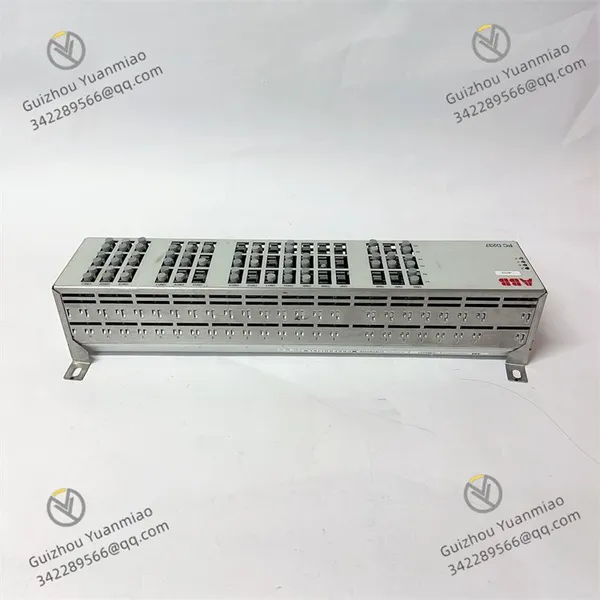
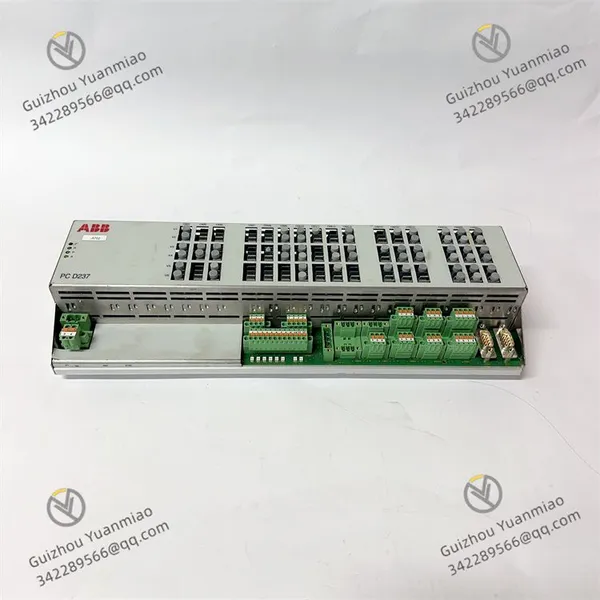
Material
Other, Global universal model
Condition
Other, Global universal model
Task
Other, Global universal model
Mathematical Model
Other, Global universal model
Signal
Other, Global universal model
Customized
Non-Customized
Structure
Other, Global universal model
Operating Temperature
-10℃-60℃
Relative Humidity
5%~95% (non-condensing)
Storage temperature
-40℃ to 85℃
Dimensions
120mm × 180mm × 80mm
I. Overview
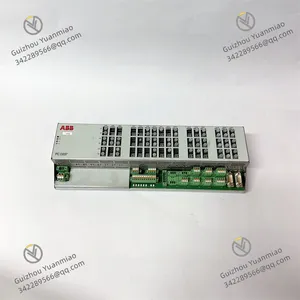
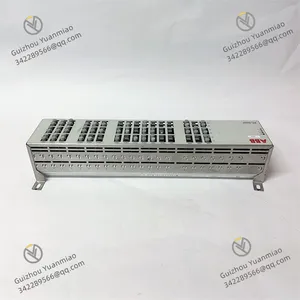
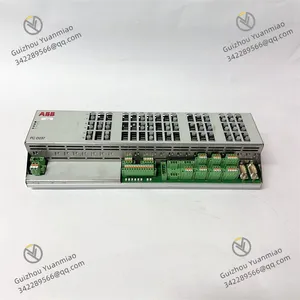
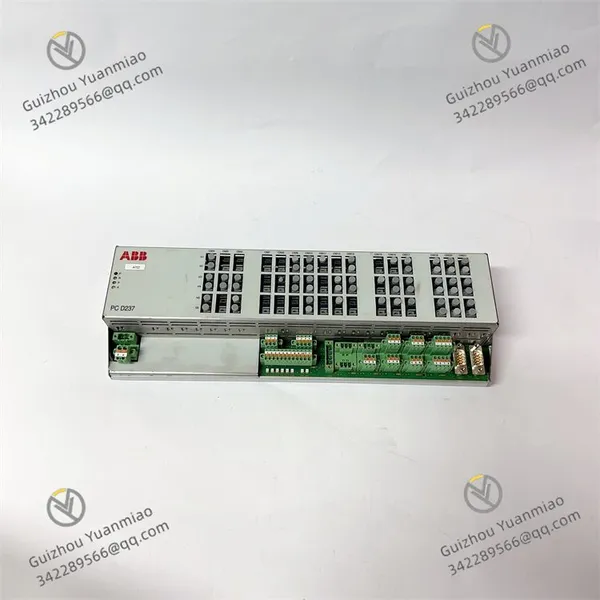
ABB PCD237A1011 3BHE028915R0101 is a process control unit module dedicated to the AC 800M Distributed Control System (DCS), with its core positioning as the "distributed I/O acquisition and logical control hub for industrial production processes".
Its core value lies in integrating ABB's distributed control technology and high-reliability hardware design to provide an integrated solution of "multi-type I/O signal acquisition (analog/digital) + real-time logical operation + collaborative control with DCS main controller" for scenarios such as temperature/pressure regulation of chemical reactors, water level control of power plant boilers, and process parameter monitoring of metallurgical rolling mills. Through modular expansion and high-speed communication, it realizes decentralized control and centralized management of production processes, adapting to large-scale industrial scenarios with strict requirements for control real-time performance (response time ≤ 1ms) and system redundancy, thus ensuring stable and efficient operation of production processes.
As a core I/O control component of the AC 800M DCS, this module supports seamless integration with AC 800M main controllers (e.g., PM861) and ABB Harmony HMI. It combines industrial-grade anti-interference capability and flexible expandability, making it a key component of modern large-scale industrial automation systems.

II. Technical Specifications
(I) Performance Parameters
(II) Environmental & Reliability Parameters
(III) Physical & Installation Parameters
III. Functional Features
(I) Distributed I/O Acquisition & High-Speed Control for Large-Scale Industrial Scenarios
Comprehensive Coverage of Multi-Type I/O: With a configuration of 8 AI + 4 AO + 16 DI + 8 DO channels, it can simultaneously collect analog signals such as temperature (e.g., PT100 converted to 4-20mA via a transmitter), pressure, and flow, as well as digital signals such as valve switching and motor start-stop. It can meet the needs of small and medium-sized control loops without additional expansion modules;
High-Speed Local Operation: With a minimum operation cycle of 1ms, it supports PID algorithms (e.g., temperature control of chemical reactors with adjustment accuracy ±0.5℃) and sequential control (e.g., production line start-stop processes). Local processing reduces the load on the main controller and improves the response speed of the entire DCS system;
Profinet IRT Real-Time Communication: With a communication rate of 100Mbps and latency ≤1ms, it ensures real-time data interaction with the AC 800M main controller (e.g., PM861), avoiding control deviations caused by communication delays (e.g., real-time feedback is required for water level control of power plant boilers).
(II) Industrial-Grade Reliability Design for Uninterrupted Production
Multiple Redundancy Protection: Dual 24V DC power supply redundancy (switching time ≤10ms), Profinet dual-link communication redundancy, and key I/O channel redundancy (e.g., 1:1 backup for AI pressure signals) prevent control interruptions caused by single-point failures, complying with industrial safety standards (EN ISO 13849-1 Cat.3);
Strong Anti-Interference & Environmental Adaptability: Certified for electromagnetic compatibility in accordance with IEC 61000-4, it resists interference from frequency converters and high-voltage equipment. The wide-temperature design (-10℃-60℃) adapts to high-temperature environments in chemical workshops and heat radiation near power plant boilers, ensuring stable I/O acquisition signals (analog fluctuation ≤±0.1%);
Fault Self-Diagnosis & Safety Protection: Automatically detects I/O channel open circuits/short circuits (e.g., outputs an alarm signal when an AI sensor is disconnected), power abnormalities, and communication interruptions. Fault information is uploaded via LED lights and the main controller, and it supports a "fail-safe mode" (e.g., DO output maintains the state before the fault to avoid misoperation of actuators).
(III) Flexible Integration & Ease of Use for Reduced System Complexity
Seamless Compatibility with AC 800M DCS: It can be directly inserted into AC 800M standard racks, enabling linkage with the main controller and HMI without additional protocol converters. It supports unified configuration via ABB Control Builder M software, reducing cross-system integration workload;
Adaptation to Third-Party Equipment: The Modbus RTU protocol supports connection to third-party sensors (e.g., Siemens pressure transmitters) and actuators (e.g., Schneider frequency converters). The HART protocol enables online debugging of sensors in AI/AO channels (e.g., calibrating 4-20mA output) without disassembling the module;
Visual Configuration & Debugging: Through Control Builder M software, graphical configuration of I/O parameters (e.g., AI range, DO output mode) and PID parameters (proportional gain, integral time) is supported. It also allows online monitoring of real-time I/O values and historical curves, enabling non-professionals to get started quickly.
(IV) Expandability & Compliance for Long-Term Upgrades
Modular Expansion: Supports expansion of ABB remote I/O modules (e.g., CI854A) via Profinet. When the number of I/O points exceeds the local limit of 1,000, it can be expanded to thousands of points to meet the needs of expanded production scales (e.g., adding reactor control in chemical parks);
Compliance with Industry Standards: Certified by CE, UL, and CSA, it meets the safety requirements of industries such as chemical engineering (ATEX Zone 2) and power plants (IEC 61508 SIL 2), adapting to equipment access standards in different regions and industries;
Data Tracing & Auditing: Supports storage of 1,000 key I/O fault records (including timestamps, fault types, and values at the time of fault), with data retained even when power is off. This facilitates post-accident tracing and analysis, complying with safety production supervision requirements.
IV. Application Fields
(I) Chemical Industry: Reactor Temperature & Pressure Control
Application Scenario
In the control of polymerization reactors in large-scale chemical parks, it is necessary to monitor the temperature (80-120℃, accuracy ±0.5℃), pressure (0.5-2.0MPa, accuracy ±0.01MPa), and start-stop status of agitator motors (DI signals) of 3 reactors; control the jacket cooling water valves of the reactors (AO 4-20mA for adjusting opening) and heating devices (DO for start-stop). The module is required to operate stably in high-temperature (≤55℃) and dusty workshop environments, and achieve real-time linkage with the AC 800M main controller.
Module Function Implementation
I/O Acquisition & Control: 8 AI channels are connected to the temperature transmitters (4-20mA) and pressure transmitters (4-20mA) of the 3 reactors respectively; 16 DI channels are connected to the start-stop feedback of agitator motors and safety door status; 4 AO channels output signals to control the opening of 3 cooling water valves and PID adjustment of 1 heating device; 8 DO channels output start-stop commands for agitator motors and control signals for alarm lights;
Local PID Operation: Local PID control (operation cycle 10ms) is adopted for the temperature of each reactor. The opening of the cooling water valve is adjusted according to the temperature deviation (e.g., increasing the valve opening when temperature >120℃), with a control accuracy of ±0.3℃, reducing the load on the main controller;
Redundancy & Alarm: Dual power supply redundancy avoids power outage risks, and Profinet dual links ensure uninterrupted communication with the main controller. When the AI pressure signal exceeds 2.0MPa, the local DO alarm light is triggered, and the main controller is notified to trigger an emergency shutdown to prevent reactor overpressure.
(II) Power Industry: Boiler Water Level & Steam Pressure Control
Application Scenario
In the boiler control of a 300MW unit in a thermal power plant, it is necessary to monitor the boiler water level (0-10m, accuracy ±0.05m), steam pressure (8-12MPa, accuracy ±0.02MPa), and operation status of feedwater pumps (DI signals); control the feedwater pump frequency converters (AO 4-20mA for adjusting speed) and steam valves (DO for switching). The module is required to withstand high temperatures (60℃) and vibration (≤2g) near the boiler, and support real-time data interaction with the AC 800M main controller (latency ≤1ms).
Module Function Implementation
High-Speed I/O & Communication: AI channels collect signals from water level transmitters (4-20mA) and steam pressure transmitters, with an operation cycle of 1ms to ensure real-time feedback; Profinet IRT enables high-speed communication with the main controller, uploading water level/pressure data and receiving setpoint commands from the main controller (e.g., target water level of 5m);
Redundancy Protection: Dual power supply redundancy, Profinet dual-link redundancy, and 1:1 redundancy for AI water level signals prevent boiler water level control failure caused by single-point faults. When the main communication link is interrupted, it automatically switches to the backup link (switching time ≤10ms);
Fail-Safe: When the water level is
(III) Metallurgical Industry: Rolling Mill Roller Table Speed & Temperature Control
Application Scenario
In the roller table control of a hot rolling mill in a steel plant, it is necessary to monitor the motor speed (0-1500rpm, 4-20mA feedback via frequency converter), surface temperature (200-500℃, 4-20mA via infrared sensor), and start-stop status (DI signals) of 6 roller tables; control the speed of roller table frequency converters (AO 4-20mA for adjustment) and cooling fans (DO for start-stop). The module is required to adapt to the vibration (≤2g) and dusty environment of the rolling mill, and support collaborative control of the rolling mill rhythm with the AC 800M main controller.
Module Function Implementation
Adaptation to Multi-Type I/O: AI channels collect speed feedback and temperature signals; DI channels collect roller table start-stop feedback and emergency stop signals; AO channels output speed commands for frequency converters; DO channels control cooling fans;
Collaborative Control: Local PID adjustment of roller table speed is performed (e.g., setting a speed of 1200rpm according to the rolling mill rhythm, with adjustment accuracy ±1rpm). Real-time speed and temperature data are uploaded to the main controller, which issues speed adjustment commands based on the overall rolling mill process to achieve "local fine control + global collaboration";
Environmental Adaptability: IP20 protection and anti-vibration design resist dust and vibration in the rolling mill. The wide-temperature design (-10℃-60℃) adapts to day-night temperature changes in the workshop, ensuring long-term stable I/O acquisition and control functions.









 Contact Platform Support
 Help Center