Home > Electrical & Electronics > Electrical Control System > ABB UNS0884A-P,V1 3BHE004385R0001 Current Sensor 2000A
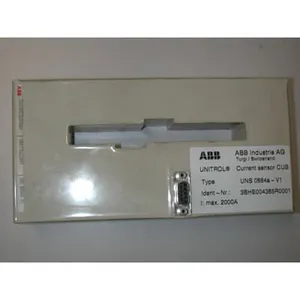
ABB UNS0884A-P,V1 3BHE004385R0001 Current Sensor 2000A
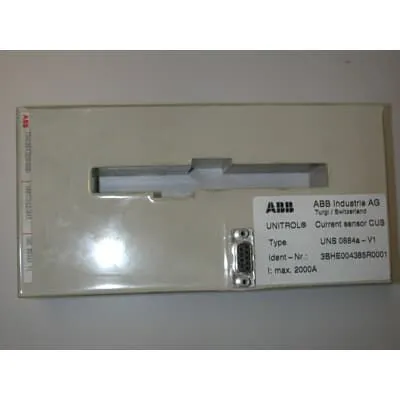
ABB UNS0884A-P,V1 3BHE004385R0001 Current Sensor 2000A photo-1

Negotiable MOQ: 1 Piece (Price negotiable depending on order volume and customization)
Key Specifications
Get Latest Price
Material:
Other, Global universal model
Condition:
Other, Global universal model
Task:
Other, Global universal model
Payment & Shipping
Payment Methods:
Port of Shipment:
guizhou
Delivery Detail:
Delivery time depends on order quantity.
Material Other, Global universal model
Condition Other, Global universal model
Task Other, Global universal model
Mathematical Model Other, Global universal model
Signal Other, Global universal model
Customized Non-Customized
Structure Other, Global universal model
Operating Temperature -25℃ to 65℃
Relative Humidity 5%-95% (non-condensing)
Storage temperature -40℃ to 85℃
Dimensions 140mm × 200mm × 75mm

I. Overview


The ABB UNS0884A-P, V1 3BHE004385R0001 is a safety communication gateway, with its core positioning as a "central hub for secure data interaction between multi-protocol industrial safety systems (SIS/ESD) and heterogeneous devices". Its core value lies in breaking down communication barriers between different safety systems and equipment of various brands through SIL 2 safety certification and a multi-protocol compatible architecture. It establishes a cross-domain secure data transmission network of "ABB Safety Controller - Third-Party SIS - Distributed Safety Instruments - Upper-Level Monitoring Platform", and provides an integrated communication solution of "multi-protocol conversion + secure data verification + redundant backup" for industries with extremely high requirements for system compatibility and secure data interaction, such as petrochemicals, nuclear power, and high-end manufacturing. This ensures delay-free and error-free interaction of safety interlock commands and equipment status signals between heterogeneous systems during industrial processes, and prevents safety accidents and production interruptions caused by protocol incompatibility or data transmission errors.


Compared with single-protocol safety communication modules, it focuses more on the "secure collaboration of heterogeneous systems":
  • Specifically designed for the interconnection between the ABB System 800xA SIS and third-party safety equipment (such as Siemens S7-400F, Rockwell GuardLogix), it supports bidirectional conversion of mainstream industrial safety protocols including PROFIBUS, Modbus, and EtherNet/IP.

  • At the same time, it integrates local safety I/O interfaces, which can directly collect on-site safety signals (such as emergency stop buttons and safety valve feedback), reducing intermediate transfer modules and lowering system complexity.


As a core component of ABB's cross-system safety communication, it can not only realize the collaboration of interlock commands between different safety systems (e.g., synchronizing emergency shutdown commands issued by ABB SIS to third-party ESD) but also integrate data from distributed safety equipment and upload it to the upper-level monitoring platform. It is a key hardware support in the industrial field for "achieving integrated management and control of heterogeneous safety systems and improving system compatibility and reliability".


II. Technical Parameters


(I) Communication Performance Parameters

Parameter Category Specific Specifications
Supported Protocols Safety protocols: PROFIBUS DP/PA safety protocol (IEC 61158-6-10), Modbus TCP safety protocol (IEC 62351-3), EtherNet/IP safety protocol (CIP Safety), ABB dedicated safety bus protocol (AC 800M Safety Bus); General protocols: Modbus RTU, Profinet, OPC UA (safety version). It can seamlessly interface with third-party SIS (Siemens S7-400F, Rockwell GuardLogix) and distributed safety instruments (such as P+F safety sensors).
Protocol Conversion Capability


Supports bidirectional protocol conversion with a conversion delay ≤ 10ms (e.g., PROFIBUS DP safety signals ↔ EtherNet/IP safety signals, Modbus TCP safety commands ↔ ABB dedicated safety protocol data); Supports custom protocol data mapping, and the signal correspondence between different protocols can be configured via software (e.g., mapping "PROFIBUS DI1" to "EtherNet/IP Input 1").

Communication Interfaces


4 Gigabit Ethernet interfaces (RJ45, supporting Modbus TCP/EtherNet/IP/OPC UA), 2 PROFIBUS DP/PA interfaces (Phoenix terminals, connected with shielded wires), 1 RS-485 interface (supporting Modbus RTU), 1 USB Type-C interface (for debugging and configuration).

Communication Distance


Ethernet interface: Maximum distance of a single network cable segment ≤ 100m; the maximum distance when extended via a switch depends on the switch level; PROFIBUS DP: 100m at 12Mbps, 400m at 1.5Mbps (shielded twisted pair); PROFIBUS PA: 1900m without a repeater (dedicated bus cable); RS-485: 1200m without a repeater (shielded twisted pair).

Data Processing Capability


Supports bidirectional transmission of up to 1024 safety signals (including input/output); Processes ≥ 1000 safety data frames per second; Supports data priority classification (safety interlock commands have the highest priority, and general monitoring data has the lowest priority).


(II) Safety and Redundancy Parameters

Parameter Category Specific Specifications
Safety Certifications SIL 2 safety certification (compliant with IEC 61508 standard), suitable for cross-system safety loops with Safety Integrity Level 2; Certified by TÜV Rheinland, ATEX (hazardous areas Zone 1/2), IECEx, CE, and RoHS, meeting safety and environmental protection requirements of major industrial regions worldwide.
Redundancy Design


Communication redundancy: 4 Ethernet interfaces support dual-network redundancy (main network/backup network), 2 PROFIBUS interfaces support bus redundancy, with a switching time ≤ 5ms; Power redundancy: Dual 24V DC inputs (18V-36V DC wide voltage range), the backup power supply takes over seamlessly when the main power supply fails, with a power interruption time ≤ 3ms; Hardware redundancy: Dual redundancy for core communication chips and data processing chips; a single chip failure does not affect system operation.

Safety Mechanisms


Data transmission adopts a triple safety mechanism of "CRC cyclic redundancy check + message encryption (AES-128 algorithm) + timestamp synchronization" to prevent data tampering, loss, or delay; Supports "2-out-of-3 (2oo3)" data voting logic to improve the reliability of secure data transmission; Equipped with protocol storm suppression function to prevent malicious data frames from occupying communication bandwidth.

Fault Detection


Supports four-level fault diagnosis: interface-level (communication disconnection, short circuit, protocol error), protocol-level (data verification failure, frame format error), hardware-level (chip failure, memory error), and power-level (overvoltage, undervoltage); Fault information is fed back through three methods: LED indicators, upper-level system alarms, and SMS notifications (optional).


(III) Local I/O and Calculation Parameters

Parameter Category Specific Specifications
Local Safety I/O 8-channel DI (24V DC dry contact, supporting safety signal collection, such as emergency stop buttons and safety door status) with a response time ≤ 1ms; 4-channel DO (24V DC transistor output, 2A per channel, supporting safety interlock output, such as emergency shutdown relays and audible-visual alarms), with configurable fail-safe output (4mA/20mA/maintain current value); 2-channel AI (4-20mA/RTD, collecting safety-related analog signals such as temperature and pressure) with a measurement accuracy of ±0.1% FS.
Logic Calculation Capability


Supports basic safety logic operations (e.g., "DI1 AND DI2 → DO1", "AI1 > Threshold → DO2"), compliant with the IEC 61131-3 standard (Function Block Diagram - FBD programming); Can store 100 custom logic rules and support online modification and download; Instruction execution speed ≤ 1μs per step (basic logic instructions).

Data Storage


Built-in 512MB Flash non-volatile memory, capable of storing 500,000 safety data records (including timestamps, parameter values, and protocol types) and 1,000 fault records (including fault codes, occurrence time, and impact scope); Data retention ≥ 10 years after power-off; Supports scheduled data backup to upper-level systems or industrial cloud platforms.


(IV) Environmental and Physical Parameters

Parameter Category Specific Specifications
Environmental Adaptability Operating temperature: -25℃ to 65℃ (covering workshops with extreme low temperatures and high-temperature industrial scenarios); Storage temperature: -40℃ to 85℃; Relative humidity: 5%-95% RH (no condensation, compliant with IEC 60068-2-3 standard); Vibration resistance: 10-2000Hz, acceleration ≤ 5g (compliant with IEC 60068-2-6 standard); Shock resistance: 30g (11ms half-sine wave, compliant with IEC 60068-2-27 standard).
Electromagnetic Compatibility (EMC)


Radiated interference: Compliant with EN 55011 Class A standard; Anti-interference capability: EN 61000-4-2 (±8kV ESD contact discharge), EN 61000-4-4 (±4kV EFT electrical fast transient), EN 61000-4-6 (30V/m RFI radiated immunity), EN 61000-4-8 (50Hz magnetic field immunity), resisting interference in complex industrial electromagnetic environments.

Physical Specifications


Dimensions: 140mm (width) × 200mm (height) × 75mm (depth) (adapted to ABB System 800xA standard racks); Weight: ≤ 1.2kg (including terminal module); Installation method: ABB standard rack mounting (compatible with System 800xA and Advant OCS control cabinet racks), 35mm DIN rail mounting (independently deployed in distributed control cabinets).

9IBA244932_400x400


(V) Power Supply and Wiring Parameters

Parameter Category Specific Specifications
Power Supply Parameters Supply voltage: 24V DC (dual redundant inputs, input range 18V-36V DC); Power consumption: ≤ 25W (full-load operation, including 4-channel Ethernet communication, local I/O collection, and protocol conversion); Power protection: Overvoltage protection (automatic shutdown when > 36V), overcurrent protection (automatic shutdown when > 3A), reverse connection protection (no damage when reverse voltage ≤ 30V), surge protection (compliant with EN 61000-4-5 standard, ±2kV line-line, ±4kV line-ground).
Wiring Specifications


Communication interface terminals: Ethernet interface uses CAT5e or higher shielded network cables; PROFIBUS interface supports 0.5-2.5mm² shielded wires, with the shield grounded at one end (gateway side); RS-485 interface supports 0.5-2.5mm² shielded wires; Power interface terminals: Support 1.0-4.0mm² wires; Local I/O terminals: DI/DO support 0.5-2.5mm² wires, AI/AO support 0.5-2.5mm² shielded wires; Terminals are clearly marked (e.g., "ETH1-ETH4", "PROFIBUS 1/2", "DI1-DI8") with anti-reverse connection design.


III. Functional Features


(I) Multi-Protocol Compatibility and Bidirectional Conversion, Breaking Down Heterogeneous System Barriers

  • Cross-protocol secure interconnection: Supports bidirectional conversion of mainstream safety protocols such as PROFIBUS, Modbus, and EtherNet/IP, enabling seamless data interaction between "ABB System 800xA SIS (PROFIBUS DP safety protocol) ↔ Siemens S7-400F (Profinet safety protocol)" and "Rockwell GuardLogix (EtherNet/IP safety protocol) ↔ upper-level OPC UA safety platform". For example, in a petrochemical integrated unit, the module converts the "reactor emergency shutdown" command (PROFIBUS DP protocol) issued by ABB SIS into the EtherNet/IP safety protocol, synchronizes it to the Rockwell GuardLogix controller, and controls the shutdown of downstream transfer pumps to achieve cross-system interlock collaboration.

  • Custom data mapping: The signal mapping relationship between different protocols can be customized via ABB Control Builder M software, supporting "one-to-many" and "many-to-one" mapping (e.g., mapping 1-channel PROFIBUS AI signal to 3-channel Modbus TCP AI signals and uploading them to 3 different monitoring platforms respectively); Supports signal range conversion and data filtering (configurable cut-off frequency: 0.1-100Hz) to ensure the accuracy and stability of converted data.


(II) Local Safety I/O Integration, Simplifying System Architecture

  • Integrated signal collection and transmission: Equipped with built-in 8-channel DI, 4-channel DO, and 2-channel AI local safety I/O interfaces, it can directly collect on-site safety signals (such as emergency stop buttons, safety valve switch feedback, and temperature/pressure sensor signals) without the need for additional distributed I/O modules. For example, in a nuclear power auxiliary workshop, the module collects safety door status via local DI and equipment temperature via AI, uploads the data to the ABB SIS after protocol conversion, and simultaneously receives SIS commands to drive audible-visual alarms via local DO, reducing intermediate transfer links and lowering system failure rates.

  • Local safety logic operation: Supports basic safety logic operations (e.g., "Safety door not closed (DI1) AND Equipment running (DI2) → Trigger alarm (DO1)", "Temperature > 60℃ (AI1) → Emergency shutdown (DO2)"), and can be used as a small independent safety controller (e.g., controlling the safety interlock of a single key piece of equipment), reducing reliance on the main SIS and improving system flexibility.


(III) Full-Dimensional Redundancy and Safety Mechanisms, Ensuring Reliable Data Transmission

  • Triple redundancy protection: Communication-level redundancy (dual-network redundancy, bus redundancy) ensures no data loss when the link is interrupted; power-level redundancy (dual-input redundancy) ensures stable power supply; hardware-level redundancy (core chip redundancy) ensures uninterrupted functionality in case of equipment failure. For example, if the main Ethernet interface of the module fails due to electromagnetic interference, it switches to the backup Ethernet interface within 5ms, with no interruption to protocol conversion and data transmission; when the main power supply is cut off, the backup power supply takes over within 3ms, ensuring normal operation of local I/O collection and safety logic calculation.

  • Multi-level safety protection: Data transmission adopts "CRC check + AES-128 encryption + timestamp synchronization" to prevent data tampering or theft (e.g., third parties maliciously intercepting and modifying safety interlock commands); Supports "2oo3" data voting logic, which performs triple collection and voting on key safety signals (such as emergency shutdown commands) and executes the command only when 2 or more signals are consistent, avoiding misoperation caused by a single signal error.


(IV) Industrial-Grade Environmental Adaptability and Strong Anti-Interference, Adapting to Harsh Scenarios

  • Extreme environment resistance: The operating temperature range of -25℃ to 65℃ covers severe cold in northern winters (-20℃) and high temperatures in southern summers (60℃); it also features anti-salt spray and anti-dust designs (terminal blocks adopt gold-plated anti-oxidation treatment, with an enclosure protection level of IP20, which can reach IP54 when installed in a control cabinet), enabling stable operation in extreme environments such as offshore platforms and desert oilfields; The 5g vibration resistance adapts to vibration scenarios of large equipment (such as steam turbines and compressors), ensuring no hardware loosening or communication interruption.

  • Complex electromagnetic interference resistance: Adopts a four-level anti-interference design of "metal shielded enclosure + power EMI filter + signal differential transmission + grounding isolation", which can resist interference generated by strong electromagnetic equipment such as frequency converters, welding machines, and high-voltage motors. In a metallurgical workshop with multiple frequency converters, the module's communication data error rate is ≤ 10⁻⁹, and the fluctuation of locally collected temperature signals via AI is ≤ ±0.1℃, which is far better than industrial-grade standard requirements.


(V) Usability and Flexible Operation & Maintenance, Lowering Application Thresholds

  • Integrated configuration and debugging: The entire process of "protocol configuration, data mapping, logic writing, and online debugging" can be completed via ABB Control Builder M software. The software has built-in "cross-system interlock templates" (such as ABB-Siemens and ABB-Rockwell interconnection templates); engineers only need to select the template and associate signal addresses to complete basic configuration within 30 minutes; it supports online modification of protocol parameters and data mapping relationships without power-off restart, ensuring no impact on system operation.

  • Visual fault diagnosis and remote operation & maintenance: The module panel is equipped with three-level LED indicators for communication, power supply, and local I/O (e.g., "ETH1 green light on" indicates normal communication of Ethernet 1, "DI1 red light on" indicates DI1 open circuit), allowing operation and maintenance personnel to quickly locate the fault level via the indicators; it supports remote access to the module via Ethernet (authorized IP address required) to view real-time communication status (such as protocol conversion delay and data frame processing volume), download configuration files, and upgrade firmware; for remote sites, wireless remote operation & maintenance can be realized via optional 4G/5G modules, reducing fault handling time from 8 hours to 1 hour.

Product Tags: UNS0884A-P,V1 , 3BHE004385R0001

Send Inquiry to This Supplier

* Message
0/5000

Want the best price? Post an RFQ now!
Verified Business License
Business Type
Trading Company
Year Established
2014
Factory Size
1,000-3,000 square meters
Product Certifications
SA8000