Material
Other, Global universal model
Condition
Other, Global universal model
Task
Other, Global universal model
Mathematical Model
Other, Global universal model
Signal
Other, Global universal model
Customized
Non-Customized
Structure
Other, Global universal model
Temperature
0℃~55℃
Humidity
5%~95% (non-condensing)
NI PXI-7344I. Product Positioning and Core Features
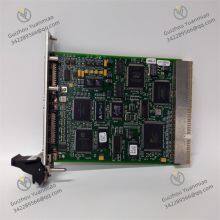
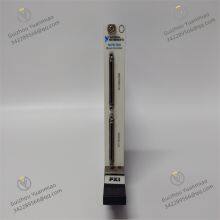
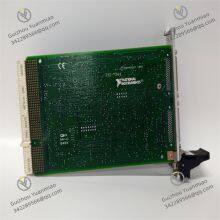
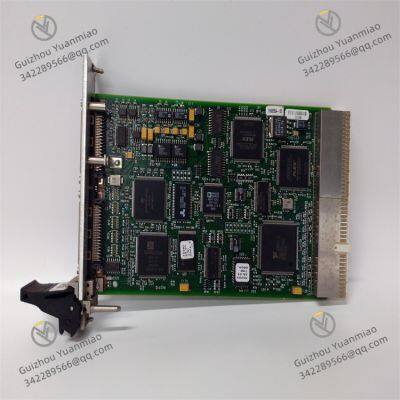
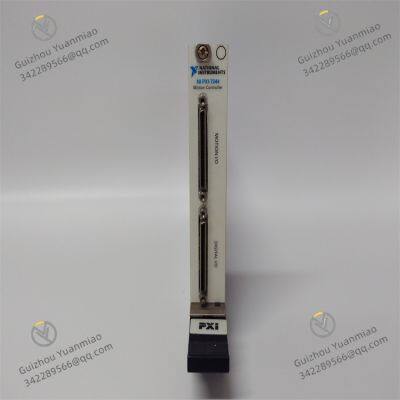
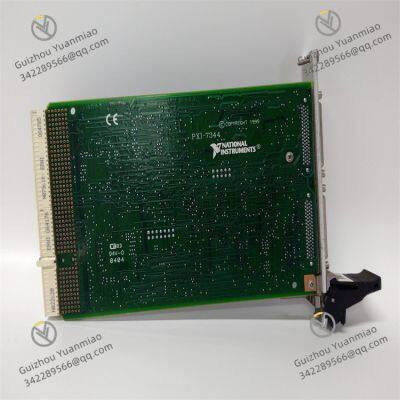
The NI PXI-7344 is a high-performance motion control module based on the PXI bus, specifically designed for multi-axis servo/stepper motor control, precision positioning systems, and automated production lines. Its core features include:
Multi-Axis Synchronous Control: Supports 4-axis independent or coordinated motion control, compatible with various motor types (e.g., DC servo, AC servo, stepper motors), suitable for complex trajectory planning scenarios.
High-Speed Real-Time Control: Built-in motion processor supporting microsecond-level instruction response, enabling advanced motion modes such as linear interpolation, circular interpolation, and spline curves.
Flexible Triggering and Feedback: Integrated encoder interfaces, limit switch inputs, and analog feedback channels, supporting hardware-triggered interrupts to ensure real-time performance and safety in motion control.
Open Programming Interface: Compatible with NI-Motion drivers and development platforms such as LabVIEW and C++, supporting custom motion algorithms and system integration.

II. Hardware Specifications and Technical Parameters
| Parameter Category | Specific Indicators |
|---|
| Control Axes | 4 axes (independent or coordinated control) |
| Motor Types | Servo motors (pulse + direction, analog voltage), stepper motors (pulse + direction) |
| Encoder Interface | Supports differential input (up to 10 MHz), resolution up to 24 bits (16 million pulses/revolution) |
| Output Signals | - Pulse frequency: Up to 8 MHz (stepper/servo pulse control) - Analog output: ±10 V (servo voltage control) |
| Input Signals | 8 digital inputs (limit switches, home position signals, etc.), supporting 5 V/24 V level compatibility |
| Motion Modes | - Point-to-point control, continuous trajectory control, linear interpolation, circular interpolation, electronic gearing - Supports S-curve acceleration/deceleration, custom acceleration/deceleration curves |
| Triggering & Synchronization | - Hardware trigger input/output (supports PXI trigger bus, external triggers) - Synchronized clock with other PXI modules (e.g., data acquisition cards) |
| Communication Interface | PXI 2.2 bus (32-bit/33 MHz PCI), maximum data transfer rate of 132 MB/s |
| Operating Environment | Temperature: 0°C~55°C, Humidity: 5%~95% (non-condensing) |
III. Typical Application Scenarios1. Semiconductor Wafer Inspection Platform
Scenario: Precision positioning for wafer probe stations, requiring 4-axis synchronous control to achieve nanometer-level movement accuracy.
Implementation: Utilize the circular interpolation function of the NI PXI-7344 to control X/Y-axis translation and θ-axis rotation, combined with Z-axis height adjustment, to drive the probe tip along the wafer surface trajectory with positioning error <1 μm.
2. 3C Product Automated Assembly Line
Scenario: Lamination process for smartphone screens and frames, requiring multi-axis coordinated motion for high-speed pick-and-place and precise alignment.
Implementation: Employ S-curve acceleration/deceleration mode to control robotic arm movement, provide real-time position feedback via encoders, and integrate with vision systems (e.g., NI PXI-1430 image acquisition card) for closed-loop correction, achieving lamination efficiency >200 cycles/minute.
3. Laser Processing Equipment
Scenario: Laser cutting path control for metal sheets, requiring real-time generation of complex curved trajectories.
Implementation: Precompute cutting paths using spline curve interpolation, drive servo motors with 8 MHz high-speed pulse output, and synchronize laser switching via hardware triggers to achieve cutting speeds >1000 mm/s with edge roughness <50 μm.

IV. Software Support and Programming Interfaces1. Drivers and Development Tools
NI-Motion Driver: Provides API functions for axis configuration, trajectory planning, and real-time status monitoring, compatible with development environments such as LabVIEW, Python, and C#.
LabVIEW Motion Control Module: Graphical programming interface supporting drag-and-drop motion process design, with built-in interpolation algorithm libraries and oscilloscope tools (real-time monitoring of position/velocity curves).
NI SoftMotion: Software motion controller suitable for complex multi-axis systems, supporting advanced functions such as electronic cams and virtual axes.
2. LabVIEW Programming Example (Pseudocode)
// 4-axis linear interpolation motion (from start to end) [Initialization] → Configure 4 axes in servo mode (analog output ±10 V), set encoder resolution to 16 million pulses/revolution → Define coordinate system origin and working range, enable hardware limit protection (input signals 1-8 correspond to axis limits) // Point-to-point motion (single-axis independent control) → Move Axis 0 to position 100 mm at 500 mm/s with S-curve acceleration/deceleration (acceleration 1000 mm/s²) → After Axis 0 reaches target position, start moving Axis 1 to position 50 mm (synchronized trigger) // Linear interpolation (4-axis coordinated motion) → Define start coordinates (0,0,0,0) and end coordinates (10,20,5,3) (unit: mm) → Generate interpolation trajectory at 300 mm/s, enable real-time encoder feedback correction → Read encoder position in real-time during motion (via DAQmx functions), display position deviation // Hardware-triggered interrupt (emergency stop) → Configure Digital Input 1 as emergency stop trigger source (rising edge active) → Immediately interrupt all motion upon trigger, output alarm signal (set Digital Output 0 high)
V. System Integration and Expansion Solutions1. Hardware Matching Recommendations
Servo Drives: Pair with NI PXI-4135 power supply module and third-party drives (e.g., Yaskawa, Mitsubishi), supporting analog (±10 V) or pulse (8 MHz) control modes.
Feedback Systems: Use high-precision linear encoders (e.g., Renishaw) or rotary encoders connected via the NI PXI-7344's differential interface to enhance position feedback accuracy.
Multi-Module Synchronization: Collaborate with the NI PXI-6683 timing module to synchronize multiple PXI-7344 modules via a 10 MHz clock, enabling coordinated motion for 8+ axes (e.g., multi-robot collaboration).
2. Performance Optimization Strategies
Real-Time Optimization: Deploy motion control programs using NI RT (Real-Time Operating System) to reduce system response latency (typical <100 μs).
Anti-Interference Design: Use shielded twisted-pair cables for encoder signals and separate routing for analog outputs and digital signals to avoid EMI affecting position feedback accuracy.

VI. Comparison with Similar Products
| Model | NI PXI-7344 | NI PXI-7354 | NI PXI-7390 |
|---|
| Control Axes | 4 axes | 8 axes | 16 axes (software motion control) |
| Max Pulse Frequency | 8 MHz | 20 MHz | 10 MHz |
| Interpolation Functions | Linear/circular/spline | Linear/circular/helical | Supports electronic cams |
| Core Advantage | Balanced multi-axis performance, cost-effective | High-speed pulse output, ideal for stepper motors | Software-defined motion, flexible expansion |
| Applications | Medium-precision multi-axis control (semiconductor, 3C) | High-speed pick-and-place (electronics assembly) | Complex multi-axis systems (robotics, laser processing) |