








 Contact Platform Support
 Help Center
Titanium Mesh-Plate Composite Sintered Diffusion Layer For PEM Electrolyzer



Related Products
-
 The Multi-layer Titanium Mesh Sintered Plates for ElectrolysisUS$ 5 - 100MOQ: 1 Piece
 -
1um Platinized Titanium Expanded Mesh For HT-PEMFCUS$ 5 - 100MOQ: 1 Piece
-
Titanium Electrodes for Wastewater TreatmentUS$ 20 - 50MOQ: 1 Piece
-
Titanium and Titanium Alloy BlockUS$ 10 - 1000MOQ: 1 Piece
-
Titanium FlangeUS$ 25 - 1000MOQ: 1 Piece
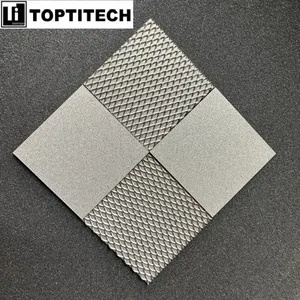
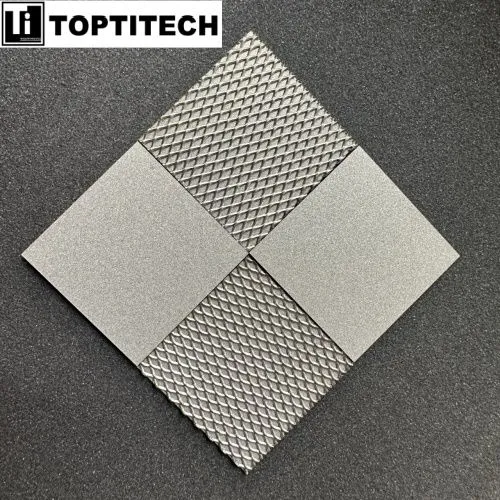
TOPTITECH's newly developed titanium mesh-plate composite sintered diffusion layer is a multifunctional integrated component specifically engineered for proton exchange membrane water electrolysis hydrogen production technology. Through high-temperature vacuum sintering, a 1.0mm thick titanium porous plate with 10-micron filtration accuracy is metallurgically bonded with a 1.0mm thick titanium expanded mesh featuring 3×6mm openings, forming a monolithic composite structure measuring 100×100mm with a total thickness of 2.0mm.
The porous plate undertakes precision gas-liquid distribution and particle interception through its uniform micron-sized pores, while the expanded mesh provides mechanical support and flow channels through its high-strength diamond lattice. The synergistic interaction sets new performance standards for diffusion layers in PEM electrolyzers.
Manufactured from high-purity Gr1 titanium through precision powder sintering and mesh-plate composite processes, this product establishes dual-function pathways with gradient structure. The porous layer facilitates timely detachment of hydrogen/oxygen bubbles from the catalyst surface, preventing gas accumulation; the expanded mesh layer enhances overall rigidity, maintaining dimensional stability and reliable contact throughout long-term operation, thereby improving electrolysis efficiency while significantly extending stack service life.
Material: Gr1 titanium
Size: 100*100*2.0mm
Ti porous plate pore size: 10 micron
Ti expanded mesh hole size: 3*6mm
Technique: sintering
Features
Synergistic Gradient Composite Architecture
Metallurgical integration of a 10-micron precision sintered porous plate with a 3×6mm expanded mesh creates a complete gradient pathway from micron-level filtration to millimeter-scale flow distribution. This design ensures fine distribution of reactants while providing macro-scale escape routes for gaseous and liquid products, eliminating transport bottlenecks common in single-pore-size structures.
Enhanced Mechanical Stability and Structural Rigidity
The 1.0mm titanium expanded mesh serving as a reinforcement framework significantly improves compressive strength compared to pure porous plates. During electrolyzer stack assembly and operation, it effectively resists compression deformation, maintaining consistent contact pressure between the diffusion layer, bipolar plates, and catalyst layer, ensuring uniform current distribution and long-term operational reliability.
Optimized Gas-Liquid Transport and Bubble Management
The porous layer's uniform 10-micron pore size facilitates stable gas-liquid interface formation at the catalyst surface, promoting bubble nucleation and detachment; the expanded mesh's open channels provide low-resistance escape pathways for detached bubbles, significantly reducing gas retention within the diffusion layer, thereby minimizing concentration polarization and enhancing limiting current density.
Environmental Durability from All-Titanium Monolithic Structure
The entire composite plate is fabricated from Gr1 pure titanium through high-temperature sintering without any organic binders or dissimilar metals. This construction delivers exceptional corrosion resistance in the high-oxidation-potential, strongly acidic environment of PEM electrolyzer anodes, while withstanding thermal cycling impacts from frequent start-stop operations, ensuring consistent stack performance over thousands of operating hours.
Applications
PEM Electrolyzer Anode Diffusion Layer
As the diffusion and transport medium on the oxygen evolution reaction side, its oxidation and acid resistance make it indispensable for anode applications. The 10-micron precision layer interfaces directly with the catalyst layer, ensuring uniform reactant supply; the expanded mesh layer contacts the bipolar plate flow field, promoting rapid oxygen release and efficient electron collection.
PEM Electrolyzer Cathode Diffusion Layer
On the hydrogen evolution side, this composite plate plays equally critical roles. The porous layer helps maintain optimal catalyst layer humidification, preventing drying; the expanded mesh structure ensures rapid hydrogen permeation and extraction, reducing diffusion overpotential and enhancing hydrogen production efficiency.
Electrode Support and Fluid Distribution Plate for Flow Batteries
In electrochemical energy storage systems such as vanadium redox flow batteries, this composite plate serves as electrode support and electrolyte distributor, leveraging its porous layer for uniform fluid distribution and mesh layer for enhanced flow guidance, improving power density and cycling stability.
Multifunctional Electrode Substrate for Electrochemical Sensors and Reactors
Combining filtration, distribution, electrical conductivity, and mechanical support functions, this material can be employed as catalyst support in micro-reactors, working electrode substrate in electrochemical sensors, or gas diffusion electrode in corrosive media, providing a reliable material platform for advanced electrochemical devices.

Send Inquiry to This Supplier


You May Also Like
-
Titanium ElectrodeUS$ 50 - 1000MOQ: 1 Piece
-
Titanium Processing PartsUS$ 20 - 1000MOQ: 1 Piece
-
Three Classifications of Metal-coated Titanium ElectrodesUS$ 50 - 1000MOQ: 1 Piece
-
TC4 Titanium Rod for AviationUS$ 10 - 100MOQ: 1 Piece
-
Titanium Sintered Porous GetterUS$ 5 - 10MOQ: 1 Piece
-
Industrial Pure Titanium TubeUS$ 5 - 10MOQ: 1 Piece
-
Titanium MeshUS$ 5 - 100MOQ: 1 Piece
-
DSA Titanium Electrode for WatertreatmentUS$ 5 - 100MOQ: 1 Piece
-
Sintered Titanium Felt for LGDLUS$ 10 - 100MOQ: 1 Piece
-
Customized Titanium Fiber Felt for Fuel CellUS$ 10 - 100MOQ: 1 Piece


