








 Contact Platform Support
 Help Center
1um Platinized Titanium Expanded Mesh For HT-PEMFC



Related Products
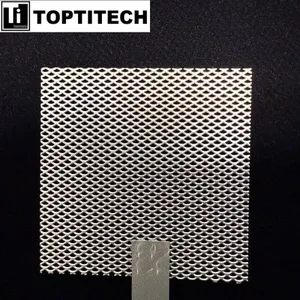
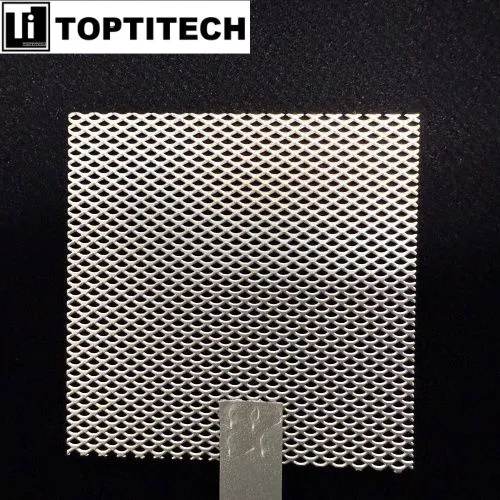
TOPTITECH's 1µm Platinized Titanium Expanded Mesh for HT-PEMFC starts with flattened and annealed ASTM B265 CP-Ti expanded mesh, then receives a controlled platinum coating at approximately 1µm thickness. This platinized titanium mesh functions as the anode-side gas diffusion layer (GDL) in high-temperature proton exchange membrane fuel cells. Carbon-based GDL materials oxidize under high anodic potential and oxygen evolution reaction (OER) conditions, converting to CO₂ and degrading stack compression and contact resistance. Bare titanium avoids carbon consumption but grows a passive TiO₂ layer that raises interfacial resistance. The platinum layer blocks TiO₂ formation while preserving surface conductivity at typical HT-PEMFC operating temperatures (120–200°C).
TOPTITECH's 1µm Platinized Titanium Expanded Mesh for HT-PEMFC provides the open diamond-shaped structure needed for uniform gas distribution and water management. Expanded mesh delivers higher mechanical integrity than woven mesh, with strands integrated into a continuous sheet without welded intersections. The flattened profile minimizes membrane puncture risk and ensures consistent contact pressure across the electrode assembly. Titanium delivers corrosion resistance in phosphoric acid-doped PBI membrane environments where stainless steel or nickel alloys degrade. The 1µm coating thickness balances conductivity and cost: thinner coatings lose protection, thicker ones add expense without performance gain.
Specifications
Material: GR1 titanium
Pore size: 2*3mm
Thickness: 0.5mm
Size: 55*55mm
Coating: 1um Platinum coating
Features
Prevents TiO₂ Passivation Layer Formation – Uncoated titanium exposed to high anodic potential and oxygen-rich environment develops insulating TiO₂ layer on fiber surface, progressively elevating interfacial contact resistance (ICR) and degrading cell performance. 1µm Platinized Titanium Expanded Mesh For HT-PEMFC blocks TiO₂ growth while preserving substrate conductivity at HT-PEMFC operating temperatures (120–200°C).
Eliminates Carbon GDL Oxidation Failure – Carbon-based gas diffusion layers (carbon paper/carbon cloth) undergo thermodynamically driven oxidation on the anode side: C + O²⁻ → CO₂↑, causing rapid consumption, loss of compression integrity, and irreversible stack resistance increase. 1µm Platinized Titanium Expanded Mesh For HT-PEMFC delivers carbon-free operation without corrosion or material depletion.
Delivers Expanded Mesh Structural Integrity – Expanded metal fabrication produces diamond-shaped openings with strands and nodes integrated into continuous sheet without welded intersections, delivering superior mechanical stability under stack compression compared to woven mesh alternatives. Flattened and annealed surface profile minimizes membrane puncture risk and ensures consistent contact pressure across MEA.
Maximizes Mass Transfer and Gas Distribution – Open diamond-shaped pore structure enables uniform hydrogen and reactant gas distribution across electrode active area while facilitating rapid water removal from cathode side, preventing local flooding under high-current-density HT-PEMFC operation.
Ensures Acidic Environment Compatibility – Grade 1 CP-Ti substrate combined with platinum coating withstands phosphoric acid-doped PBI membrane environment where stainless steel or nickel alloys suffer pitting corrosion or dissolution. Natural TiO₂ passive layer on titanium combined with Pt surface layer delivers dual corrosion protection in aggressive HT-PEMFC operating conditions.
Supports High-Temperature Operation – Titanium base material maintains strength and dimensional stability across HT-PEMFC operating temperature window (120–200°C), unlike carbon GDLs which degrade or polymer electrolyte membranes which soften under combined thermal and oxidative stress. 1µm Platinized Titanium Expanded Mesh For HT-PEMFC retains mechanical integrity and electrical continuity without creep or deformation.
Applications
Anode-side gas diffusion layer (GDL) in phosphoric acid-doped PBI membrane systems – HT-PEMFCs operating at 120–200°C typically use polybenzimidazole membranes doped with phosphoric acid as the proton-conducting electrolyte. The 1µm platinized titanium expanded mesh replaces conventional carbon-based GDLs which oxidize to CO₂ under high anodic potential and oxygen evolution reaction conditions, while untreated titanium grows insulating TiO₂ that elevates interfacial contact resistance. The platinum coating blocks TiO₂ formation and maintains stable electrical conductivity across the MEA.
Current collector and flow field distributor in off-grid CHP systems – HT-PEMFC generators used in combined heat and power applications recover waste heat for residential heating or hot water supply. The open diamond-shaped expanded mesh structure of 1µm platinized titanium expanded mesh distributes reformate gas uniformly across the electrode active area while enabling efficient water vapor removal, which is critical since HT-PEMFCs produce gaseous water requiring no separate humidification system.
PTL (porous transport layer) in aviation fuel cell stacks – The aviation sector requires HT-PEMFCs with simplified water management and lower system weight. 1µm platinized titanium expanded mesh functions as a porous transport layer between the catalyst layer and bipolar plate, offering the highest strength-to-weight ratio of any metal combined with titanium's corrosion resistance in the acidic operating environment, without the durability limitations of carbon-based materials.
Anode-side diffusion medium for heavy-duty vehicle power systems – HT-PEMFCs are being developed for medium-to-long-haul heavy trucks and marine auxiliary power units where fuel flexibility (methanol, LNG, diesel after reforming) and CO tolerance are essential. The flattened and annealed surface profile of 1µm platinized titanium expanded mesh ensures consistent contact pressure across the cell, preventing membrane puncture while facilitating uniform hydrogen distribution under high-current-density operation.
Electrode support structure in stationary power generation – Fixed power plants employing HT-PEMFC technology for baseload electricity generation require thousands of operational hours with minimal degradation. 1µm platinized titanium expanded mesh serves as a dimensionally stable electrode support, with the 1µm platinum coating at 60–80 µg/cm² loading protecting the CP-Ti substrate from passivation in the oxidizing anode environment while preserving the open porosity needed for gas diffusion.
Flow field plate component for methanol reformate-fueled HT-PEMFCs – HT-PEMFC systems running on hydrogen produced from methanol reforming tolerate CO concentrations up to 3% without significant performance loss. The expanded titanium mesh structure can be integrated into composite bipolar plates alongside titanium sheets, delivering the mechanical support and current conduction needed for reformate operation while the platinum coating maintains interfacial conductivity under prolonged exposure to trace impurities.
Why not use a Carbon based Gas Diffusion Layer in an Electrolyzer?
Carbon-based Gas Diffusion Layers (GDLs) are electrochemically incompatible with the anode side of an electrolyzer. Under anodic polarization and oxygen evolution reaction (OER) conditions, carbon thermodynamically oxidizes to carbonate ions (in alkaline media) or directly to CO₂ gas (in acidic media), depending on the local pH environment of the membrane electrode assembly. This oxidation—often referred to as carbon corrosion reaction (COR)—generates a false, short-lived drop in cell voltage. The carbon GDL then rapidly depletes, leaving a physical gap and causing poor stack compression, which drives up electrical contact resistance and permanently lowers electrolysis performance. For this reason, carbon-based GDLs are not suitable for the anode side, although carbon cloth or carbon paper may still be used on the cathode side where no oxygen evolution occurs and carbon remains stable.

Send Inquiry to This Supplier


You May Also Like
-
 Three Classifications of Metal-coated Titanium ElectrodesUS$ 50 - 1000MOQ: 1 Piece
 -
TC4 Titanium Rod for AviationUS$ 10 - 100MOQ: 1 Piece
-
Titanium Sintered Porous GetterUS$ 5 - 10MOQ: 1 Piece
-
Industrial Pure Titanium TubeUS$ 5 - 10MOQ: 1 Piece
-
Titanium MeshUS$ 5 - 100MOQ: 1 Piece
-
DSA Titanium Electrode for WatertreatmentUS$ 5 - 100MOQ: 1 Piece
-
Sintered Titanium Felt for LGDLUS$ 10 - 100MOQ: 1 Piece
-
Customized Titanium Fiber Felt for Fuel CellUS$ 10 - 100MOQ: 1 Piece
-
Ti-Based Gas Diffusion Layer Anode Titanium GDLUS$ 5 - 100MOQ: 1 Piece
-
0.4mm Ti Felt for LGDL in PEM ElectrolyzerUS$ 10 - 100MOQ: 1 Piece


