








 Contact Platform Support
 Help Center
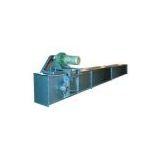
Drag Conveyor
Negotiable
MOQ: 1 Piece (Price negotiable depending on order volume and customization)
Key Specifications
Get Latest Price
Brand Name:
YINGCHUN
Place of Origin:
China
Model Number:
MS

Payment & Shipping
Payment Methods:


Port of Shipment:
China
Delivery Detail:
7 days
Related Products
Brand Name
YINGCHUN
Place of Origin
China
Model Number
MS
Ⅰ. Use and Performance & Character of Drag Conveyor
MS series Drag Conveyor is a continuous horizontal transportation equipment. It is applied to transport powder, small particles and other bulk materials. With small size, high efficiency, low noise, sealing, and install & maintain easily, MS series Drag Conveyor can highly improve labor intensity and prevent environment pollution. So it is widely used in oil, feed, chemicals, port and other industries.
Ⅱ. Structural Outline of Drag Conveyor
Drag Conveyor is made up of head, trough, trail, transmission device, chains and so on.
1. Head: Power from reducer spreads to the head-wheel axle by the chain. And at the bottom of the head is the discharging hole.
2. The trough is welded by forged steel plate and angle iron, which has good strength and tightness. The upper and bottom of the trough can set several loading and discharging holes according to the technical requirements.
3. Trail: Tensioning screw, installed on both sides, is used to adjust the tension of the chain.
4. The chain adopts manganese steel, and rollaway nest is made by macro-molecule wear resistant material, which can eliminate noise, reduce power consumption and prolong life span.
Ⅲ. Technical Requirements for Installation of Drag Conveyor
1. Requirements
The machine should be connected with foundation tightly. Unit assembling requires that linearity error is not more than 10 mm and the parallel error of the head and trail axletree is not more than 1.5 mm. The joint of inner face of the trough should be even. There must be enough regulation space for the guide screw of the trail after assembling the flight chain.
2. Check up before starting
(1) Transmission chain with appropriate tension
(2) Correct circuit connections
(3) Reducer refueling according to the regulations
(4) Check up the connection of the chain
3. Commissioning
(1) Ensure the direction of motor rotation is correct before commissioning because a reverse direction of the motor will damage the equipment.
(2) No-load running to check and ensure the chain work smoothly and not touch the trough.
(3) Ensure the reducer, chain, axletree and other parts normal are not leaking oil or hear abnormal noise.
(4) If there is no problem after half hour continuous no-load running, you can make loading operation gradually and then work the full capacity after the final confirmation of all parts are normal.
Ⅳ. Operation Notandum
1. Wire-mesh grille is set up at the inflowing hole to prevent rope, thread and stones or other impurities entering into the machine. Strobe is set to control the flow capacity.
2. Loading stop is not allowed. In case of an emergency or power out, close the feeding hole immediately, and remove the grain left in the trough before restart.
3. No stopping before discharging the grain in trough totally.
4. Open the trough to check the chain and the connect device frequently at the usual time. Replace the wearing parts with new one immediately. When no adjustable space left for the tensioning screw, you should cut the chain at least two joints.
MS series Drag Conveyor is a continuous horizontal transportation equipment. It is applied to transport powder, small particles and other bulk materials. With small size, high efficiency, low noise, sealing, and install & maintain easily, MS series Drag Conveyor can highly improve labor intensity and prevent environment pollution. So it is widely used in oil, feed, chemicals, port and other industries.
Ⅱ. Structural Outline of Drag Conveyor
Drag Conveyor is made up of head, trough, trail, transmission device, chains and so on.
1. Head: Power from reducer spreads to the head-wheel axle by the chain. And at the bottom of the head is the discharging hole.
2. The trough is welded by forged steel plate and angle iron, which has good strength and tightness. The upper and bottom of the trough can set several loading and discharging holes according to the technical requirements.
3. Trail: Tensioning screw, installed on both sides, is used to adjust the tension of the chain.
4. The chain adopts manganese steel, and rollaway nest is made by macro-molecule wear resistant material, which can eliminate noise, reduce power consumption and prolong life span.
Ⅲ. Technical Requirements for Installation of Drag Conveyor
1. Requirements
The machine should be connected with foundation tightly. Unit assembling requires that linearity error is not more than 10 mm and the parallel error of the head and trail axletree is not more than 1.5 mm. The joint of inner face of the trough should be even. There must be enough regulation space for the guide screw of the trail after assembling the flight chain.
2. Check up before starting
(1) Transmission chain with appropriate tension
(2) Correct circuit connections
(3) Reducer refueling according to the regulations
(4) Check up the connection of the chain
3. Commissioning
(1) Ensure the direction of motor rotation is correct before commissioning because a reverse direction of the motor will damage the equipment.
(2) No-load running to check and ensure the chain work smoothly and not touch the trough.
(3) Ensure the reducer, chain, axletree and other parts normal are not leaking oil or hear abnormal noise.
(4) If there is no problem after half hour continuous no-load running, you can make loading operation gradually and then work the full capacity after the final confirmation of all parts are normal.
Ⅳ. Operation Notandum
1. Wire-mesh grille is set up at the inflowing hole to prevent rope, thread and stones or other impurities entering into the machine. Strobe is set to control the flow capacity.
2. Loading stop is not allowed. In case of an emergency or power out, close the feeding hole immediately, and remove the grain left in the trough before restart.
3. No stopping before discharging the grain in trough totally.
4. Open the trough to check the chain and the connect device frequently at the usual time. Replace the wearing parts with new one immediately. When no adjustable space left for the tensioning screw, you should cut the chain at least two joints.

Send Inquiry to This Supplier

* Email
Want the best price?
Post an RFQ now!
Business Type
Trading Company
Year Established
2008
Total Employees
101 - 200 People
Main Markets
North America, South America, Eastern Europe
You May Also Like
-
 Saimo Tilt Switch Model PLR30M-G(SL20) and Controller PLR38(SL28) and PLR39(SL29)NegotiableMOQ: 1 Piece
 -
Changyun Technology Small Cable Laying Machine With Automatic Alignment for 5-50mm Cable DiameterUS$ 2300 - 2500MOQ: 1 Combo
-
Vehicle Mounted Electric Grain Suction Machine for Individual UseUS$ 490 - 1,500MOQ: 1 Set
-
Used for Oilfield Drilling Waste Screw Auger ConveyorNegotiableMOQ: 1 Set
-
Coal Mining Conveyor With ISO BV Certificates And Best PriceUS$ 1,200 - 24,000MOQ: 1 Set
-
24V LiFePO4 Battery for AGV 60Ah, 48V100AhNegotiableMOQ: 1 Piece
-
Reliable Quality v Belt Conveyor With Iron Remover RCYB-8US$ 2,000 - 4,000MOQ: 1 Set
-
Scooter Assembly Conveyor Line / Production LineUS$ 1,000 - 1,000,000MOQ: 1 Set
-
Used Rubber Conveyor Belt PriceUS$ 100 - 500MOQ: 1 Set
-
Henan Standard Spiral ElevatorUS$ 999 - 3,999MOQ: 1 Set


