








 Contact Platform Support
 Help Center
MVR Evaporator for Smelting Wastewater Treatment



Related Products
-
 MVR Evaporator for Landfill Leachate TreatmentNegotiableMOQ: 1 Set
 -
MVR Evaporator for Dyeing Wastewater TreatmentNegotiableMOQ: 1 Set
-
MVR (Mechanical Vapor Recompression) Evaporator for Ammonium Chloride CrystallizationNegotiableMOQ: 1 Set
-
MVR (Mechanical Vapor Recompression) Evaporator for Amino Acid ConcentrationNegotiableMOQ: 1 Set
-
MVR (Mechanical Vapor Recompression) Evaporator for Landfill Leachate TreatmentNegotiableMOQ: 1 Set
Project Overview
Smelting wastewater typically contains high concentrations of dissolved salts, primarily sodium chloride and sodium sulfate, making conventional wastewater treatment both energy-intensive and challenging. Our Mechanical Vapor Recompression (MVR) evaporation system provides an efficient solution for concentrating high-salinity wastewater while recovering valuable salt crystals and significantly reducing wastewater volume.
By recycling the secondary vapor generated during evaporation, the MVR system minimizes fresh steam consumption, resulting in lower operating costs and improved energy efficiency.
Process Solution
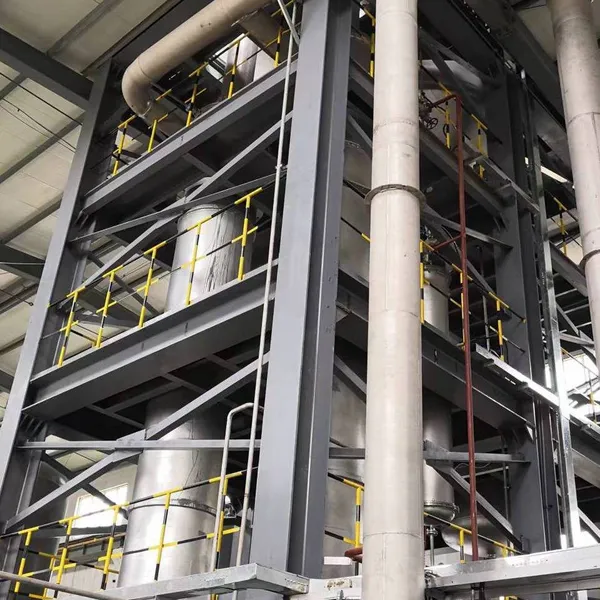
Our solution combines MVR technology with a forced circulation evaporator, ensuring stable and reliable operation when treating high-salinity smelting wastewater.
The wastewater is continuously concentrated to a supersaturated condition within the forced circulation evaporator. The concentrated slurry is then transferred to a centrifuge for solid-liquid separation, where salt crystals are recovered for disposal or potential reuse. The separated mother liquor is returned to the evaporator for further concentration, forming a continuous closed-loop process.
The secondary vapor generated during evaporation is compressed by the MVR compressor and reused as the heating source for the evaporator, significantly reducing external steam demand and overall energy consumption.
System Features
High Energy Efficiency
The MVR system fully recovers and reuses secondary vapor as the heating medium, greatly reducing steam consumption and lowering operating costs compared with conventional evaporation technologies.
Reliable Treatment of High-Salinity Wastewater
The forced circulation design effectively handles wastewater with high concentrations of dissolved salts while minimizing the risks of scaling and heat exchanger tube blockage. This ensures stable long-term operation with reduced maintenance requirements.
Continuous Salt Recovery
The system concentrates wastewater to a supersaturated state, allowing salt crystals to be separated by centrifugation. The mother liquor is recycled back to the evaporator for continuous concentration, maximizing salt recovery and minimizing wastewater discharge.
Intelligent Automatic Control
A DCS (Distributed Control System) provides automatic operation, real-time monitoring, and stable process control, ensuring safe and reliable plant operation.
Typical System Configuration
Our MVR Evaporator system for smelting wastewater treatment typically includes:
One set of forced circulation evaporator
One set of Mechanical Vapor Recompression (MVR) unit
One set of Preheater system
One set of vapor-liquid separator with high-efficiency demister
One set of centrifuge for crystal separation
One set of DCS automatic control system
Key Advantages
Low energy consumption through MVR technology
Suitable for high-salinity smelting wastewater
Continuous salt crystallization and recovery
Reduced scaling and fouling
Stable and reliable continuous operation
Lower maintenance requirements
Automated process control
Reduced operating costs and environmental impact

Send Inquiry to This Supplier


You May Also Like
-
MVR (Mechanical Vapor Recompression) Evaporator for Metallurgical Wastewater TreatmentNegotiableMOQ: 1 Set
-
MVR (Mechanical Vapor Recompression) Evaporator for Sodium Sulfate CrystallizationNegotiableMOQ: 1 Set
-
MVR (Mechanical Vapor Recompression) Evaporator for Sodium ChlorideNegotiableMOQ: 1 Set
-
MVR Evaporator for Ammonium Sulfate WastewaterNegotiableMOQ: 1 Set
-
MVR Evaporator for Sodium Sulfate WastewaterNegotiableMOQ: 1 Set
-
MVR Evaporator for Extract ConcentrationNegotiableMOQ: 1 Set
-
MVR Evaporator for Sodium Sulfate Wastewater TreatmentNegotiableMOQ: 1 Set
-
MVR Distillation TechnologyNegotiableMOQ: 1 Set
-
Potassium-Sodium Separation EvaporatorNegotiableMOQ: 1 Set
-
Anhydrous Calcium Chloride Granulation & Drying SystemNegotiableMOQ: 1 Set

