








 Contact Platform Support
 Help Center
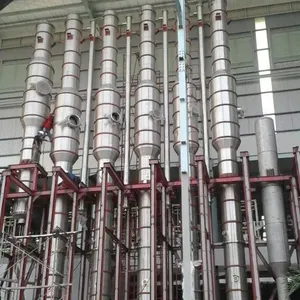
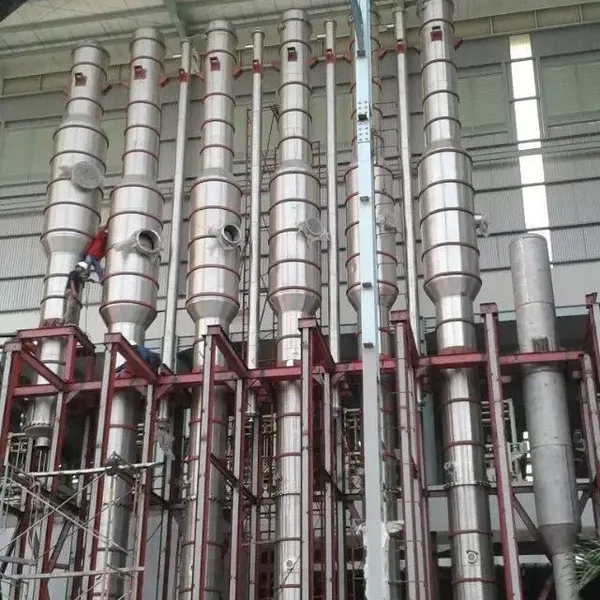
Five-effect Evaporator



Related Products
-
 Tubular Falling Film EvaporatorNegotiableMOQ: 1 Set
 -
Mutiple-effect Forced Circulation EvaporatorNegotiableMOQ: 1 Set
-
Triple-effect Evaporating Crystalizer for Inorganic Salt ProductionNegotiableMOQ: 1 Set
-
Falling Film Evaporator With Molten Salt System for Caustic Soda 50% - 99% ConcentrationNegotiableMOQ: 1 Set
-
Triple-effect Forced Circulation Evaporator for Calcium Chloride ConcentrationNegotiableMOQ: 1 Set
What Is a Five-Effect Evaporator?
Evaporation is a thermal separation process widely used in industry to remove a solvent, typically water, from a solution or slurry, thereby increasing the concentration of the desired product.
A multiple-effect evaporator improves energy efficiency by utilizing the secondary vapor generated in one effect as the heating medium for the next effect. This cascading use of vapor significantly reduces live steam consumption while maintaining continuous evaporation.
A five-effect evaporator is specifically designed to maximize the utilization of secondary steam throughout the evaporation process. By reusing the vapor generated in each effect as the heating source for the subsequent effect, the system greatly reduces external steam demand and operating costs while delivering high evaporation efficiency.
Working Principle
The process begins with the feed entering the first effect, where it is heated by live steam. As the solution boils, secondary vapor is generated and directed to the second effect as its heating medium.
Each subsequent effect operates at a progressively lower pressure and boiling temperature than the previous one. This pressure gradient allows the secondary vapor from one effect to provide sufficient heat for the next, enabling efficient heat recovery throughout the system.
The process continues through all five effects, with each stage making effective use of the residual thermal energy from the preceding stage. As a result, a five-effect evaporator requires only a fraction of the live steam needed by a single-effect evaporator while achieving the same evaporation duty.
System Configuration
A typical five-effect evaporator consists of:
Five evaporator effects connected in series
A condenser
A vacuum system
Feed and discharge pumps
Heat exchangers
Instrumentation and automatic control system
Other auxiliary equipment
The system operates continuously with continuous feed and discharge, ensuring stable production and high operating efficiency.
Depending on the process requirements, the evaporator can also be integrated with various types of separators and crystallizers to perform both concentration and crystallization. This flexible configuration makes it suitable for processing a wide variety of products across different industries.
Applications
Thanks to its excellent energy efficiency, operational flexibility, and scalability, the five-effect evaporator is widely used in many industries, including:
Desalination: Concentration of seawater and production of fresh water.
Food and Beverage: Concentration of fruit juices, dairy products, sweeteners, extracts, and other food ingredients.
Chemical Industry: Concentration of chemical solutions, recovery of solvents, and industrial wastewater treatment.
Pharmaceutical Industry: Concentration of pharmaceutical intermediates and medicinal solutions.
Environmental Protection: Treatment of industrial wastewater from chemical, pharmaceutical, metallurgical, mining, petrochemical, rare earth, lithium battery, and hazardous waste industries.
With customized process design, a five-effect evaporator can be tailored to meet the specific requirements of different products and production processes.
Energy Consumption
One of the greatest advantages of a five-effect evaporator is its outstanding energy efficiency.
Typically, a five-effect evaporator consumes only 0.25–0.30 tons of live steam per ton of water evaporated, compared with approximately 1.1–1.2 tons of steam per ton of water evaporated for a conventional single-effect evaporator.
This substantial reduction in steam consumption translates directly into lower operating costs and reduced environmental impact.
Design Considerations
Each evaporation application has unique process requirements. When designing a five-effect evaporator, our engineering team carefully evaluates factors such as:
Product characteristics and heat sensitivity
Required evaporation capacity and concentration ratio
Heat recovery and energy optimization
Selection of suitable evaporation technology (falling film, rising film, forced circulation, or natural circulation)
Fouling tendency and the need for automatic CIP (Clean-in-Place) systems
Process automation, operational flexibility, and maintenance requirements
Based on these considerations, we provide customized solutions that maximize efficiency, reliability, and long-term operating performance.
If you have any requirements for evaporation, concentration, or crystallization systems, please feel free to contact us. Our engineering team will be pleased to provide a customized solution tailored to your specific process needs.

Send Inquiry to This Supplier


You May Also Like
-
Triple-effect Forced Circulation Evaporator for Industrial Wastewater TreatmentNegotiableMOQ: 1 Set
-
Double-effect Forced Circulation Evaporator for Crystallization of Inorganic SaltNegotiableMOQ: 1 Set
-
Multiple-effect Crystallization Evaporator for Wastewater DesalinationNegotiableMOQ: 1 Set
-
Triple-effect Falling Film Evaporator for Sodium SulphideNegotiableMOQ: 1 Set
-
Five-effect Falling Film Evaporator for Glucose ConcentrationNegotiableMOQ: 1 Set
-
TVR (Thermal Vapor Recompression) Evaporator for Evaporation and ConcentrationNegotiableMOQ: 1 Set
-
Double-effect Forced Circulation Evaporator for Electroplating Effluent TreatmentNegotiableMOQ: 1 Set
-
Multiple-effect TVR (Thermal Vapor Recompression) Evaporator for Juice ConcentrationNegotiableMOQ: 1 Set
-
Triple-effect Forced Circulation Evaporator for Sulphate Salts CrystallizationNegotiableMOQ: 1 Set
-
Triple-effect Forced Circulation Evaporator for Flue Gas Wastewater TreatmentNegotiableMOQ: 1 Set

