








 Contact Platform Support
 Help Center
Clinical Diagnostic Lab Bench — Steel Frame With Chemical Resistant Worktop for Hospitals
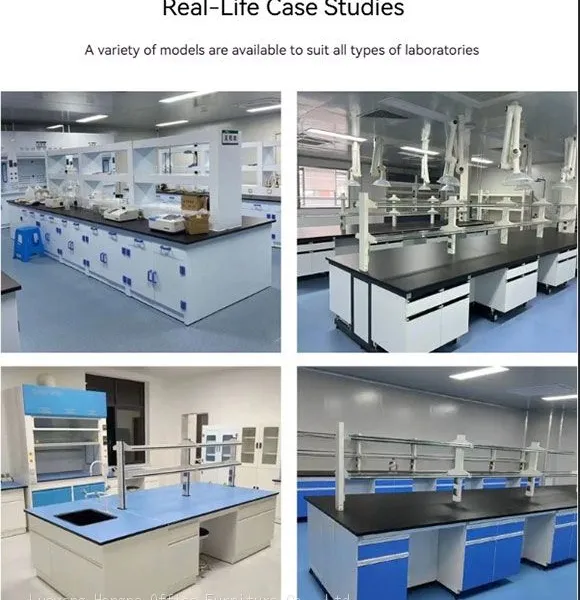
Product Spotlights



Related Products
-
 Custom Lab Bench Manufacturer — OEM Steel-Wood Workbenches With CE CertificateUS$ 200 - 800MOQ: 3 Sets
 -
Chemical Resistant Lab Bench — 19mm Phenolic Resin Top & Cold-Rolled Steel FrameUS$ 200 - 800MOQ: 3 Sets
-
Laboratory Wax Block Cabinet QST-LK53 Microscope Slides 72 Drawers CabinetNegotiableMOQ: 10 Pieces
-
11000 Tissue Blocks Cold-roll Steel Paraffin Block Cabinet Lab - Grade Wax Block CabinetNegotiableMOQ: 10 Pieces
-
Microscope Slides Slide Drying Cabinet With Numbered Labels Compact Wax Block CabinetNegotiableMOQ: 10 Pieces
Clinical Diagnostic Lab Bench — Steel Frame with Chemical Resistant Worktop for Hospitals
Hospital clinical labs are nothing like research labs. The bench gets used harder, cleaned more often, and has to pass infection control — every single day.
Walk into a hospital clinical lab at 3 PM. Every bench is occupied. Technicians processing blood samples, running urine analyses, preparing slides for microbiology. The work surface has been wiped down with alcohol and bleach a dozen times since morning. By the end of the week, a cheap top starts showing wear. By the end of the year, it needs replacing.
That's the problem with most lab benches sold to hospitals — they're designed for university research labs where one grad student works at a bench for a few hours a day. A hospital clinical lab is different traffic. More samples, more staff, more cleaning cycles, more chemicals.
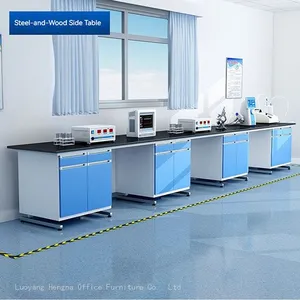
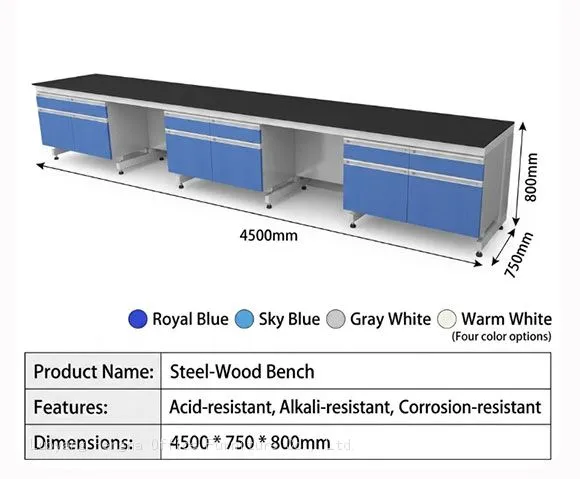
This clinical diagnostic lab bench is built for that traffic. Cold-rolled steel frame for durability. Solid phenolic resin worktop — resistant to the disinfectants and reagents that a hospital lab throws at it every day.
The Worktop: This Is What "Chemical Resistant" Actually Means
The top on this bench is 19mm solid phenolic resin. Not laminate. Not high-pressure laminate. Solid phenolic — one homogeneous slab from top to bottom.
Here's why that matters in a clinical lab:
Hospital labs use aggressive disinfectants. 70% ethanol, 10% bleach, quaternary ammonium compounds, peracetic acid. These are standard. They kill pathogens. They also attack cheap work surfaces. Laminate tops bubble at the edges after repeated bleach exposure. The glue that holds the laminate to the core breaks down. The surface delaminates.
Solid phenolic resin doesn't have a separate surface layer to delaminate. It's the same material all the way through. Bleach doesn't attack it. Alcohol doesn't swell it. Blood or urine spills won't stain it.
Infection control requires seamless surfaces. Any gap, any edge that isn't sealed, any porous spot — that's where pathogens hide. Solid phenolic can be installed with sealed joints. The surface is non-porous. Wipe it down and it's clean — no microscopic crevices for bacteria to survive.
The worktop is 19mm thick. You'll find 12mm and 16mm phenolic tops on the market. They're cheaper. But in a hospital lab where the bench takes daily instrument loads — centrifuges, analyzers, microscopes, automated stainers — 12mm flexes over time. 19mm stays flat. Thicker edges also mean better resistance to chipping when glassware or metal trays get set down hard.
The Frame: 1.2mm Cold-Rolled Steel, Welded and Coated
Hospital lab benches get bumped. Carts roll into them. Technicians lean on them while pipetting. The frame needs to take that abuse without wobbling.
The understructure is welded 1.2mm cold-rolled steel. Not bolted. Welded. A bolted frame will loosen over time in a high-use environment — the screws back out from vibration and impact. A welded frame doesn't. It stays rigid.
Surface protection is two-stage: phosphate pretreatment, then electrostatic powder coating. Wet paint wouldn't last six months in a hospital environment where the bench is wiped down with disinfectants daily. The chemicals would eat through it. Powder coating is chemically resistant. It bonds to the steel at a molecular level — scrubbing won't take it off.
Frame colors: white or light grey. These are standard in hospital labs. They reflect light, keep the room bright, and make contamination visible during inspection. Dark colors hide dirt — that's the last thing an infection control officer wants.
Casework and Storage
The cabinet bodies are cold-rolled steel, same as the frame. Interior surfaces are clean — no exposed screw heads, no raw MDF edges. Every adjustment hole in the cabinet interior is capped. No dead spaces where dust and biological residue can accumulate.
Drawers run on three-section ball-bearing slides, rated for heavy daily use. Pull out fully. Can be dismantled for cleaning. Drawer fronts are flush — no protruding handles that snag on lab coats passing by. Instead, recessed handles or D-handles.
Cabinet doors close with magnetic catches. Gaps are tight. When the lab is running PCR or handling infectious samples, a cabinet that doesn't seal properly is an infection risk.
Drawers and doors can be fitted with locks — required when storing controls, reagents, or patient samples under restricted access.
Sizing and Configuration
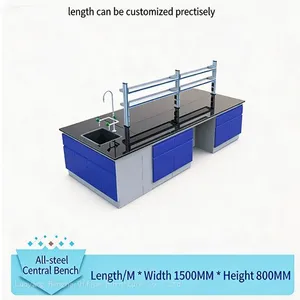
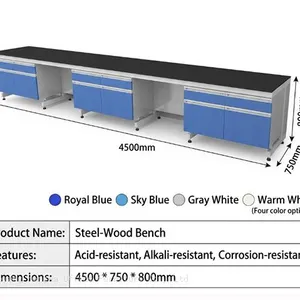
Standard widths run from 1000mm to 4500mm. Depth is 750mm. Height is 800mm — the standard seated working height for most clinical lab tasks.
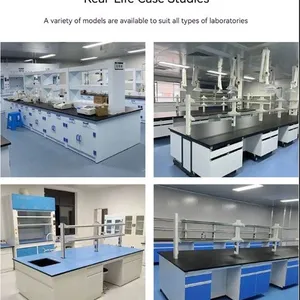
Hospital labs typically need a mix:
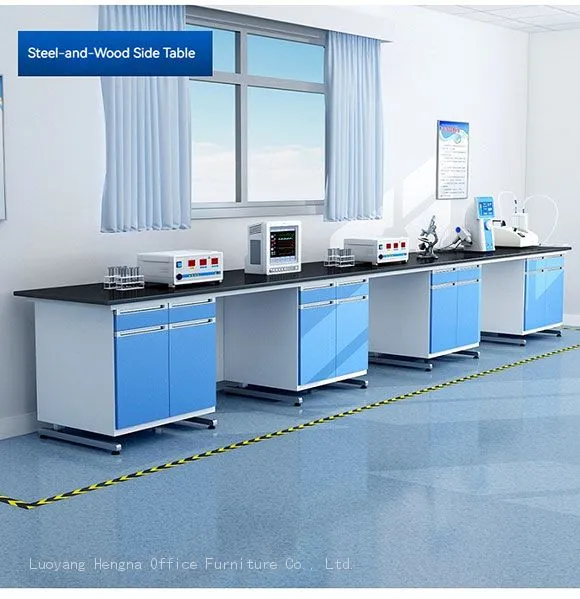
Wall benches along the perimeter for routine processing
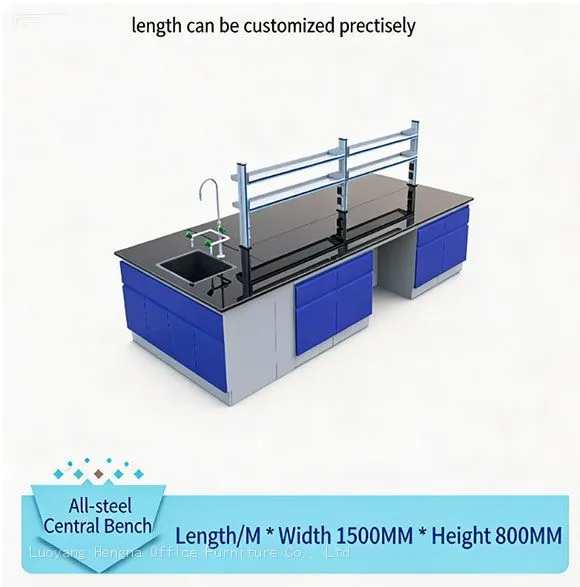
Island benches in the center of the room for shared equipment
Corner units for L-shaped layouts
All of these are available. If your floor plan is irregular, custom sizing is standard for us — we don't charge extra just because you need a 2200mm bench instead of a 2000mm.
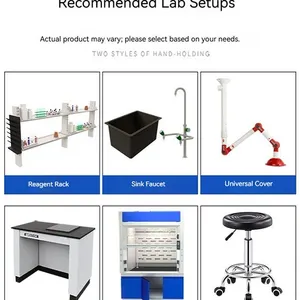
Sinks and Plumbing (Optional)
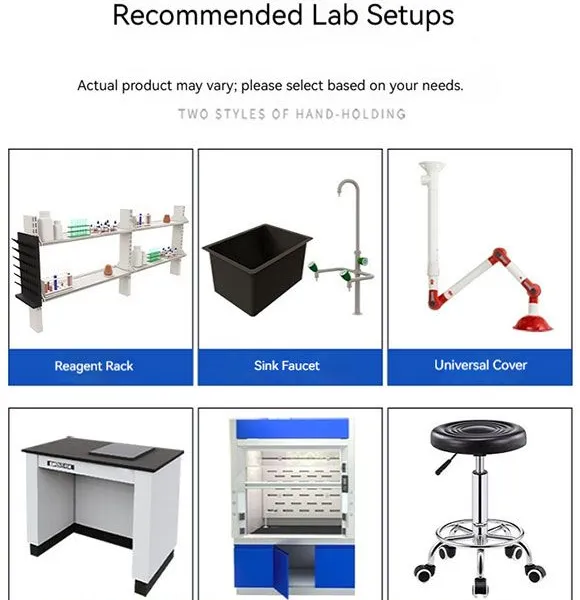
PP sinks are available. Polypropylene handles hospital-grade disinfectants and biological waste better than stainless steel — stainless steel can pit over time when exposed to bleach repeatedly.
The gooseneck faucet has a curved spout that keeps water from splashing when technicians wash sample containers. The pipe chase behind the sink is fully enclosed — no exposed plumbing where dust or biological material can settle.
Why Hospital Buyers Choose This Bench
Chemical resistant worktop — 19mm solid phenolic resin. Handles daily disinfection without degrading. Non-porous, easy to clean, infection-control friendly.
Steel frame — 1.2mm cold-rolled steel, welded construction. Built for high-traffic labs that see daily use year after year.
Clean design — no exposed MDF, capped screw holes, flush drawer fronts. No places for contamination to hide.
Custom and OEM — dimensions, colors, sink configurations, lock systems, logo printing. Everything configurable. If you're a hospital project contractor, this is the supply partner you need.
CE certified — meets applicable European safety standards for laboratory furniture.
24-hour quoting — send your floor plan and requirements. We respond within one business day.
FAQ
MOQ? No fixed minimum. Individual benches for one lab section or full hospital projects — both are fine.
Is the worktop certified for clinical use? Yes. The phenolic resin top is tested for chemical resistance, impact resistance, and non-porosity. Documentation available for your infection control and procurement teams.
What disinfectants can the top handle? 70% ethanol, 10% sodium hypochlorite (bleach), quaternary ammonium compounds, peracetic acid, hydrogen peroxide. All tested — no surface damage under routine clinical disinfection protocols.
Can you match existing lab furniture? Yes. Send a color reference and dimensions — we'll match your existing setup for expansions or renovations.
Lead time? Standard sizes 15–20 days. Custom sizes 20–30 days.
Packaging? KD knock-down. Moisture barrier film, corner protectors, components grouped by part number matching assembly drawings. Unpack and build — no confusion.
Warranty? One year on the worktop.Wear items (drawer slides, hinges, handles) available at cost for the lifetime of the bench.
Installation? We ship KD — local assembly by your contractor. Assembly drawings included. Installation partners available in select regions.
Are you a trading company? No. We are Luoyang Hengna Office Furniture Co., Ltd. — own brand, directly partnered with production facilities. What you pay is factory-direct. No middleman.

Send Inquiry to This Supplier



You May Also Like
-
Pathological Ection Cabinet JTGZ062 Wax Block Cabinet for LaboratoryNegotiableMOQ: 10 Pieces
-
Paraffin Wax Storage Cabinet QST 068 Pathology Microscope Slide CabinetNegotiableMOQ: 10 Pieces
-
Customized Oem Histology Wax Block Storage Cabinets for Medical Labs FactoryNegotiableMOQ: 10 Pieces
-
Custom Paraffin Block Storage Cabinet for Histology Laboratories – Factory Direct From Hengna FurnitureNegotiableMOQ: 10 Pieces
-
OEM & ODM Paraffin Block Storage Cabinets for Histology Laboratories – Made in China by Luoyang Hengna OfficeNegotiableMOQ: 10 Pieces
-
White Stackable Pathology Wax Block Storage Drawers for Labs Near London-Hengna OfficeNegotiableMOQ: 10 Pieces
-
Professional High-Capacity Paraffin Block Storage Cabinet for Histology Labs – Heavy-Duty Steel Stackable DrawersNegotiableMOQ: 10 Pieces
-
Space-Saving Histology Lab Wax Block Storage Solution –Steel Stackable Cabinet With High-Capacity DrawersNegotiableMOQ: 10 Pieces
-
Wax Block Storage Cabinet for Pathology Samples – 8-Drawer Unit Holds Up to 500 BlocksNegotiableMOQ: 10 Pieces
-
Paraffin Block Organizer - Heavy-Duty 8-Drawer Steel Cabinet With Shock-Absorbing Slides, Holds 500+ Pathology SpecimensNegotiableMOQ: 10 Pieces

