








 Contact Platform Support
 Help Center
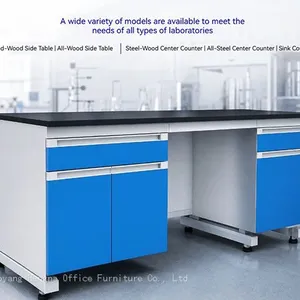
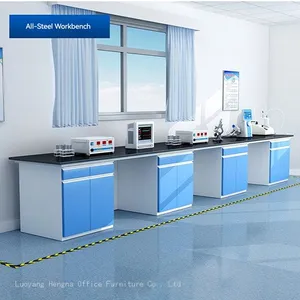
Chemical Resistant Lab Bench — 19mm Phenolic Resin Top & Cold-Rolled Steel Frame
Product Spotlights



Related Products
-
 Paraffin Block Storage Cabinet — Indexed Drawers: Know Which Block Is Where Before You Open the DrawerUS$ 80 - 300MOQ: 5 Combos
 -
Paraffin Block Storage Cabinet — Indexed Drawers: Know Which Block Is Where Before You Open the DrawerUS$ 80 - 300MOQ: 5 Combos
-
Laboratory Wax Block Cabinet QST-LK53 Microscope Slides 72 Drawers CabinetNegotiableMOQ: 10 Pieces
-
11000 Tissue Blocks Cold-roll Steel Paraffin Block Cabinet Lab - Grade Wax Block CabinetNegotiableMOQ: 10 Pieces
-
Microscope Slides Slide Drying Cabinet With Numbered Labels Compact Wax Block CabinetNegotiableMOQ: 10 Pieces
Chemical Resistant Lab Bench — 19mm Phenolic Resin Top & Cold-Rolled Steel Frame
Every lab spills something. The question is whether your worktop survives it.
Walk through any working laboratory — chemistry, materials testing, food QA, pharma QC — and you'll see the same thing on the cheap benches: a ring stain where someone left a reagent overnight, a bubbled edge where acid seeped under the laminate, a dull patch where solvent ate the surface. The bench didn't fail in a dramatic way. It just stopped being safe to work on.
A chemical resistant lab bench isn't a premium option. In most labs, it's the minimum. If your worktop can't take the chemicals your work actually uses, you're replacing it in two years — and explaining to whoever approved the budget why.
This bench is built around one job: take the chemicals and don't break down. 19mm solid phenolic resin top, cold-rolled steel frame. No laminate to delaminate, no thin sheet metal to flex.
What "Chemical Resistant" Means for a Worktop
The top on this bench is 19mm solid phenolic resin. That phrase matters, so let's be specific about what it is and isn't.
It is not laminate. Laminate tops are a decorative surface glued onto a particleboard or MDF core. The glue is the weak point. Spill concentrated acid near an edge or a scratch, and it migrates into the core. The board swells. The surface lifts. Once that starts, it doesn't stop — you're looking at replacement.
It is solid phenolic resin. Multiple layers of kraft paper saturated with phenolic resin, pressed under heat and pressure into one homogenous slab. No core, no separate skin, nothing to delaminate. The chemical resistance is the same from the surface to the bottom of the slab.
What that means in daily use:
Dilute acids (HCl, H₂SO₄, acetic) — no etch, no stain
Alkalis (NaOH, KOH) — no swelling
Organic solvents (ethanol, methanol, acetone, toluene) — no surface attack under normal exposure
Oxidizers (hydrogen peroxide, peracetic acid) — no degradation
Blood, urine, culture media — wipe clean, no absorption
We don't claim it resists everything — concentrated hydrofluoric acid and hot concentrated nitric will attack almost any bench material, and we'll tell you that straight. But for the routine chemicals in 95% of labs, this top holds.
Why 19mm, Not 12mm or 16mm
Thickness is load capacity. A lab bench isn't a shelf — it carries instruments that cost more than the bench.
12mm phenolic is the budget grade. Fine for a light-duty prep table. Under an analytical balance or a centrifuge, it flexes. Flex means vibration, and vibration means your readings drift.
16mm handles moderate loads but the unsupported span between cabinets bends under constant weight. Over a few years you see a permanent sag in the middle.
19mm is the standard for working labs. Rigid across the span, thick enough at the edge that setting down glassware or a metal tray won't chip it. This is what most chemistry, QC, and testing labs spec.
The top comes in black or dark grey. Both hide minor staining while still making residue visible during a cleanup check — a light-colored top hides less but shows contamination more. Your call based on the lab.
The Frame: Cold-Rolled Steel, Not Hot-Rolled
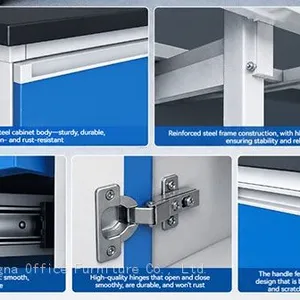
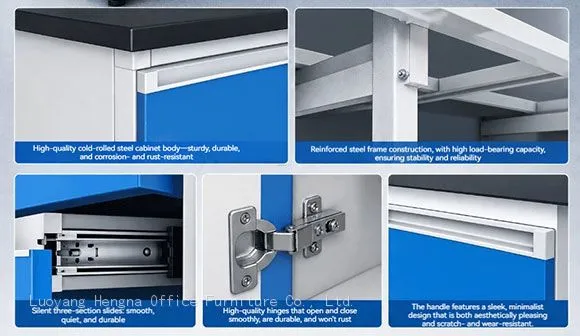
The understructure is welded 1.2mm cold-rolled steel. The "cold-rolled" part isn't a detail — it's the difference between a frame that stays square and one that doesn't.
Hot-rolled steel is cheaper and comes out of the mill with a scale surface and looser tolerances. In a lab bench that gets bumped by carts and leaned on by technicians, hot-rolled frames drift out of square within a couple of years. Doors rack, drawers bind.
Cold-rolled steel is processed to tighter tolerances and a cleaner surface. We weld it, then phosphate-treat and electrostatic powder coat. The coating bonds — it doesn't just sit on top like wet paint, which flakes off at the corners after a year of disinfectant wipes. Powder coating shrugs off the daily cleaning a working lab bench gets.
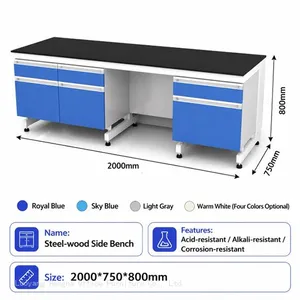
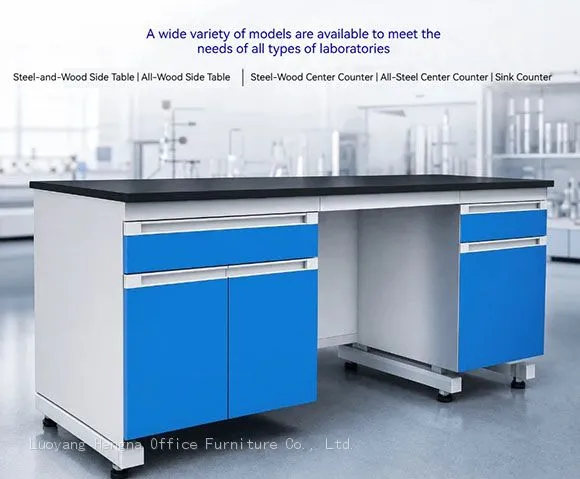
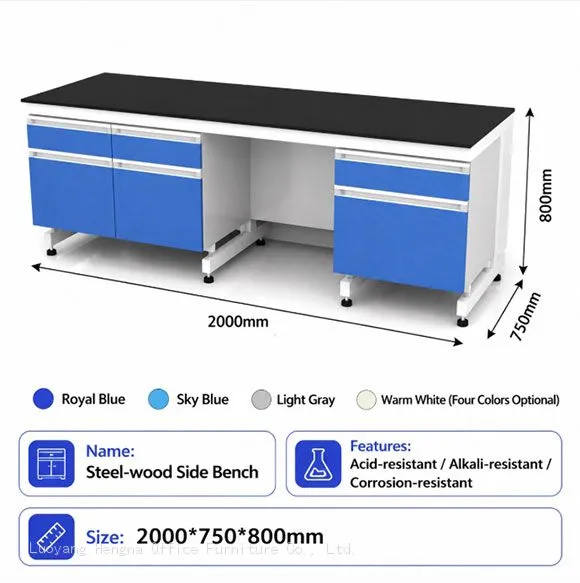
Frame colors: white, light grey, blue. White and grey are common in clinical and QC settings; blue reads more "education and training lab." All are standard, no upcharge.
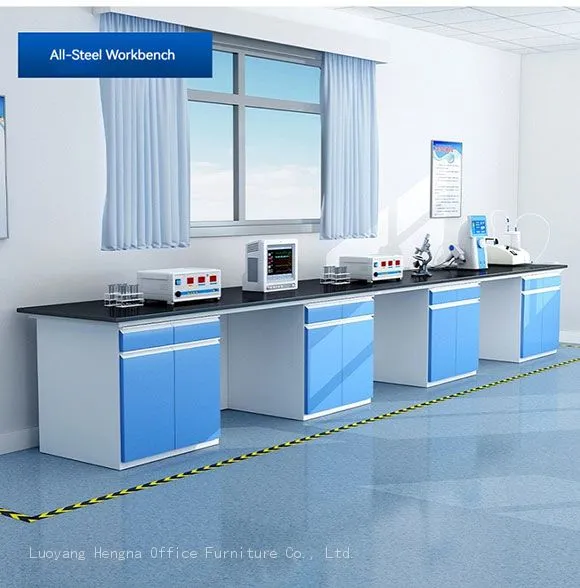
Where This Bench Gets Used
This is the general-purpose build, so the application range is broad:
Chemistry and research labs — acid/base work, solvent handling, synthesis prep
Materials testing — sample prep, corrosion testing, coating evaluation
Food and beverage QA — microbiology prep, titration, pH work
Environmental testing — water and soil sample processing
Pharma and cosmetics QC — formulation, stability sampling
Teaching labs — where the bench takes more abuse than anywhere else
One bench, spec'd the same way, covers most of these. That's why it's the entry point in our range — if you're not sure which bench a client needs, this one fits.
Configuration and Options
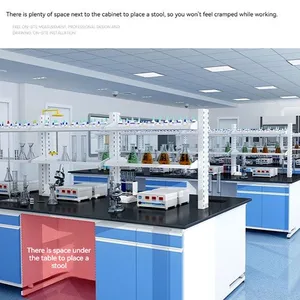
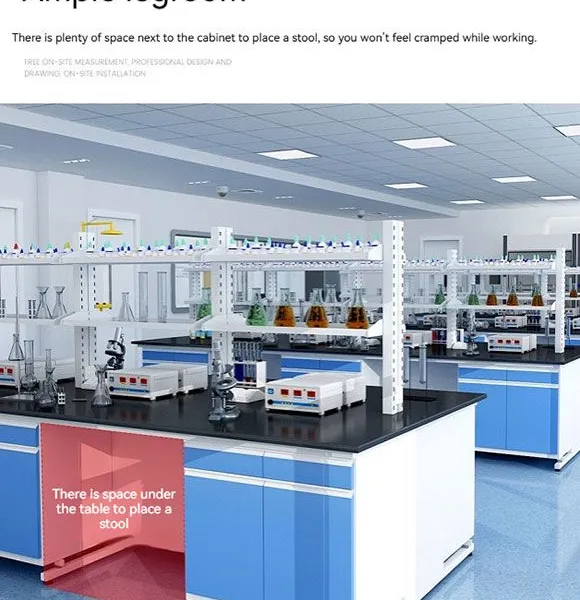
Standard widths 1000mm to 4500mm, 750mm deep, 800mm high. Wall bench, island bench, corner unit — all standard builds.
Options:
PP sink + gooseneck faucet — PP resists acids better than stainless, which pits under repeated bleach exposure
Reagent rack / overhead cabinet — keeps commonly used bottles off the work surface
Lockable drawers and doors — for controlled substances or restricted reagents
Power and gas modules — integrated into the worktop or side panel
Leveling feet — dial out uneven floors without shims
Custom dimensions and non-standard layouts are built to drawing. Send the floor plan.
Why Buyers Spec This Bench
Chemical resistant worktop — 19mm solid phenolic resin, non-absorbent, no delamination risk
Cold-rolled steel frame — welded, powder coated, stays square under daily lab traffic
Right thickness for real loads — instruments sit steady, no flex, no sag
Configurable — sinks, racks, locks, power, gas — one supplier for the bench and its fittings
CE certified — documentation supplied for tender and import
OEM/ODM available — logo, packaging, manuals to your spec
Quoted within 24 hours — send the plan, get the proposal
FAQ
MOQ? No fixed minimum. One bench or a full lab fit-out — both buildable. Volume pricing applies on larger runs.
What chemicals does the top resist? Routine lab chemicals: dilute acids, alkalis, common solvents (ethanol, acetone, toluene), oxidizers at working concentrations, and biological spills. Full chemical resistance chart provided on request. We're straight about the exceptions.
Can the frame handle a heavy analyzer? Yes. 1.2mm cold-rolled steel understructure, 19mm top — rated for standard lab instruments including centrifuges and analyzers. Load spec available.
Custom sizes? Yes. Standard 1000–4500mm, but off-catalog dimensions and corner units are normal for us. Send the floor plan.
Lead time? Standard sizes 15–20 days. Custom 20–30 days.
Packaging? KD knock-down. Moisture barrier film, corner protectors, parts grouped by number matching the assembly drawing. Your crew unboxes and builds — no mix-ups.
Warranty? One year on the complete bench — frame, worktop, and casework. Wear items (drawer slides, hinges, handles) supplied at cost for the life of the product.
Are you a trading company? No. We are Luoyang Hengna Office Furniture Co., Ltd. — own brand, directly partnered with production facilities. Manufacturer-direct, no middleman margin.

Send Inquiry to This Supplier



You May Also Like
-
Pathological Ection Cabinet JTGZ062 Wax Block Cabinet for LaboratoryNegotiableMOQ: 10 Pieces
-
Paraffin Wax Storage Cabinet QST 068 Pathology Microscope Slide CabinetNegotiableMOQ: 10 Pieces
-
Customized Oem Histology Wax Block Storage Cabinets for Medical Labs FactoryNegotiableMOQ: 10 Pieces
-
Custom Paraffin Block Storage Cabinet for Histology Laboratories – Factory Direct From Hengna FurnitureNegotiableMOQ: 10 Pieces
-
OEM & ODM Paraffin Block Storage Cabinets for Histology Laboratories – Made in China by Luoyang Hengna OfficeNegotiableMOQ: 10 Pieces
-
White Stackable Pathology Wax Block Storage Drawers for Labs Near London-Hengna OfficeNegotiableMOQ: 10 Pieces
-
Professional High-Capacity Paraffin Block Storage Cabinet for Histology Labs – Heavy-Duty Steel Stackable DrawersNegotiableMOQ: 10 Pieces
-
Space-Saving Histology Lab Wax Block Storage Solution –Steel Stackable Cabinet With High-Capacity DrawersNegotiableMOQ: 10 Pieces
-
Wax Block Storage Cabinet for Pathology Samples – 8-Drawer Unit Holds Up to 500 BlocksNegotiableMOQ: 10 Pieces
-
Paraffin Block Organizer - Heavy-Duty 8-Drawer Steel Cabinet With Shock-Absorbing Slides, Holds 500+ Pathology SpecimensNegotiableMOQ: 10 Pieces

