








 Contact Platform Support
 Help Center
Single-Head Cable Pulling Grip, Galvanized Steel Grip & High-Strength Mesh Sleeves

Related Products
-
 Galvanized Cable Pulling Grip & Metal Mesh Sockets | Industrial Cable Protection & Pulling Tools for ConstructionUS$ 20 - 100MOQ: 1 Combo
 -
Galvanized Steel Grip & Changyun Tech Cable Pulling Sock | Industrial Cable Handling Tools for Electrical & Construction ProjectsUS$ 20 - 100MOQ: 1 Combo
-
Two-Head Cable Mesh Sleeve Connector, Galvanized Steel Grip & Changyun Tech Cable Pulling SockUS$ 20 - 100MOQ: 1 Combo
-
Two-Head Steel Wire Mesh Cable Pulling Grip (50–63 mm), Galvanized Steel Grip & Changyun Tech High-Strength Cable Pulling SockUS$ 20 - 100MOQ: 1 Combo
-
Dual‑Head Cable Puller , Galvanized Steel Cable Pulling Grip & Cable Pulling Sock | Industrial Cable Handling Tools for High‑VoltageUS$ 20 - 100MOQ: 1 Combo
Cable sock, also known as a pulling sock or conductor sock, is a specialized traction tool installed at the end of a cable. It is woven from high-strength steel wire rope or stainless steel wire into a sock-like structure that tightens further under tension, thereby firmly gripping the cable and enabling safe pulling.
🔧 Structure and Principle
• Material: Typically woven from double-layer galvanized or stainless steel high-strength steel wire rope, with an openable sock mouth for easy insertion of the cable.
• Structure: One or both ends are pressed into rings, double ears, or other connection loops for attaching the pulling rope or pulling equipment.
• Principle: Relies on the radial elasticity of the mesh structure; when force is applied, it automatically contracts and tightens around the cable, providing reliable pulling force and anti-slip capability.
🎯 Main Applications
1. Power Line Stringing: Used in overhead line construction to pull ACSR (aluminum conductor steel reinforced), insulated conductors, ground wires, etc.
2. Communication Installation: Used to pull optical fibers, optical cables, and other communication lines, and can smoothly pass through stringing blocks.
3. Equipment Maintenance: Used for replacing and laying cables inside power plants and substations.
4. Special Applications: As a hanging net or protective sleeve for suspending or protecting streetlight feeder cables, drainage pump cables, high-pressure oil pipes, etc., preventing wear and excessive stress.
✨ Key Features
• High Safety: Made of high-strength steel wire rope with breaking loads reaching tens of tons, far exceeding ordinary hemp ropes or iron wires.
• Strong Anti-Slip: The mesh structure automatically tightens under force, effectively preventing slippage.
• Cable Protection: The contact surface is relatively soft, significantly reducing damage to the cable’s outer sheath compared to direct pulling with steel wire rope.
• Easy Operation: Light weight, good radial flexibility, easy to install and remove, and reusable.
• Strong Adaptability: Can smoothly pass through various pulleys and curved conduits, suitable for medium- and short-distance pulling operations.
📏 How to Select
1. Match Cable Diameter: Choose based on the outer diameter of the cable or optical cable. Sock specifications usually cover a range (e.g., 38–60 mm); ensure the cable’s outer diameter falls within this range—too large causes slipping, too small prevents proper fitting or damages the cable.
2. Match Pulling Force: Select according to the maximum pulling force required. Ensure the sock’s rated breaking load is much greater than the maximum pulling force during construction, leaving sufficient safety margin.
3. Match Usage Environment:
• Outdoor/Moist Environments: Prefer stainless steel material for corrosion resistance.
• Long-Term Submersion: Must use all-stainless steel socks.
• Special Media: For protecting high-pressure oil pipes, use dedicated oil pipe socks.
📝 Usage Methods
1. Traction End Installation (Standard Method)
1. Inspection: Confirm the sock specification matches the cable and check for broken wires, rust, or other defects.
2. Insertion: Place one end of the cable into the sock through the open mouth, ensuring the sock covers the section of cable that will bear the load.
3. Connection: Connect the pulling rope or pulling equipment to the connection loop at the sock’s end.
4. Pre-Tightening: Gently pull the rope to initially tighten the sock and confirm correct positioning.
5. Pulling: During pulling, keep the cable, sock, and pulling rope as straight as possible; avoid sudden stops, rapid acceleration, or lateral forces.
2. Semi-Open Sock Installation (Wrap Method)
1. Wrapping: Wrap the semi-open sock around the cable like a piece of cloth.
2. Threading: Pull the pulling rope out from one end of the sock, then thread it in and out sequentially across the sock like tying shoelaces, gradually tightening it.
3. Fixing: After the rope exits, wrap the remaining rope around the cable tail several times and tie a knot to secure it.
4. Completion: Keep the mesh even while tightening to ensure uniform force distribution.
3. Steel Wire Rope Connection Method
1. Insertion: Insert the two steel wire ropes to be connected into opposite ends of the hollow sock.
2. Pulling: Through pulling, the sock contracts and tightly clamps the steel wire ropes, achieving flexible connection.
3. Removal: Push the sock in reverse to easily disassemble it for reuse.
⚠️ Safety Precautions
• No Overloading: Ensure the pulling force remains within the sock’s rated load capacity; overloading is strictly prohibited.
• Condition Check: Before each use, inspect the sock for damage; immediately discard if broken wires, severe rust, or cracks at crimp joints are found.
• Standard Operation: During pulling, personnel must not stay or walk under the pulling rope or cable.
• Avoid Damage: Prevent the sock from rubbing against sharp objects to avoid damaging the cable’s outer sheath.
• Environmental Adaptation: In moist or corrosive environments, select socks with appropriate protection levels (e.g., stainless steel).
• Professional Construction: For high-voltage, large-section cables, or complex environments, work should be carried out by professionals with a specific plan.
Product Description
Improve safety and efficiency in cable installation and pulling with our comprehensive range of industrial cable handling tools, engineered for construction, electrical, mining, and utility projects worldwide.
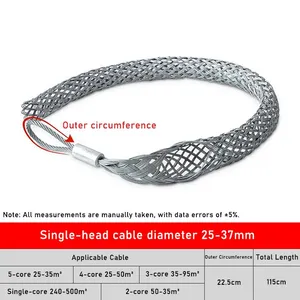
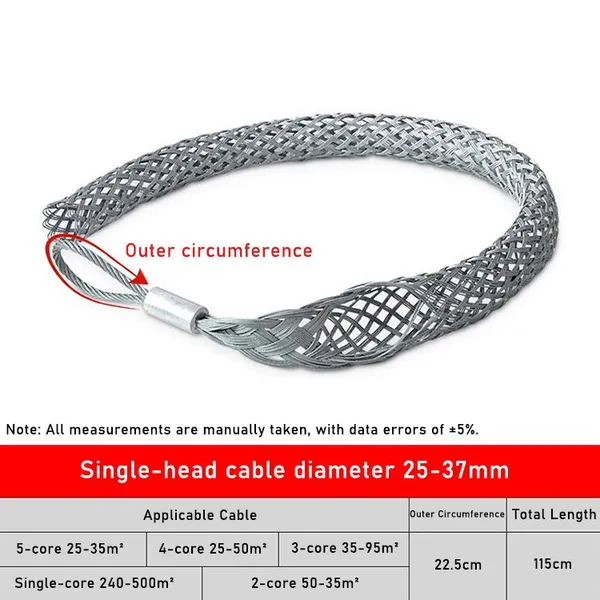
Single‑Head Cable Pulling Grip (25–37 mm)
Crafted from a sturdy braided metal material, this grip features an outer circumference designed to accommodate cables with diameters of 25–37 mm. Displayed in a clear looped form against a plain white background, the grip’s key dimension is highlighted with a red arrow and label. All measurements are manually taken and carry a possible data error of ±5%. The total length is 115 cm, and the product’s outer circumference is 22.5 cm. Compatibility spans multiple cable types:
-
5‑core: 25–35 m²
-
4‑core: 25–50 m²
-
3‑core: 35–95 m²
-
Single‑core: 240–500 m²
-
2‑core: 50–35 m²
-
This detailed specification table enables quick selection for specific cable‑pulling needs.
-
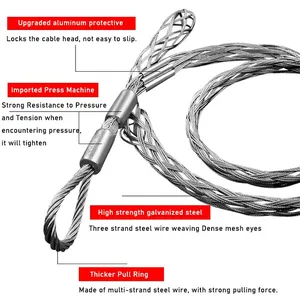
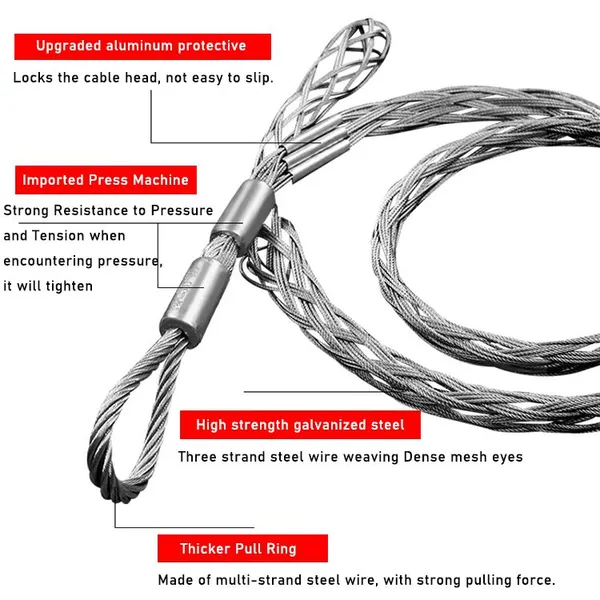
Robust Galvanized Steel Cable Pulling Grip with Aluminum Protection
Built for maximum reliability, this grip is made from high‑strength galvanized steel using a three‑strand steel wire weaving dense mesh eyes design. The eyelet is reinforced with an upgraded aluminum protective piece that locks the cable head, significantly reducing slippage. At the center, an imported press machine component offers strong resistance to pressure and tension, automatically tightening under load for a secure hold. The thicker pull ring, made from multi‑strand steel wire, delivers powerful pulling force for demanding rigging tasks. Metallic gray coloring emphasizes its industrial durability.
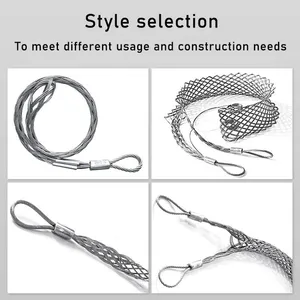
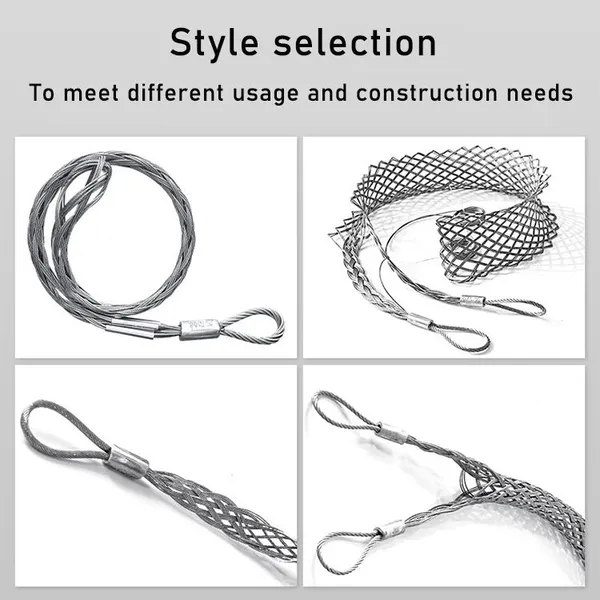
Versatile Steel Cable Mesh Sleeves – Style Selection
Our steel cable mesh sleeves come in multiple designs to meet different usage and construction requirements:
-
Neat coiled loop for compact storage and transport
-
Partially unraveled view showcasing the woven structure
-
End fitted with a metal clamp for secure connection
-
Close‑up of end fitting and assembly details
Finished in a hard‑wearing silver‑gray, these sleeves are ideal for pulling or protecting cables in varied site conditions. Style selection ensures the right configuration for each project.
-
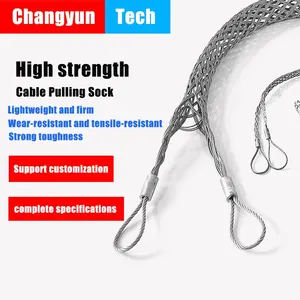
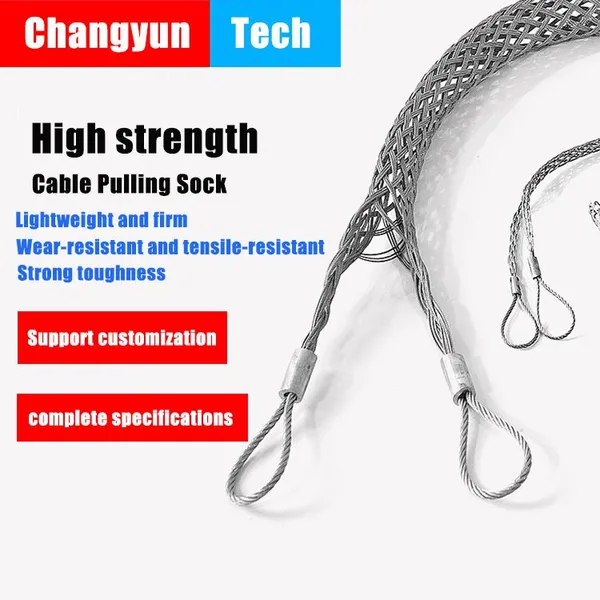
High‑Strength Cable Pulling Sock by Changyun Tech
Featuring a curved silver‑gray braided mesh construction, this sock has metal loops at both ends for quick, secure attachment during pulling operations. Key attributes include:
-
Lightweight yet firm
-
Wear‑resistant
-
Tensile‑resistant
-
Strong toughness
-
Backed by support for customization and complete specifications, it is designed for safe, damage‑free handling of cables in harsh environments.
-
All products combine global‑standard engineering, high load capacity, and reliable performance for professionals handling small‑ to large‑diameter power and communication cables across multiple industries.

Send Inquiry to This Supplier



You May Also Like
-
High-Strength Cable Pulling Sock & Cable Grip | Industrial Cable Handling Tools for Construction & Electrical ProjectsUS$ 20 - 100MOQ: 1 Combo
-
High‑Strength Cable Pulling Sock, Galvanized Steel Cable Pulling Grip & Two‑Head Cable Puller | Industrial Cable Handling Tools for ElectricalUS$ 20 - 100MOQ: 1 Combo
-
Two‑Head Cable Puller 7–12 mm, Galvanized Steel Cable Pulling Sock | Industrial Cable Handling Tools for ElectricalUS$ 20 - 100MOQ: 1 Combo
-
Heavy-Duty Galvanized Steel Cable Pulling Sock (7-12 mm Diameter) for Electrical Wire InstallationUS$ 20 - 100MOQ: 1 Combo
-
Middle Mesh Sleeve 300–400 Steel Wire Rope Sleeve | Heavy‑Duty Cable Protection & Lifting SleeveUS$ 20 - 90MOQ: 1 Combo
-
Middle Mesh Sleeve 25–50 & High-Strength Cable Pulling Tools | Galvanized Steel Mesh Sleeves for Wire Management & Cable InstallationUS$ 20 - 90MOQ: 1 Combo
-
Cable Net Sleeve 185–240 & High‑Strength Cable Pulling Tools | Galvanized Steel Mesh Sleeves & Socks for Secure Wire ManagementUS$ 20 - 100MOQ: 1 Combo
-
70–95 Cable Mesh Sleeve & High‑Strength Cable Pulling Tools | Galvanized Steel Wire Protection & Industrial Rigging AccessoriesUS$ 20 - 100MOQ: 1 Combo
-
Heavy‑Duty Cable Pulling Grips & Mesh Sleeves | Galvanized Steel Cable Management Tools for Construction & Electrical ProjectsUS$ 20 - 120MOQ: 1 Combo
-
Changyun Tech High‑Strength Cable Pulling Sock & Grip Set | Galvanized Steel Mesh Sleeves for Reliable Cable Installation & RiggingUS$ 20 - 100MOQ: 1 Combo


