








 Contact Platform Support
 Help Center
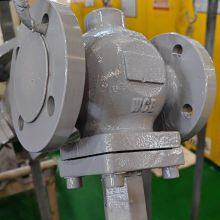
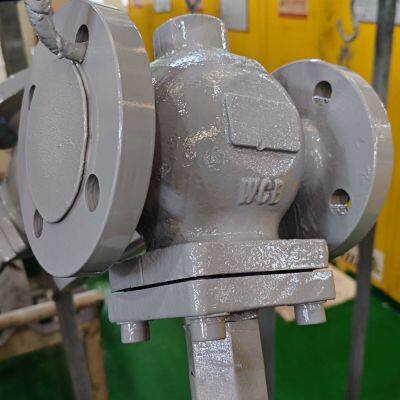
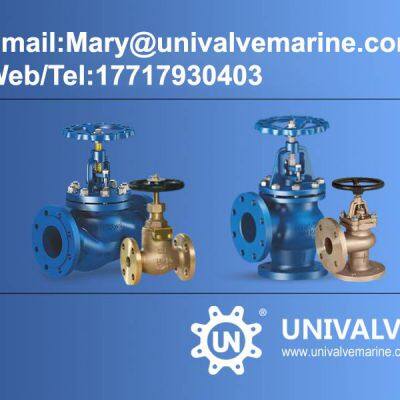
Marine Valve - Cast Steel Temperature Control Valve With Certificates From Major Classification Societies Such as Ccs and nk






Related Products
-
 Marine Valve Flange F7330 Jis 40k Forged Steel Angle Valve With Ccs Classification Society CertificateNegotiableMOQ: 0 Piece
 -
Marine Valves F7422 Jis-20k Forged Steel Angle Valves - Types "s" and "f"NegotiableMOQ: 0 Piece
-
Marine Valve Flange F7378 Jis 16k Cast Iron Angle Valve Sdnr With Ccs Classification Society CertificateNegotiableMOQ: 0 Piece
-
Marine Valve Flange F7329 Jis 40k Forged Steel Globe Valve With Ccs Classification Society CertificateNegotiableMOQ: 0 Piece
-
Marine Valve Flange F7310 Jis 16k Cast Iron Angle Valve With Ccs Classification Society CertificateNegotiableMOQ: 0 Piece
1. Working Principle
The temperature control valve controls the outlet temperature of the equipment by regulating the inlet flow of the primary hot (cold) medium of heat exchangers, air conditioning units, or other heating and cooling equipment. When the load changes, the valve opening degree is adjusted to change the flow rate, eliminating the impact caused by load fluctuations and restoring the temperature to the set value.
2. Classification
Temperature control valves can be generally divided into two types: self-acting temperature control valves and electric temperature control valves.
Self-acting temperature control valve: It realizes automatic adjustment based on the principle of liquid thermal expansion and incompressibility. When the temperature of the controlled medium is higher than the set value, the temperature-sensitive liquid expands, pushing the valve core downward to close the valve and reduce the flow of the hot medium; when the temperature of the controlled medium is lower than the set value, the temperature-sensitive liquid contracts, and the return spring pushes the valve core to open, increasing the flow of the hot medium.
Electric temperature control valve: It is a typical application in temperature control fields such as HVAC. It is composed of an electric control valve, a temperature controller, and a temperature sensor. The controller has PI and PID adjustment functions, with precise control, multi-loop control, and diverse functions. It can control fluid flow, pressure, differential pressure, temperature, humidity, enthalpy, and air quality. The actuator has two types: electric mechanical and electric hydraulic, with manual and automatic adjustment functions. It has sensitive adjustment, large shut-off force, and adjustable flow characteristics (such as linear and equal percentage).
3. Structure and Application
Structure: A temperature control valve (especially a radiator temperature control valve) generally consists of a thermostatic controller, a flow control valve, and a pair of connectors. The core component of the thermostatic controller is the sensor unit, namely the temperature bulb. The temperature bulb can sense the temperature change of the surrounding environment and generate a volume change, driving the valve core of the control valve to move, and then adjusting the water volume of the radiator to change the heat dissipation of the radiator.
Application: Temperature control valves are widely used in the industrial process automatic control systems of industries such as power, petroleum, chemical, metallurgy, environmental protection, light industry, teaching, and scientific research equipment. Especially in heating and air conditioning systems, temperature control valves automatically adjust the flow of hot and cold media to ensure a constant indoor temperature, improve energy efficiency, and ensure a comfortable environment.
4. Installation and Precautions
Installation: The temperature control valve is generally installed on the inlet pipe of the radiator or the main inlet pipe of the household heating system. During installation, attention should be paid to avoiding the thermal effect of the valve body and the surface pipeline, which may cause the thermostatic controller to malfunction. Ensure that the sensor of the thermostatic valve can sense the temperature of the indoor circulating air and is not covered by curtain boxes, radiator covers, etc.
Precautions: When installing the thermostatic valve, an air vent valve should be installed at the end of each radiator group to prevent air accumulation in the pipe from causing water circulation stagnation and affecting the heating effect. At the same time, during use, if the radiator leaks, it should be repaired in time to avoid increasing heat loss.

Send Inquiry to This Supplier


You May Also Like
-
Marine Valve Flange F7309 Jis 16k Cast Iron Globe Valve With Ccs Classification Society CertificateNegotiableMOQ: 0 Piece
-
Marine Valve Flange F7311 Jis 5k Cast Steel Globe Valve With Ccs Classification Society CertificateNegotiableMOQ: 0 Piece
-
Marine Valve Flange F7305 Jis 5k Cast Iron Globe Valve With Ccs Classification Society CertificateNegotiableMOQ: 0 Piece
-
Marine Valve Flange F7317 Jis 40k Cast Steel Globe Valve With Ccs Classification Society CertificateNegotiableMOQ: 0 Piece
-
Marine Valve Flange F7318 Jis 40k Cast Steel Angle Valve With Ccs Classification Society CertificateNegotiableMOQ: 0 Piece
-
Marine Valve Flange F7308 Jis 10k Cast Iron Angle Valve With Ccs Classification Society CertificateNegotiableMOQ: 0 Piece
-
Marine Valve Flange F7312 Jis 5k Cast Steel Angle Valve With Ccs Classification Society CertificateNegotiableMOQ: 0 Piece
-
Marine Valve Flange F7314 Jis 20k Cast Steel Angle Valve With Ccs Classification Society CertificateNegotiableMOQ: 0 Piece
-
Marine Valve Flange F7319 Jis 10k Cast Steel Globe Valve With Ccs Classification Society CertificateNegotiableMOQ: 0 Piece
-
Marine Valve Flange F7320 Jis 10k Cast Steel Angle Valve With Ccs Classification Society CertificateNegotiableMOQ: 0 Piece


