








 Contact Platform Support
 Help Center
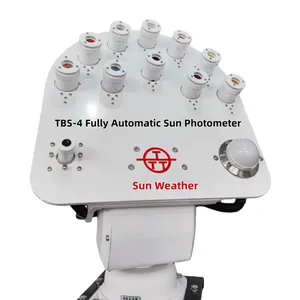
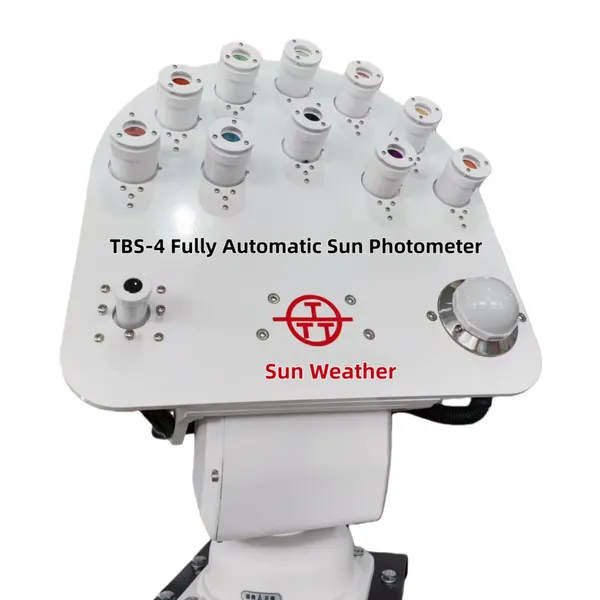
TBS-4 Fully Automatic Solar Photometer Automatic Sun Photometer Photovoltaic Luminosity Monitoring System


Related Products
-
 TBQ-2WX Solar Radiation Meter Calibrator Calibration Instrument Portable CalibratorNegotiableMOQ: 1 Unit
 -
YGF-2 Dust Monitoring System for Solar Panel Dust Sensor Dust DeviceNegotiableMOQ: 1 Unit
-
TRM-GPS4 Handheld Sensor for Weather Station, Monitoring Device Portable Ultrasonic Hand HeldNegotiableMOQ: 1 Unit
-
TRM-GPS5 Handheld Sensor for Weather Station Portable Hand Held Portable Ultrasonic Weather StationNegotiableMOQ: 1 Unit
-
TRM-GPS6 Portable Handheld Sensor for Weather Station Handheld Monitor SystemNegotiableMOQ: 1 Unit
TBS-4 Fully Automatic Sun Photometer
I. Product Overview
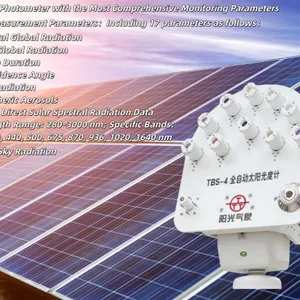
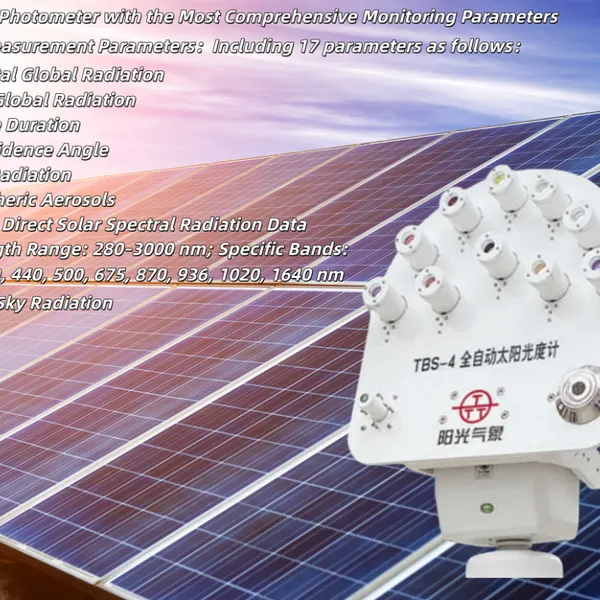
The TBS-4 Fully Automatic Sun Photometer is a high-precision instrument designed for outdoor measurements of solar and sky radiation. It is capable of measuring direct solar radiation across ten spectral bands, as well as a wide range of parameters including global solar radiation, diffuse solar radiation, sunshine duration, solar altitude angle, atmospheric aerosol optical depth, and sky radiance. Additionally, it features real-time positioning and tracking via GPS.
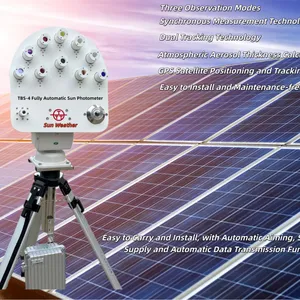
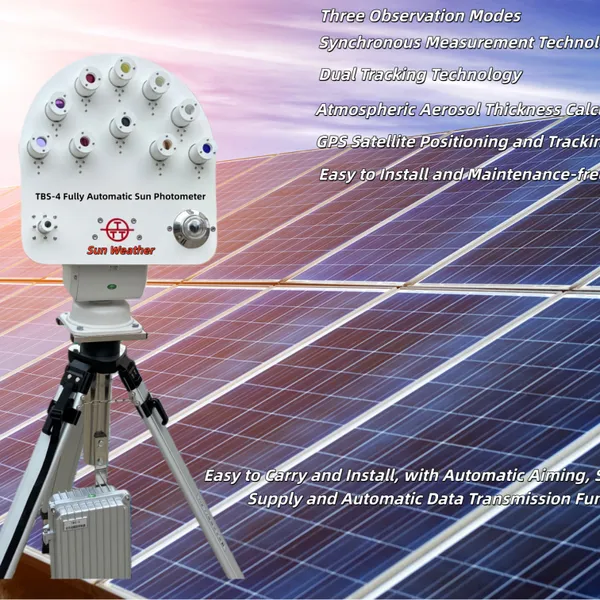
Boasting characteristics such as easy portability and installation, automatic solar alignment, solar-powered operation, wireless networking for cloud-based monitoring, and automatic data transmission, this instrument perfectly integrates robotic control technology with radiation measurement technology. It adopts a comprehensive application of technologies including solar tracking, rotation angle measurement, radiation spectrum measurement, and GPS satellite positioning and tracking.
As one of the most widely used, fully-featured, and authoritative sun photometers available today, it is primarily used to measure the radiation brightness of the sun and sky across different spectral bands, directions, and times. These measurements enable the derivation of the characteristics of atmospheric components such as aerosols, water vapor, and ozone, making it suitable for applications in atmospheric environmental monitoring and satellite calibration.
II.Product Features
1. Adopts synchronous measurement technology: In addition to simultaneously monitoring direct radiation across 10 spectral bands, it can measure global solar radiation, diffuse solar radiation, sunshine duration, solar altitude angle, sky radiance across 9 spectral bands, and other parameters at the same time. It resolves the time error issue associated with time-sharing measurement adopted by foreign equivalent instruments. This measurement mode significantly improves the accuracy of solar spectral analysis.
2. Automatic solar alignment: Equipped with dual-tracking technology combining optical scanning and time-based solar tracking, it ensures high tracking precision. The instrument automatically tracks the sun’s movement throughout the day without any manual intervention.
3. Enables derivation of atmospheric aerosol optical depth: Atmospheric aerosols refer to a type of colloidal dispersion system, specifically composed of solid particles or liquid droplets suspended and dispersed in a gaseous medium. The system calculates atmospheric transmittance or scattered light intensity based on sky scanning data and solar radiation data. By comparing the calculated data with standard luminosity values, it retrieves aerosol optical properties and other characteristics (e.g., particle size distribution, phase function). This allows for the derivation of the properties of atmospheric components such as aerosols, water vapor, and ozone.
4. GPS real-time positioning and tracking: Enables accurate positioning of the local longitude, latitude, and altitude.
5. Military-grade motor: Ensures the long-term stable operation of the photometer.
6. Easy installation and maintenance-free operation: No regular maintenance is required after installation.
7. Wireless automatic data upload: Data can be automatically transmitted to the Sunshine Smart Cloud Platform, allowing users to access and retrieve data via multiple terminals such as mobile phones, computers, and tablets.
8. Exclusive resource-sharing privileges for VIP users of Sunshine Meteorology: VIP users gain access to shared multi-region data resources on the Sunshine Smart Cloud Platform, providing robust scientific support for their research projects.
9. Software-selectable observation modes: In addition to the automatic solar tracking mode, the photometer supports two other modes:
✱Full-sky observation mode: Automatically acquires azimuth angles and completes a full-sky scan, recording 1,296 sky radiance data points.
✱User-specified azimuth and altitude mode: Allows manual setting of target altitude and azimuth angles to measure sky radiance and global solar radiation values at the designated positions.
III. Structure and Composition
IV. Technical Specifications
1. Basic Parameters
Name |
Basic Parameters |
Solar Spectrum Central Wavelengths |
10 bands covering (280nm–3000 nm), including 340nm, 380nm, 440nm, 500nm, 675nm, 870nm, 936nm, 1020nm, and 1640nm |
Solar Measurement Parameters (17 items) |
Direct radiation, horizontal global radiation, vertical global radiation, sunshine duration, solar incident angle, diffuse radiation, atmospheric aerosols, direct radiation of 9-band spectrum, 9-band sky radiance |
Power Supply |
AC220V/DC12V |
Tracking Accuracy |
≤±0.5° within 4 hours |
Rotation Speed |
50°/sec |
Observation Modes |
Full-automatic tracking mode, full-sky observation mode, user-specified azimuth & altitude angle mode |
Full-automatic Solar Tracking Technology |
Adopts optical scanning and satellite positioning tracking technology. The instrument automatically tracks the sun after installation without any manual intervention, realizing all-weather automatic operation |
Compatible Transmission Modes |
Lead screw, gear, and other transmission modes |
GPS Satellite Positioning |
Equipped with GPS satellite positioning and tracking technology, ensuring tracking measurement accuracy ≤1% in low-light conditions even when the sun is obscured by clouds |
Solar Tracking Drive Components |
Optical collimator, control cabinet, dual-axis stepper motor system |
Total Field of View |
1.3° |
Detectors |
Solar radiation: enhanced silicon detector; Sky radiance: silicon detector |
Optical Components |
Total field of view of solar collimator: 1.3°; Measurement accuracy: 1%; Linearity: 0.1% |
Operating Temperature |
-30℃~+60℃ (for outdoor all-weather operation) |
Operating Humidity |
<99%RH |
Horizontal Rotation Range (Solar Azimuth Angle) |
0~360° |
Vertical Adjustment Range (Solar Declination Angle) |
0°~90° |
Overall Weight |
<18kg |
Automatic Zero-reset Function |
When the solar incident angle is below 0°, the instrument automatically resets to zero and calibrates the zero position to avoid cumulative error impacts on the next day's operation |
Protection Grade |
IP65 |
Communication Interfaces |
Supports RS232, RS485, GPRS, RJ45, WiFi, etc. |
2. Monitoring Parameters
Monitoring Parameters |
Measurement Range |
Resolution |
Accuracy |
Direct Radiation |
0~2000 W/㎡ |
1 W/㎡ |
≤3% |
Solar Spectral Direct Radiation |
0~200 W/㎡ |
0.1 W/㎡ |
≤3% |
Sunshine Duration |
0~24 h |
0.1 h |
±0.1 h |
(Vertical + Horizontal) Global Radiation |
0~2000 W/㎡ |
1 W/㎡ |
≤5% |
Diffuse Radiation |
0~2000 W/㎡ |
1 W/㎡ |
≤5% |
Solar Incident Angle |
0°~90° |
0.1° |
±0.5° |
Atmospheric Aerosol Optical Depth |
0~1 |
0.001 |
≤1% |
V. Traditional Comparison
Items |
Traditional Sun Photometers |
TBS-4 Automatic Sun Photometers |
Monitoring Parameters |
Direct solar radiation of a single spectral band |
Monitors 10-band direct solar radiation, as well as global solar radiation, diffuse solar radiation, sunshine duration, solar altitude angle, longitude, latitude, altitude, atmospheric aerosol optical depth, 9-band sky radiance, etc. |
Commissioning |
Band-by-band commissioning required |
No commissioning required |
Maintenance |
Maintenance required at least once a week |
Maintenance-free |
Tracking Method |
Manual tracking |
Fully automatic tracking |
Data Storage |
None |
Available |
Data Transmission |
None |
Available |
Response Time |
> 10 seconds (slow) |
|
Spectral Range |
Bands need to be purchased separately |
Full coverage of 10 spectral bands |
Price |
High |
Low |
Cloud Platform Function |
None |
Available |
VI. System Configuration of Automatic Sun Photometer
No. |
Equipment Name |
Model No. |
Quantity |
Unit |
Remarks |
01 |
Automatic Sun Photometer |
TBS-4 |
1 |
Unit |
- |
02 |
Solar Spectrum Data Logger |
PC-2GL |
1 |
Unit |
- |
03 |
Solar Spectrum Analysis Software |
PC-2GL |
1 |
Set |
- |
04 |
GPS Satellite Locator |
GPS |
1 |
Unit |
- |
05 |
Wireless Network Data Communication Module (Optional) |
GPRS-1 |
1 |
Unit |
- |
06 |
Solar Power Supply System (Optional) |
TDC-25 |
1 |
Set |
90W |
07 |
Mounting Bracket |
PC-ZJ |
1 |
Set |
- |
08 |
Data Cable |
- |
1 |
Set |
- |
VII. Cloud Platform
The entire system consists of three layers: the Perception Layer, Platform Layer, and Application Layer.
The Perception Layer is composed of automatic photometers deployed at multiple stations, which transmit monitoring data from each device to the IoT Cloud Center Platform via wireless networks.
The Platform Layer receives real-time data from the Perception Layer for analysis, and performs data processing, aggregation and collation using big data analytics technology.
The Application Layer enables real-time display of monitoring data from each station via mobile phones, computers, LED screens, and other terminals.
Features of the Cloud-based System
1. Monitors direct solar radiation across all spectral bands and atmospheric aerosol data by orientation.
2. An IoT cloud service platform that supports real-time data viewing, downloading and online analysis.
3. Adopts internationally advanced technologies to ensure sensor accuracy, stability and environmental durability.
4. Supports resource sharing, allowing users to access data from other stations via the platform.
5. Enables real-time data access through multiple terminal devices.
6. Features powerful functions, stable operation, user-friendly interface and exquisite visualization.
By connecting to the Sunshine Smart Cloud Platform, device data can be monitored and stored in the cloud in real time around the clock.
Users do not need to stay online for data monitoring—data collection and calculation are processed on the server side by the cloud platform. Users only need to activate the monitoring system, log in to the platform and synchronize cloud data to view real-time and historical data information.
Core Advantages of the Platform
· Built on Alibaba Cloud Architecture
· Equipped with a brand-new Chinese software platform—Sunshine Smart Cloud
· Supports remote and intelligent station management
· Provides user permission management
· Enables historical data query
· Allows web browsing and web-based data downloading
· Supports SQL database
· Generates monthly data reports
· Provides data curve analysis charts
For more information, please contact me.
Jinzhou Sunshine Meteorological Technology Co., Ltd
Address: No. 15 Donghai Avenue,Jinzhou,Liaoning,China
Sales Manager : Ms. Zhang
Email: Jzyg322@gmail.com
Whatsapp:+86 15841668971
Wechat: 15841668971

Send Inquiry to This Supplier

You May Also Like
-
ZLHJ-600 Portable Weather Station Environmental Monitoring Instrument Weather StationNegotiableMOQ: 1 Set
-
YG-TBQ9A Luminance Detector for Tunnel Brightness Sensor Exterior Tunnel Luminance DetectorNegotiableMOQ: 1 Unit
-
TBS-YG5 Automatic Solar TrackerNegotiableMOQ: 1 Unit
-
PC-6 Portable Automatic Weather Station, Rainfall, Solar Radiation, Carbon Dioxide, Evaporation, Environmental Temperature& HumidityNegotiableMOQ: 1 Set
-
PC-XS2 Automatic Snow Depth Monitoring Station Automatic Snow Depth SensorNegotiableMOQ: 1 Set
-
YX-2 Rain and Snow Sensor Environments Rainfall or Snowfall RS485 Output Environmental MonitoringNegotiableMOQ: 1 Piece
-
TRM-ZS8 Marine Meteorological Monitoring Station Marine Environments Monitoring Meteorological SensorsNegotiableMOQ: 1 Set
-
TRM-GPS4 Micro Weather Station Monitoring Environmental Temperature and Humidity, Ultrasonic Wind Direction and Speed, Optical RainfallNegotiableMOQ: 1 Set
-
TRM-ZS4 Wind Farm Meteorological Acquisition System Modbus Rtu Meteorological Ultrasonic Data Logger SystemNegotiableMOQ: 1 Set
-
TRM-ZSH Forest Fire Risk Meteorological Forecasting and Monitoring Station Station MonitorsNegotiableMOQ: 1 Set


