Material
Other, Global universal model
Certification
CE
Function
Other, Global universal model
Condition
New
Task
Other
Mathematical Model
Other, Global universal model
Signal
Other
Customized
Non-Customized
Structure
Other, Global universal model
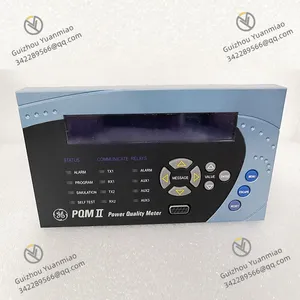
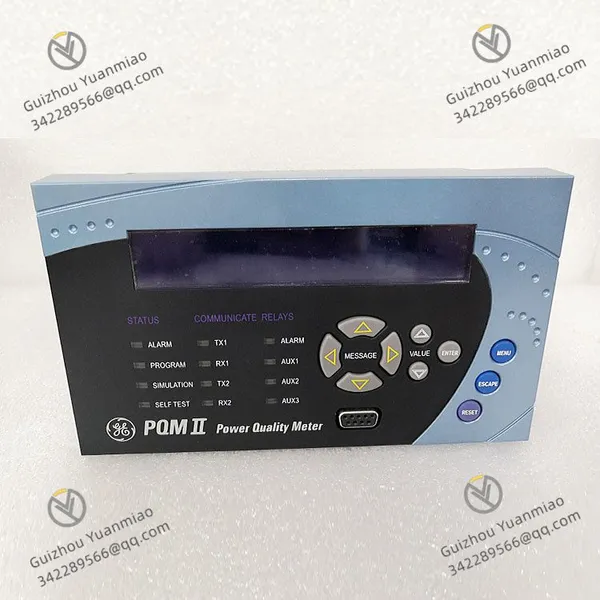
The GE PQMII-T20-C-A is a high-precision, multi-functional power quality analysis device under GE's industrial power monitoring product line. Its core positioning is "comprehensive power quality parameter monitoring, transient event capture, and data traceability analysis for both power grid and user sides". Widely applied in industrial plants, commercial buildings, data centers, and power distribution networks, it provides users with an all-in-one solution ranging from basic electrical parameter measurement to complex harmonic analysis. It helps identify equipment failures caused by power quality issues (such as harmonic pollution and voltage sags) while optimizing energy efficiency and power supply reliability.

I. Basic Information & Core Positioning1. Model Identification & Product Positioning
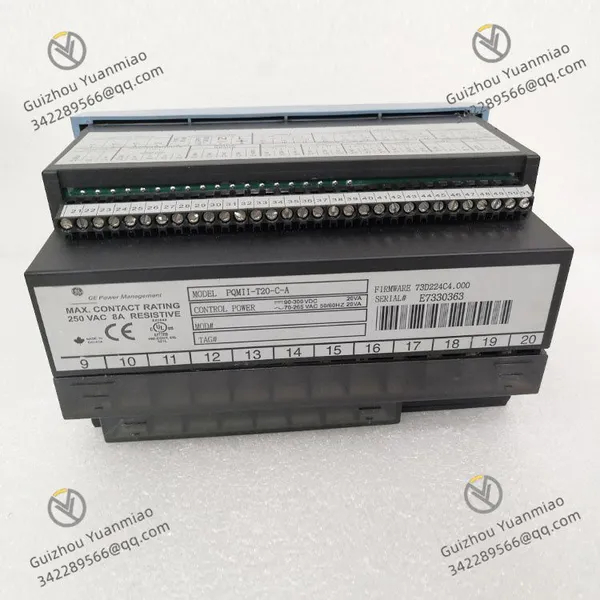
The model naming of PQMII-T20-C-A follows GE's power quality monitor logic of "Series + Function Level + Hardware Configuration + Application Adaptation", with specific breakdowns as follows:
PQMII: Product series identifier, representing "Power Quality Monitor II (2nd-Generation Power Quality Monitor)". Compared with the first-generation PQM series, it features optimized sampling rate, storage capacity, and communication compatibility.
T20: Function level and measurement channel configuration. The "T" stands for "Industrial-Grade Comprehensive Parameter Monitoring Type", and "20" indicates support for two wiring modes (3-phase 4-wire / 3-phase 3-wire) and high-precision measurement for loads up to 20kVA.
C: Hardware configuration code. The "C" represents "Enhanced Data Processing Unit", equipped with a high-performance ARM processor (800MHz clock speed) to support higher-frequency harmonic analysis and faster event capture.
A: Application adaptation identifier. The "A" denotes "General Industrial / Commercial Scene Adaptation", compatible with wide voltage input (100-480V AC), distinguishing it from Type "B" (dedicated for high-voltage distribution networks) and Type "D" (customized for data centers).
2. Physical & Installation Characteristics
| Item |
Specification Details |
| Dimensions |
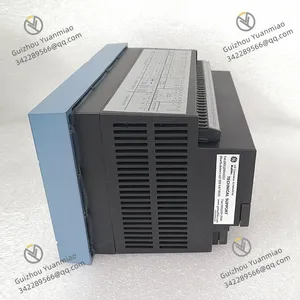
144mm × 144mm × 52mm (standard 96-type panel size, fitting 144mm×144mm cutouts). With a thickness of 52mm, it can be flush-mounted on distribution cabinet panels without occupying extra space. |
| Weight |
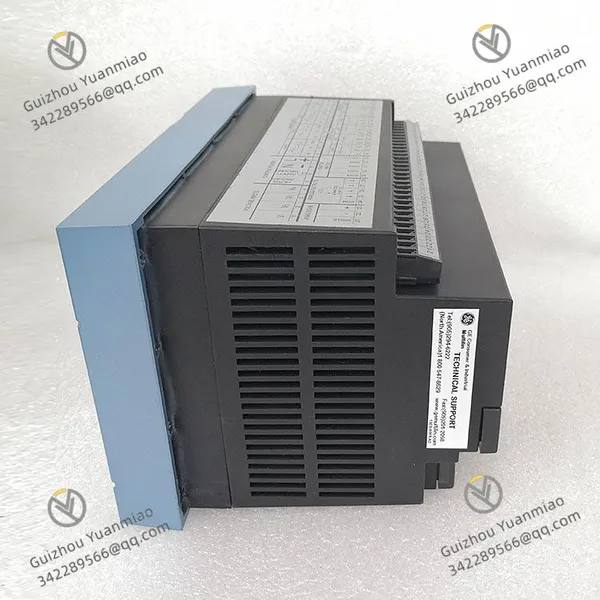
Approximately 1.5kg (including housing and terminal blocks). Adopts an ABS flame-retardant housing (UL 94 V-0 rating) with an impact resistance grade of IK08. |
| Installation Method |
Flush panel mounting (standard mounting brackets and fixing screws included). Supports 0°-90° viewing angle adjustment for easy on-site reading. |
| Display Interface |
2.8-inch color LCD screen (320×240 resolution), supporting Chinese/English bilingual switching. Displays real-time parameters, waveform curves, and alarm information, with adjustable backlight brightness (adapting to strong/weak light environments). |
| Operation Method |
4 physical buttons (Confirm, Back, Up/Down Adjustment) + key lock function (to prevent misoperation). Supports quick switching between display pages (e.g., real-time data page, harmonic analysis page, event log page) via buttons. |

II. Core Technical Specifications (Comprehensive Details)1. Electrical Parameter Measurement Range & Accuracy
The PQMII-T20-C-A covers the full range of measurements from basic voltage/current to complex power quality parameters, with accuracy complying with the IEC 61000-4-30 Class A standard (the highest industrial accuracy grade). Specific parameters are as follows:
| Measurement Parameter |
Measurement Range |
Accuracy Grade (Reference Conditions: 23℃±5℃, 50/60Hz) |
Remarks |
| Voltage (V) |
Phase voltage: 100-480V AC; Line voltage: 173-830V AC |
±0.1% of Reading (RDG) ±0.05% of Full Scale (FS) |
Supports 3-phase 4-wire (Y-type) / 3-phase 3-wire (Δ-type) wiring. |
| Current (A) |
0-5A AC (direct input); 0-1000A AC (with CT) |
±0.1% RDG ±0.05% FS |
Compatible with standard current transformers (CT) of 5A/1A. |
| Frequency (Hz) |
45-65Hz (standard mode); 0.1-500Hz (extended mode) |
±0.001Hz |
Frequency resolution of 0.0001Hz, supporting frequency fluctuation monitoring. |
| Active Power (W/kW) |
0-20kW (direct input); 0-2000kW (with CT/PT) |
±0.2% RDG (when power factor > 0.5) |
Supports phase-specific power and total power measurement. |
| Reactive Power (Var/kVar) |
0-20kVar (direct input); 0-2000kVar (with CT/PT) |
±0.3% RDG (when power factor > 0.3) |
Distinguishes inductive/capacitive reactive power, supporting reactive power compensation analysis. |
| Apparent Power (VA/kVA) |
0-20kVA (direct input); 0-2000kVA (with CT/PT) |
±0.2% RDG |
Supports power factor (PF) calculation (±0.001 accuracy). |
| Energy Metering (kWh/kVarh) |
Active: 0-9999999kWh; Reactive: 0-9999999kVarh |
±0.1% (compliant with IEC 62053-21 Class 0.2S) |
Supports forward/reverse energy metering, with data retention for 10 years after power failure. |
| Harmonic Analysis (Voltage/Current) |
Fundamental wave (50/60Hz) to 50th harmonic |
±0.1% FS accuracy for harmonic content measurement |
Supports total harmonic distortion (THD) and separate measurement of odd/even harmonics. |
2. Transient Event Capture Capability
For common transient issues in power grids (e.g., voltage sags, swells, interruptions), the PQMII-T20-C-A features high-speed event capture and logging—key for troubleshooting abnormal equipment shutdowns:
Event Trigger Types: Supports voltage sags (U 120% of rated value), voltage interruptions (U 120% of rated value), and frequency deviations (f 53Hz).
Capture Speed: Sampling rate of 256 points per cycle (12.8kHz at 50Hz, 15.36kHz at 60Hz), with an event trigger response time ≤ 1ms. It can fully record waveform data for 1 cycle before and 4 cycles after an event occurs.
Logging Capacity: Can store up to 1000 event records. Each record includes event type, occurrence time (accurate to milliseconds), trigger threshold, and waveform data (exportable in CSV format).
Waveform Display: Supports on-device or software-based viewing of voltage/current waveforms (e.g., voltage drop curves during sags) with 16-bit waveform resolution, facilitating analysis of event severity.
3. Environmental Adaptability & Electrical Safety
As an industrial-grade device, the PQMII-T20-C-A meets strict environmental and safety standards to ensure stable operation in complex scenarios:
Operating Environment:
Temperature: -40℃ to +70℃ (wide-temperature design, suitable for outdoor cabinets in cold regions and high-temperature industrial workshops).
Humidity: 5% to 95% RH (non-condensing, supporting high-humidity coastal environments; PCB boards feature moisture-proof coating).
Vibration: 0.006" amplitude at 5-15Hz, 0.5g acceleration at 15-50Hz, 1g acceleration at 50-100Hz (compliant with IEC 60068-2-6).
Electromagnetic Compatibility (EMC): Resistant to radio frequency interference (10V/m, 80MHz-1GHz) and electrostatic discharge (4kV contact discharge, 8kV air discharge), complying with the IEC 61000-6-2 industrial standard.
Electrical Safety:
Insulation Resistance: ≥100MΩ (tested with 500V DC).
Dielectric Loss Test: ≤2% (tested with 2kV AC at 50Hz for 1 minute).
Overload Capacity: Voltage input supports 1.2x rated value for continuous operation; current input supports 10x rated value (no damage within 1 second).
Protection Rating: IP65 for the panel (dustproof and spray-proof); IP20 for internal circuits (must be installed in enclosed distribution cabinets).
4. Communication & Data Interaction Capabilities
The PQMII-T20-C-A supports multi-interface and multi-protocol communication, enabling easy integration into monitoring systems for remote data management:
Hardware Interfaces:
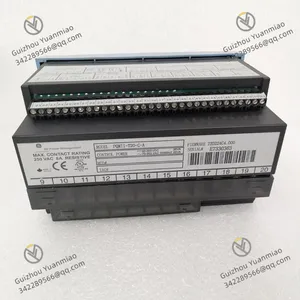
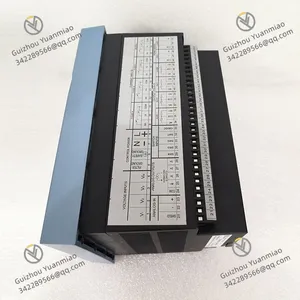
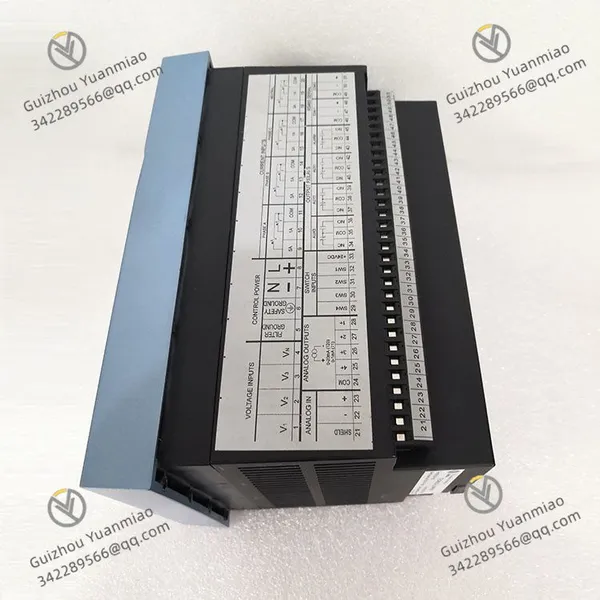
1 RS-485 interface (half-duplex, baud rate 9600-115200bps, supporting Modbus RTU protocol) for connecting to PLCs, SCADA systems, or local data loggers.
1 RS-232 interface (full-duplex, baud rate 9600-115200bps) for connecting to laptops for on-site configuration and data export.
1 optional Ethernet interface (10/100Mbps auto-negotiation, supporting Modbus TCP/IP and Bacnet IP protocols) for large-scale network monitoring scenarios.
1 USB Type A interface (Version 2.0) for exporting historical data to U disks (in CSV/Excel format), supporting U disks up to 32GB.
Data Transmission Content: Can remotely transmit real-time measurements, historical data (hourly/daily/monthly statistics), event records, and harmonic data. The transmission cycle is configurable (1s-3600s).
Time Synchronization: Supports NTP network time synchronization (for Ethernet-enabled models) or manual time calibration, ensuring consistent timestamps across multiple devices (error ≤1s/day).

III. Core Functions & Technical Advantages1. Comprehensive Power Quality Analysis (From Steady-State to Transient)
Beyond basic electrical parameter measurement, the PQMII-T20-C-A focuses on "power quality issue diagnosis" with core analysis functions including:
Harmonic Pollution Analysis: Measures the 1st to 50th harmonic content of voltage/current, calculates total harmonic distortion (THD), odd harmonic distortion (THD odd), and even harmonic distortion (THD even). It intuitively displays the proportion of each harmonic (e.g., 5% for the 3rd harmonic, 3% for the 5th harmonic) via bar charts on the display or software, helping locate harmonic sources (e.g., nonlinear loads like inverters and UPS systems).
Voltage Fluctuation & Flicker Monitoring: Compliant with the IEC 61000-4-15 standard, it measures short-term flicker (Pst) and long-term flicker (Plt) with a resolution of 0.01. It identifies voltage fluctuations caused by frequent motor starts or arc furnace operations, preventing light flicker or crashes of sensitive equipment (e.g., servers).
Three-Phase Unbalance Analysis: Calculates three-phase voltage unbalance (negative sequence voltage component / positive sequence voltage component ×100%) and three-phase current unbalance with an accuracy of ±0.1%. It monitors three-phase imbalances caused by excessive single-phase loads (e.g., air conditioners and lighting in commercial buildings), preventing transformer overheating and reduced motor efficiency.
Transient Event Traceability: As mentioned earlier, it captures voltage sags/swells/interruptions and records event waveforms and parameters. For example: "2024-05-20 14:30:05, Phase A voltage sag from 220V to 160V, duration 0.5s"—helping users determine if the event is caused by grid faults, lightning strikes, or local load switching.
2. Data Storage & Trend Analysis (Long-Term Energy Management)
To meet energy auditing and efficiency optimization needs, the device features robust data storage and statistical functions:
Storage Cycle & Capacity:
Real-Time Data: Samples at 1s intervals, with on-device storage of 1 year’s hourly statistical data (active power, reactive power, energy, etc.).
Historical Data: Generates hourly/daily/monthly statistical reports (e.g., daily energy consumption, average power factor, maximum current). Data is retained for 72 hours by a supercapacitor after power failure to prevent data loss.
Event Data: Stores 1000 event records (each with complete waveforms). When storage is full, it automatically overwrites the oldest records (configurable to "no overwrite" mode, triggering an alarm when full).
Trend Analysis Tools: Via the supporting GE PowerView software (compatible with Windows systems), it generates trend curves for parameters like voltage, current, power, and THD (e.g., 7-day power variation curves). It supports year-on-year/period-on-period analysis (e.g., monthly vs. previous month’s energy consumption comparison) to identify energy waste (e.g., no-load operation of equipment at night).
3. Alarm & Control Functions (Proactive Protection)
The PQMII-T20-C-A supports "parameter overrun alarms + linked control", upgrading from "passive monitoring" to "proactive protection":
Alarm Configuration:
Allows setting upper/lower limits for over 20 parameters (e.g., voltage upper limit 242V, lower limit 198V; current upper limit 4.5A; THD upper limit 8%).
Alarm Methods: Red blinking on the local LCD + buzzer alarm (mutable), relay output alarm (2 normally open/normally closed alarm relays, 2A/250V AC capacity), and remote communication alarm (sending alarm codes to SCADA systems via Modbus).
Alarm Logging: Automatically stores alarm events (including occurrence time, parameter values, and alarm type), exportable as reports for fault traceability.
Linked Control:
When voltage sags
When power factor
When current > 4.8A, trigger a relay to cut off non-critical loads (e.g., lighting) to avoid overload tripping.
4. Usability & Maintenance Convenience
The device is designed to "reduce on-site operation complexity" with core usability features including:
Programming-Free Quick Configuration: Via panel buttons or PowerView software, users can configure wiring modes (3-phase 4-wire / 3-wire), CT/PT ratios (e.g., 500/5A), alarm thresholds, and communication parameters—no coding required, with Chinese prompts throughout the configuration wizard.
Self-Inspection & Fault Diagnosis: The device performs regular hardware self-tests (e.g., ADC calibration, relay testing, communication interface detection). If faults are detected (e.g., CT open circuit, communication interruption), it automatically displays fault codes on the LCD (e.g., "E03-CT Open Circuit") and provides troubleshooting suggestions (e.g., "Check CT wiring").
Firmware Upgrade: Supports firmware upgrades via USB or Ethernet interfaces (latest firmware available for download on GE’s official website), no device disassembly required—ensuring continuous function optimization (e.g., firmware versions adding harmonic analysis up to the 63rd harmonic).
Wiring Fault Tolerance: Voltage input supports "phase sequence error" detection (LCD prompts "Phase Sequence Error"); current input supports "CT polarity reversal" compensation (configurable as "reverse" in software, no re-wiring needed)—reducing rework caused by on-site wiring errors.

IV. Application Scenarios & Typical Cases1. Industrial Plants (e.g., Auto Parts Factories)
Core Needs: Monitor power quality of production line equipment (e.g., inverters, machine tools) to prevent equipment shutdowns caused by harmonics or voltage sags; calculate energy consumption of each production line for cost allocation.
PQMII-T20-C-A Application:
Installed in workshop distribution cabinets to monitor 3-phase voltage/current, THD (focusing on 5th/7th harmonics generated by inverters), and voltage sag events.
Configured with "THD > 10% alarm + inverter power cutoff" to prevent motor damage from harmonics.
Uses PowerView software to generate daily energy consumption reports for each production line, identifying "Production Line B’s no-load operation at night (wasting 500kWh/month)"—optimization saves ~CNY 3,000 in monthly electricity costs.