Material
Other, Global universal model
Condition
Other, Global universal model
Task
Other, Global universal model
Mathematical Model
Other, Global universal model
Signal
Other, Global universal model
Customized
Non-Customized
Structure
Other, Global universal model
Operating temperature
-40℃ to +70℃
Humidity
5% - 95% (non - condensing)
I. Overview
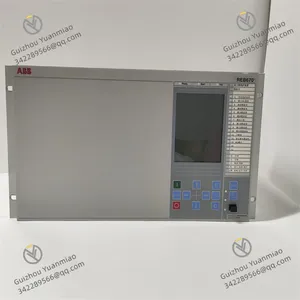
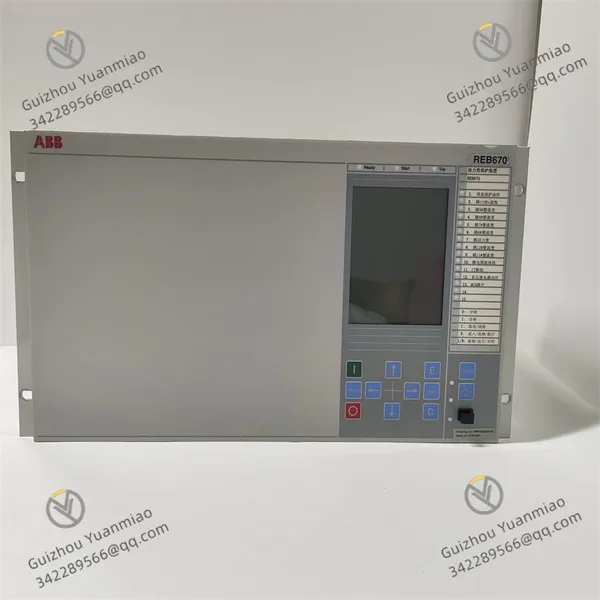
ABB REC670 1MRK002814-AB is an advanced relay protection and measurement & control device specially designed for power systems, playing a key role in the safe and stable operation of power networks. It is mainly applied to the protection, control, measurement and monitoring of power equipment such as transmission lines, transformers and busbars. It can quickly and accurately detect faults in the power system and take corresponding protection measures in time to minimize the impact of faults on the power system.
As an important member of the ABB Relion series products, REC670 1MRK002814-AB inherits the advanced, reliable and flexible characteristics of the series. Its design complies with international general power industry standards, such as IEC 61850, and has good compatibility and interoperability. It can be seamlessly integrated with other intelligent devices to build an efficient intelligent substation automation system. Whether in large-scale transmission networks or regional distribution networks, this device can perform excellently, providing a strong guarantee for the safe, stable and economical operation of power systems.
II. Technical Parameters
Electrical Parameters
Working Power Supply: Supports multiple AC and DC power inputs. The AC working voltage range is 85-265V AC, and the DC working voltage range is 85-300V DC. It can adapt to different power supply environments of power systems, ensuring that the device can work stably under various power supply conditions and providing reliable energy support for its internal protection, control and monitoring circuits.
Rated Frequency: Supports two frequencies of 50Hz and 60Hz, which can meet the frequency requirements of power systems in different regions and be applicable to power systems worldwide. It ensures that the protection and measurement accuracy of the device is not affected by frequency changes.
Power Consumption: Under normal working conditions, the power consumption is low. The typical power consumption is no more than 15VA when powered by AC power supply, and no more than 15W when powered by DC power supply. The low-power design is not only conducive to energy saving, but also reduces the heat generation of the device, improving the stability and service life of the device.
Measurement Parameters
Current Measurement Range: It can measure a wide range of currents, with the rated current usually being 1A or 5A, which can meet the current measurement needs of different power equipment. The measurement accuracy is high, with an error of no more than 0.2%, which can accurately reflect the actual current situation in the power system and provide accurate data basis for protection and control.
Voltage Measurement Range: The rated voltage can be divided into various specifications according to different application scenarios, such as 100V, 220V, etc. The measurement accuracy is also high, with an error of no more than 0.2%, which can accurately measure the voltage parameters in the power system and ensure that the protection device can accurately judge abnormal voltage conditions.
Power Measurement: It can accurately measure active power and reactive power, with a measurement accuracy of 0.5 class. It can provide reliable data support for the economic operation analysis of the power system, helping dispatchers understand the power distribution and loss of the power system.
Environmental Parameters
Working Temperature: The working temperature range is -40℃ to +70℃, with extremely strong adaptability to ambient temperature. It can work normally under various harsh environmental conditions such as cold northern regions, hot southern regions and plateau areas with large temperature differences, ensuring uninterrupted protection and monitoring of power equipment.
Relative Humidity: It can operate stably in an environment with a relative humidity of 5%-95% (non-condensing). The interior of the device adopts advanced moisture-proof technology and sealing design, which effectively prevents the erosion of internal circuits by humid air, and is suitable for humid coastal areas, rainy mountainous areas and other environments.
Anti-vibration Performance: It can withstand vibrations with a frequency of 10-2000Hz and an acceleration of 15g. In the common equipment vibration environment in power systems, it will not affect the normal working performance of the device, ensuring the reliability of protection and control functions.

III. Functional Features
Powerful Protection Functions
Line Protection: Has complete line protection functions, including distance protection, zero-sequence current protection, overcurrent protection, etc. Distance protection can quickly determine the fault location according to the electrical distance from the fault point to the protection installation and act in time to cut off the fault; zero-sequence current protection is specially used to detect ground faults, and has good protection effect for both neutral grounded systems and non-grounded systems; overcurrent protection can act in time when the line current exceeds the set value to prevent equipment damage due to overcurrent.
Transformer Protection: Can be used for transformer protection, with functions such as differential protection, gas protection, overload protection, etc. Differential protection detects internal faults by comparing the current difference between the two sides of the transformer, with quick and sensitive action; gas protection, as one of the main protections for transformers, can detect gas faults inside the transformer; overload protection can prevent the transformer from shortening its service life due to long-term overload operation.
Busbar Protection: Supports busbar protection function, which can quickly detect and cut off busbar faults to avoid the spread of faults to the entire power system. Advanced protection algorithms are adopted to improve the reliability and selectivity of busbar protection, ensuring that only the faulty busbar is cut off when a busbar fault occurs, without affecting other normally operating equipment.
Accurate Measurement and Monitoring Functions
Real-time Measurement: Can real-time measure electrical parameters such as current, voltage, power and frequency in the power system, and process and analyze these parameters with high precision. The measured data can be uploaded to the substation automation system in real time, providing operators with comprehensive and accurate information on the operating status of the power system.
Event Recording: Has a powerful event recording function, which can record operation events, fault events, alarm events of the device, etc. The content of event records includes information such as the time, type and parameters of the event occurrence, with high recording accuracy, which can be used for fault analysis and accident recall, helping operators find out the cause of the fault and summarize experience and lessons.
Status Monitoring: Can real-time monitor its own operating status, including power supply status, communication status, internal component status, etc. When the device is abnormal, it will send out an alarm signal in time to remind operators to carry out maintenance and repair, improving the reliability and availability of the device.
Flexible Control Functions
Local Control: Operators can perform local control operations through the human-machine interface (HMI) of the device, such as switching on/off of circuit breakers, modification of setting values, etc. The human-machine interface adopts a graphical design, which is simple and intuitive to operate, making it easy for operators to quickly master the operation methods.
Remote Control: Supports remote control through communication networks. Operators can remotely operate the device in the substation control center or dispatch center, such as remote switching on/off, remote modification of setting values, etc. The remote control function improves the automation level and operation efficiency of the power system, reducing the workload and errors of manual operations.
Logical Control: Has programmable logical control function. Users can write control logic according to actual needs to realize automatic control of power equipment. For example, the tap of the transformer can be automatically adjusted according to the load condition of the line to realize automatic voltage adjustment; the automatic reclosing of the circuit breaker can also be realized according to the preset logic.
Reliable Communication and Networking Capability
High-speed Communication: Adopts high-speed Ethernet communication technology with fast data transmission rate, which can meet the transmission requirements of protection and control information with high real-time requirements. At the same time, it supports network redundancy function. When the main communication link fails, it can automatically switch to the backup communication link to ensure the continuity and reliability of communication.