Overview
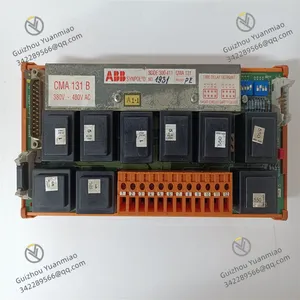
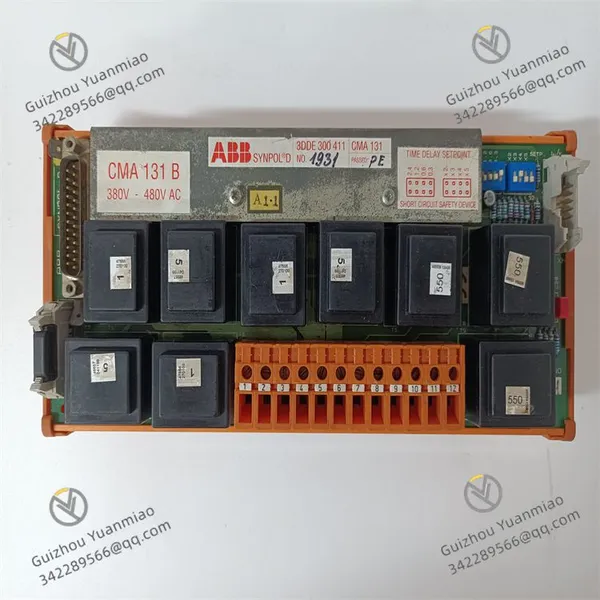
The ABB CMA131 3DDE300411 is a key device with excellent performance in the field of industrial automation, embodying ABB's profound accumulation and continuous innovation achievements in electrical and automation technologies. As an important driving force for the intelligent and efficient transformation of industrial production, this product, with its powerful functions, can accurately and efficiently collect various industrial field signals, quickly process these data using advanced algorithms, and output stable and reliable control commands based on preset logic, strongly promoting the realization of intelligent and collaborative operation modes among industrial devices. Its advanced technical architecture and outstanding performance give it a broad application space in multiple industrial fields such as power, chemical, and manufacturing, effectively helping industrial production to stride towards automation and intelligence, significantly improving enterprise production efficiency, optimizing product quality, and reducing overall operating costs.
Technical Parameters
| Parameter Category | Details |
|---|
| Product Model | CMA131 3DDE300411 |
| Product Type | Industrial Automation Control Module |
| Input Voltage | 24V DC (allowable fluctuation range ±20%) |
| Output Voltage | Flexibly configurable to adapt to different load requirements |
| Input Channels | Analog input: 4 channels; Digital input: 16 channels |
| Output Channels | Analog output: 4 channels; Digital output: 16 channels |
| Input Signal Types | Analog: supports standard signals such as 0-10V DC and 4-20mA; Digital: 24V DC |
| Output Signal Types | Analog: 0-10V DC, 4-20mA; Digital: 24V DC |
| Sampling Accuracy | Analog input: 16-bit; Analog output: 14-bit |
| Communication Interfaces | Ethernet (RJ45 interface, supports protocols such as Modbus TCP and Profinet), RS485 (supports Modbus RTU protocol), RS-232 (partially functional) |
| Communication Rates | Ethernet: 10/100Mbps; RS485: up to 115.2Kbps |
| Operating Temperature Range | -40°C to +70°C |
| Storage Temperature Range | -40°C to +85°C |
| Protection Level | IP20 (some customizations can reach IP67 to adapt to harsh environments) |
| Installation Method | 35mm DIN rail installation or panel installation |
| Dimensions | 120mm×80mm×40mm |
| Weight | Approximately 0.5kg |
| Memory Capacity | 256KB |
| Output Frequency | 50kHz (for specific control scenarios) |
| Current Capacity | Each digital output channel can carry 0.5A current |
| Resolution | The encoder module can reach 1024ppr (pulses per revolution) |
| Maximum Current Consumption | 50mA (encoder module) |

Functional FeaturesDiverse Signal Adaptation and Processing
With rich analog and digital input/output channels, it can adapt to various industrial devices, such as temperature sensors, pressure transmitters, proximity switches, and solenoid valves. Analog channels can accurately collect continuously changing signals such as temperature, pressure, and flow, providing precise data for production process monitoring; digital channels can quickly respond to discrete signals such as device start/stop and status feedback, fully meeting the diversified signal interaction needs in complex industrial scenarios.
High-Precision Data Collection and Control
The analog input has a 16-bit sampling accuracy, which can acutely capture subtle signal changes to ensure the high accuracy of collected data; the analog output has a 14-bit accuracy, which ensures the stable and precise output of control signals. In scenarios with extremely high precision requirements, such as chemical raw material proportioning and precision machining, it can effectively ensure the stability of production processes and improve product quality.
Multi-Protocol High-Speed Communication
Supporting multiple mainstream industrial communication protocols such as Modbus TCP, Profinet, and Modbus RTU, it can achieve fast and stable data interaction with devices such as PLCs, DCS systems, and host computers through Ethernet and RS485 interfaces. Whether building a small automated production line or integrating into a large complex industrial network, it can easily achieve seamless communication and collaborative operations between devices, greatly improving system integration efficiency.
High Reliability and Environmental Adaptation
Adopting industrial-grade high-quality components and optimized circuit design, and having undergone strict environmental testing and reliability verification, it can operate stably in harsh industrial environments such as high/low temperature and strong electromagnetic interference. The wide working temperature range and good anti-interference performance, combined with the IP20 protection level (some customizations can reach IP67), can effectively resist the intrusion of dust and a certain degree of liquid splashing, ensuring the long-term stable operation of equipment and reducing the frequency of failures.
Convenient Maintenance and Intelligent Diagnosis
Supporting hot-swapping, it allows quick replacement of faulty modules during system operation, greatly reducing downtime; equipped with intuitive LED status indicators to real-time display channel working status and communication connections; built-in intelligent diagnosis system can quickly locate problems such as communication failures and signal anomalies, facilitating timely maintenance by technicians and reducing maintenance difficulty and costs.
Flexible Function Expansion
With multiple expansion slots and interfaces, users can conveniently carry out function expansion and external device connection according to actual application requirements, easily coping with various complex industrial automation application scenarios.
Application FieldsPower Industry
In power facilities such as power plants and substations, it real-time monitors key power parameters such as voltage, current, and power. Through precise data collection by analog input channels, after analysis and processing by the module, combined with digital output channels to control equipment such as circuit breakers and disconnectors, it realizes automated regulation of the power system. At the same time, it communicates with the power monitoring system to assist in remote monitoring and intelligent operation and maintenance, ensuring stable and reliable power supply.
Chemical Industry
In chemical production processes, it accurately measures and controls core process parameters such as temperature, pressure, flow, and liquid level. Using analog channels to collect sensor data, the module processes and outputs control signals to adjust actuators such as valve openings and pump speeds, ensuring that chemical reactions proceed stably according to the scheduled process. Combined with the DCS system, it realizes the automation and safety control of the production process, significantly improving chemical production efficiency and safety.
Manufacturing Industry
In automated production lines such as automobile manufacturing and electronics assembly, it undertakes the important task of controlling the operation of robotic arms, conveyor belts, welding equipment, etc. Digital input channels receive signals such as material positions and equipment status detected by sensors, digital output channels control equipment start/stop and action sequences, and analog channels can adjust equipment operation parameters, realizing the efficient and precise operation of production lines and greatly improving product quality and production efficiency.
Energy Management Field
Applied to energy management systems in scenarios such as intelligent buildings and industrial plants, it collects data from energy metering devices such as water, electricity, and gas meters, and transmits the data to the energy management platform through Ethernet or RS485 interfaces. It realizes real-time energy consumption monitoring, statistical analysis, and optimized control, helping enterprises rationally allocate energy resources, reduce operating costs, and promote the realization of energy conservation and emission reduction goals.
Water Treatment Industry
In sewage treatment plants and waterworks, it monitors parameters such as water level and water quality (such as pH value, turbidity, etc.). After analog input channels collect data, the module outputs control signals to adjust equipment such as water pumps, valves, and dosing devices, ensuring the stable operation of water treatment processes and the compliance of effluent quality. Combined with automated control systems, it improves water treatment efficiency and intelligent management levels.
Robot Control Field
As an important part of the robot control system, it provides precise position and speed feedback for robots (if it is an encoder module), supports robot motion control and path planning, ensures that robots act precisely and efficiently when performing tasks, and is widely used in various robot application scenarios such as industrial robots and service robots.