Material
Other, Global universal model
Condition
Other, Global universal model
Task
Other, Global universal model
Mathematical Model
Other, Global universal model
Signal
Other, Global universal model
Customized
Non-Customized
Structure
Other, Global universal model
Input Power
AC 200-240V±10%, 50/60Hz
weight
3kg
Dimensions
100mm (W) × 200mm (H) × 150mm (D)
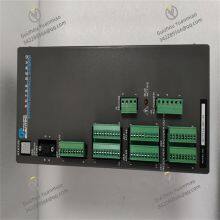
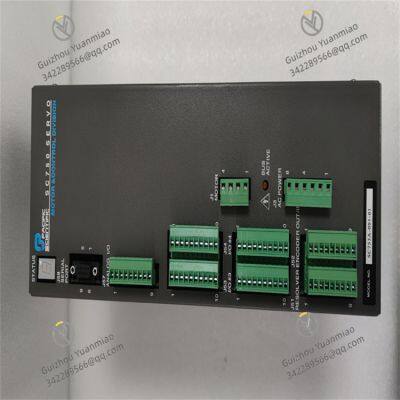
Pacific Scientific SC753A-001-01
I. Overview
The Pacific Scientific SC753A-001-01 is a high-reliability servo controller specifically designed for medium and low-power industrial automation scenarios. Its core function achieves speed, position, and torque control of servo motors through precise signal processing and power drive. With a compact design, high integration, and fast response, it is suitable for fields requiring high-precision motion control, such as electronics manufacturing, packaging machinery, and medical devices. The controller supports multiple industrial communication protocols, features modular expandability and comprehensive fault protection mechanisms, ensuring stable operation under complex working conditions to meet the efficient production needs of automated production lines.
II. Functional Features
Multi-Mode Precision Control: Supports position mode (pulse + direction/encoder feedback), speed mode, and torque mode, with positioning accuracy up to ±1 pulse, adapting to different process scenarios (e.g., precision dispensing, material sorting).
High-Speed Dynamic Response: Current loop update frequency ≥40kHz, speed loop bandwidth ≥800Hz, enabling fast tracking of high-speed start-stop and complex trajectory movements to reduce dynamic errors.
Multi-Protocol Compatibility: Standard with Modbus RTU and CANopen communication interfaces, optional EtherNet/IP, RS485, etc., facilitating integration with upper-level systems like PLC and HMI.
Multiple Safety Protections: Equipped with overcurrent, overvoltage, overload, overheat, encoder abnormality protection, and emergency stop functions to prevent equipment damage and production accidents.
Intelligent Debugging and Monitoring: Parameters can be configured via an LCD panel or dedicated software (e.g., Pacific Motion Designer), supporting real-time status monitoring, fault code display (e.g., "AL003" indicates overload), and historical data recording.
Low Interference and Environmental Adaptation: Adopts vector control algorithm and EMI filtering design to reduce electromagnetic interference; operating temperature range -10°C~+50°C, humidity ≤90% (non-condensing), protection class IP20, adapting to dusty and vibrating industrial site environments.
III. Technical Parameters
| Parameter Category | Specific Indicators |
|---|
| Input Power | Three-phase AC 100-240V±10%, 50/60Hz; single-phase AC 100-240V±10% (optional), rated current 10A |
| Output Power | Continuous output power 750W, peak power 1.5kW (duration ≤15s) |
| Control Signal Input | Differential input pulse (maximum frequency 100kHz), analog input (±10V/0-20mA), digital IO (6 inputs/4 outputs) |
| Encoder Interface | Supports incremental (1024/2048 PPR) and absolute encoders (BiSS-C, SSI), feedback resolution up to 16 bits |
| Communication Interface | Modbus RTU (RS485), CANopen (up to 1Mbps), optional EtherNet/IP slave |
| Speed Control Accuracy | ±0.02% (rated speed), speed fluctuation ≤±0.2% |
| Position Repeat Accuracy | ±1 pulse (depending on encoder resolution) |
| Protection Functions | Overcurrent (>25A), overvoltage (DC bus >380V), overheat (heat sink temperature >80℃), undervoltage, encoder disconnection |
| Dimensions | 100mm (W) × 250mm (H) × 150mm (D), weight approx. 3kg |

IV. Working Principle
The working principle of SC753A-001-01 is based on the servo control logic of "signal processing - vector control - closed-loop feedback", with the core processes as follows:
Control Instruction Analysis and Processing
Receives position, speed, or torque commands sent by upper-level systems (such as PLC), supporting input of pulse trains (e.g., AB phase pulses) or analog quantities (e.g., 0-10V corresponding to 0-100% speed).
Converts instructions into reference quantities required by control algorithms through a digital signal processor (DSP), and parses communication protocols (such as CANopen) to obtain parameter configurations.
Vector Control and Power Drive
Vector Algorithm Decomposition: Decomposes three-phase current into "excitation current" and "torque current" through Clark transformation and Park transformation, with independent control to achieve high-precision torque output.
PWM Modulation: Performs PID adjustment on excitation and torque currents to generate PWM drive signals, which are restored to three-phase PWM waveforms through inverse Park transformation and inverse Clark transformation to drive IGBT power modules.
Power Amplification: The IGBT module converts DC bus voltage (DC 140-340V) into three-phase AC voltage to drive the servo motor to rotate, with output power dynamically adjusted according to the load.
Closed-Loop Feedback and Precision Adjustment
Real-Time Feedback: The encoder detects the rotor position and speed of the motor, feeds back to the DSP for comparison with the command value, and generates an error signal.
Three Closed-Loop Control: The DSP dynamically corrects the output through PID adjustment of the position loop, speed loop, and current loop. For example:
Position loop: Eliminates the deviation between the target position and the actual position;
Speed loop: Suppresses speed fluctuations caused by load variations;
Current loop: Limits motor current to protect system safety.
Status Monitoring and Protection
Built-in sensors real-time monitor parameters such as current, voltage, and temperature. When abnormalities are detected, PWM output is immediately blocked and the protection circuit is triggered, while fault codes are output through the communication interface or LED indicator lights.
V. Common Faults and Solutions
| Fault Phenomenon | Possible Causes | Solutions |
|---|
| Controller unresponsive | 1. Power not connected or voltage abnormal 2. Control cable broken 3. Motherboard failure | 1. Check power wiring and voltage (AC 100-240V) 2. Test cable continuity with a multimeter 3. Replace the motherboard or contact after-sales service |
| Motor running jitter | 1. Encoder signal interference 2. Improper PID parameter setting 3. Mechanical load imbalance | 1. Check encoder cable shielding and grounding, replace the cable 2. Re-debug PID parameters (decrease proportional coefficient, increase integral time) 3. Check mechanical connections of the load |
| Overcurrent protection alarm | 1. Load overload or jamming 2. Motor wiring short circuit 3. IGBT module damage | 1. Check mechanical parts of the load, eliminate jamming 2. Detect motor winding resistance, repair short circuit points 3. Replace IGBT module or controller |
| Excessive position deviation | 1. Insufficient encoder resolution 2. Excessive mechanical transmission clearance 3. Pulse frequency exceeding response upper limit | 1. Replace with high-resolution encoder or calibrate zero point 2. Tighten mechanical components such as couplings and lead screws 3. Reduce pulse input frequency or upgrade the controller |
| Communication connection failure | 1. Poor communication cable contact 2. Baud rate/address setting error 3. Interface chip damage | 1. Re-plug the cable, check terminal crimping 2. Confirm that parameters of the upper-level system and controller are consistent 3. Replace communication module or repair interface circuit |
| Overheat alarm | 1. Radiator dust blockage 2. Excessive ambient temperature 3. Fan failure | 1. Clean radiator dust to ensure ventilation 2. Add cooling fans, control ambient temperature ≤40℃ 3. Replace fan components |
Product Tags:
Pacific Scientific
, SC753A-001-01
, 80026-529-01