








 Contact Platform Support
 Help Center
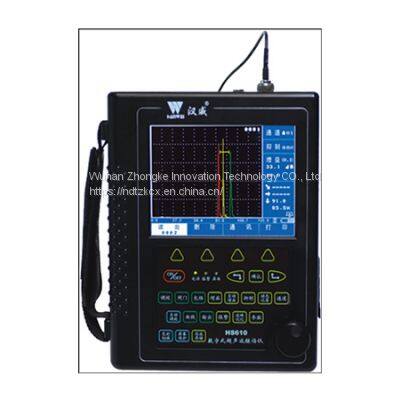
Digital Ultrasonic Flaw Detector


Related Products
-
 Rim DetectionNegotiableMOQ: 1 Piece
 -
HS PA20-Ex Multi-function Phased Array Ultrasonic Flaw DetectorNegotiableMOQ: 1 Piece
-
Welding Detection of Gears and DifferentialsNegotiableMOQ: 1 Piece
-
Ultrasonic Automatic Testing Equipment Series for PipesNegotiableMOQ: 1 Bag
-
Ultrasonic Automatic Testing Equipment For Plate SheetNegotiableMOQ: 1 Bag
/noraml-a-scan-detector-series/
A digital ultrasonic flaw detector is a specialized instrument used for non-destructive testing (NDT) to detect and analyze defects or flaws in materials using ultrasonic waves. It is commonly used in industries such as manufacturing, aerospace, automotive, and construction for quality control and inspection purposes.
The digital ultrasonic flaw detector utilizes the principle of ultrasonic sound waves. It generates high-frequency sound waves, typically in the range of 1 to 20 MHz, and sends them into the material being tested. These sound waves propagate through the material until they encounter a change in density or a defect within the material. When the sound waves encounter a defect, such as a crack, void, or inclusion, they are reflected back to the flaw detector.
The flaw detector's receiver unit captures the reflected sound waves and converts them into electrical signals. These signals are then processed and displayed on a digital screen, allowing the operator to analyze and interpret the findings. The instrument provides information about the size, location, and nature of the detected flaw, helping inspectors make informed decisions about the integrity of the material being tested.
Digital ultrasonic flaw detectors offer several advantages over their analog counterparts. They provide enhanced signal processing capabilities, improved measurement accuracy, and advanced data storage and analysis features. They often have a range of adjustable parameters, such as gain, frequency, and damping, allowing operators to optimize the inspection process for different materials and conditions. Additionally, digital flaw detectors can store test results, generate reports, and interface with other devices or software for further analysis or documentation.
These instruments are typically operated by trained technicians who have knowledge of ultrasonic testing principles and interpretation of the test results. They are widely used in the inspection of welds, forgings, castings, pipelines, and other critical components to ensure structural integrity and detect potential defects that may compromise safety or performance.

Send Inquiry to This Supplier

You May Also Like
-
Phased Array Ultrasonic Flaw DetectorNegotiableMOQ: 1 Set
-
Automatic Testing EquipmentNegotiableMOQ: 1 Set
-
HST-650 Ultrasonic Flaw Detector NDT Digital Ultrasonic Flaw DetectorUS$ 10496.85 - 11896.43MOQ: 1 Set
-
Digital Ultrasonic Flaw DetectorUS$ 50.00 - 50.00MOQ: 1 Piece
-
Digital Ultrasonic Flaw DetectorUS$ 1760.00 - 1760.00MOQ: 1 Set
-
Digital Ultrasonic Flaw Detector Detection Instrument With A-scan B-scan for MetalsUS$ 3500 - 4000MOQ: 1 Set
-
Fully Stocked Factory Directly Digital Ultrasonic Flaw DetectorNegotiableMOQ: 1 Case
-
Digital Ultrasonic Flaw DetectorUS$ 100 - 3,000MOQ: 1 Piece
-
Digital Ultrasonic Flaw DetectorNegotiableMOQ: 5 Sets
-
Digital Ultrasonic Flaw DetectorNegotiableMOQ: 1 Set


