








 Contact Platform Support
 Help Center
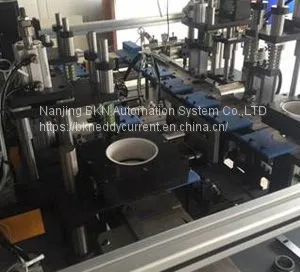
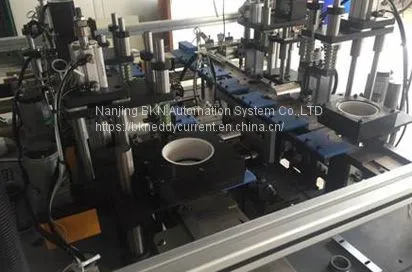
Bearing Ring Crack and Hardness Combination Flaw Detector TQJC-02


Related Products
The technology of BKN originated from eddy current Laboratory of Institute of Materials, Nanjing University of Technology. At present, it is a leading high-tech enterprise specializing in developing types of NDT non-destructive testing instruments and equipment in China. As one of the non destructive testing equipment suppliers, the company is committed to the development of eddy current, ultrasonic, magnetic flux leakage and various non-standard equipment, holding independent research and development of a number of national patents.
During the processing of bearing rings, various defects are often generated on the surface or inside, and cracks occupy a large proportion of all defects.
The cause of the cracks in the bearing rings is complicated. From the raw materials to the finished products of the ferrules, if the process is not proper, the cracks may be directly caused or the hidden cracks may be buried for the occurrence of the lap ring grinding cracks.
There are many ways to form cracks in bearing rings: Raw material defects include: cracks in raw materials and the effects of raw material defects on the grinding process.
Forging defects include forging cracks, effects of forged microstructure defects on the grinding process, and cutter cracks. There are also various heat treatment defects and the like. Therefore, crack testing equipment and hardness testing are essential. BKN has considerable experience in crack detection, and Bearing Ring Crack and Hardness Combination testing equipment is a perfect combination.
Bearing Ring Crack and Hardness Combination Flaw Detector TQJC-02 Brief Introduction
Detection process
Vibrating plate and string charging →hardness test→crack detection→automatic blanking
Bad product sorting
Automatic charging —automatic detection—automatic sorting —automatic blanking
Crack detection(the probe uses stainless steel casing+nano abrasion material ) to ensure long-term normal of the probe
Crack sensitivity: a crack with a depth of ≥0.05 mm and a length of ≥1 mm extending inward from the surface of the ferrule; for a crack that has not extended to the surface inside the ferrule, when the thickness between the subcutaneous surface and the surface of the workpiece is ≤0.2 mm, the depth is ≥0.20 mm Cracks of length ≥ 1 mm can be detected.
Hardness sensitivity: Rockwell 1HRC ~ 2HRC (other parameters remain stable and consistent).

Send Inquiry to This Supplier


You May Also Like
-
 Magnetic Flux Leakage Testing EquipmentUS$ 8 - 200MOQ: 1 Bag
 -
Benchtop Magnetic Flux Leakage Testing EquipmentUS$ 8 - 200MOQ: 1 Bag
-
Drill Pipe Magnetic Flux Leakage Detector MFL-308US$ 8 - 200MOQ: 1 Bag
-
MFL101 Tank Floor MFL ScannerUS$ 8 - 200MOQ: 1 Bag
-
Eddy Current Testing EquipmentUS$ 8 - 200MOQ: 1 Bag
-
Bearing Ring Crack and Hardness Combination Flaw Detector TQJC-02US$ 8 - 200MOQ: 1 Bag
-
BKNET-0102 Welded Pipe Eddy Current Flaw DetectorUS$ 8 - 200MOQ: 1 Bag
-
BKNET-101 Automatic Eddy Current TestingUS$ 8 - 200MOQ: 1 Bag
-
Bolt Eddy Current Sorter BKNFX-11US$ 8 - 200MOQ: 1 Bag
-
Connecting Rod Hardness Eddy Current Sorting Machine LGYDFX-01US$ 8 - 200MOQ: 1 Bag


