








 Contact Platform Support
 Help Center


Related Products
-
 Integrated MBR Waste Water Treatment PlantUS$ 5,000 - 20,000MOQ: 1 Set
 -
MBR Immersed Flat Membrane SystemUS$ 8,000 - 10,000MOQ: 1 Set
-
MBR Hospital Effluent Treatment PlantUS$ 8,000 - 10,000MOQ: 1 Set
-
Underground Plant of Integrated Sewage Treatment DeviceUS$ 15,000 - 69,000MOQ: 1 Set
-
Mechanical Bar Screen Machine for Waste Water TreatmentUS$ 4,600 - 10,500MOQ: 1 Set
Specifications
1.high treating effect2.long service
3.low cost
4.easy to install and maintain
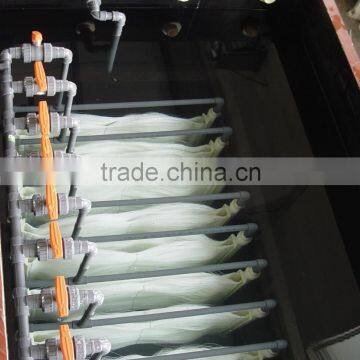
Membrane bioreactor (MBR) Sewage Treatment System
When used with domestic wastewater, MBR processes could produce effluent of high quality enough to be discharged to coastal, surface or brackish waterways or to be reclaimed for urban irrigation. Other advantages of MBRs over conventional processes include small footprint, easy retrofit and upgrade of old wastewater treatment plants.
It is possible to operate MBR processes at higher mixed liquor suspended solids (MLSS) concentrations compared to conventional settlement separation systems, thus reducing the reactor volume to achieve the same loading rate.
Recent technical innovation and significant membrane cost reduction have pushed MBRs to become an established process option to treat wastewaters.As a result, the MBR process has now become an attractive option for the treatment and reuse of industrial and municipal wastewaters, as evidenced by their constantly rising numbers and capacity.
COD removal and sludge yield
Simply due to the high number of microorganism in MBRs, the pollutants uptake rate can be increased. This leads to better degradation in a given time span or to smaller required reactor volumes. In comparison to the conventional activated sludge process (ASP) which typically achieves 95%, COD removal can be increased to 96-99% in MBRs. COD and BOD5 removal are found to increase with MLSS concentration. Above 15g/L COD removal becomes almost independent of biomass concentration at >97%.
Arbitrary high MLSS concentrations are not employed, however, as oxygen transfer is impeded due to higher and Non-Newtonian fluid viscosity. Kinetics may also differ due to easier substrate access. In ASP, flocs may reach several 100 μm in size. This means that the substrate can reach the active sites only by diffusion which causes an additional resistance and limits the overall reaction rate (diffusion controlled). Hydrodynamic stress in MBRs reduces floc size (to 3.5 μm in sidestream MBRs) and thereby increases the apparent reaction rate. Like in the conventional ASP, sludge yield is decreased at higher SRT or biomass concentration. Little or no sludge is produced at sludge loading rates of 0.01 kgCOD/(kgMLSS d).Due to the biomass concentration limit imposed, such low loading rates would result in enormous tank sizes or long HRTs in conventional ASP.
Nutrient removal
Nutrient removal is one of the main concerns in modern wastewater treatment especially in areas that are sensitive to eutrophication. Like in the conventional ASP, currently, the most widely applied technology for N-removal from municipal wastewater is nitrification combined with denitrification. Besides phosphorus precipitation, enhanced biological phosphorus removal (EBPR) can be implemented which requires an additional anaerobic process step. Some characteristics of MBR technology render EBPR in combination with post-denitrification an attractive alternative that achieves very low nutrient effluent concentrations.

Send Inquiry to This Supplier

You May Also Like
-
Water Bath SterilizerNegotiableMOQ: 1 Set
-
Cold Press Compactor EPS Foam Melter and Compressor Hot Melt Cold Press Crusher With Hot Melt and Cold PressUS$ 2599.00MOQ: 1 Set
-
Replaceable Knives Wood Chipper Digital Maximize Efficiency for BiomassNegotiableMOQ: 1 Set
-
M931 Pex Plastic Water Ice LineNegotiableMOQ: 1
-
Nickel-Iron FoamNegotiableMOQ: 10 Square Miles
-
Refuse IncineratorUS$ 5900 - 25000MOQ: 1 Piece
-
Portable Foam Wall Chemical Oil Proof 750 Gallon Flexible Pvc Spill Containment BermNegotiableMOQ: 1
-
More Than 20 Years Factory Supply Plastic Baler MachineNegotiableMOQ: 1 Set
-
Plastic To Oil Pyrolysis Plant (Continuous Type - 3TPD to 24 TPDUS$ 298,000 - 1,344,000MOQ: 1 Plant
-
Oil Drilling Cutting Waste ManagementNegotiableMOQ: 1 Set


