








 Contact Platform Support
 Help Center
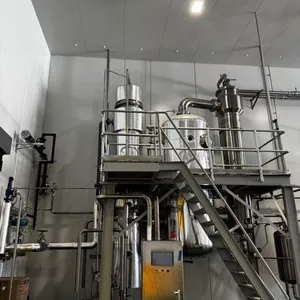
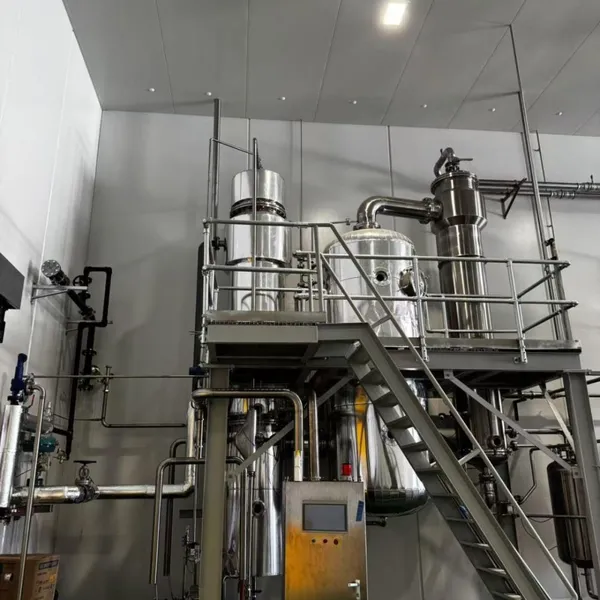
Single-effect Falling Film Evaporator



Related Products
-
 Water Cooling Rotary Drum Flaker for Condensing and CrystallizingNegotiableMOQ: 1 Set
 -
Rotary Scraper Thin-Film Evaporator for Concentration, Distillation and PurificationNegotiableMOQ: 1 Set
-
Scraper Thin Film EvaporatorNegotiableMOQ: 1 Set
-
High Efficiency Rotary Scraper Thin Film EvaporatorNegotiableMOQ: 1 Set
-
High Efficiency Rotary Scraper Film EvaporatorNegotiableMOQ: 1 Set
Low-Temperature Evaporation for Heat-Sensitive Products
The Single-Effect Falling Film Evaporator is a highly efficient evaporation and concentration system designed for processes where low evaporation temperature, short residence time, and product quality are critical.
It is particularly suitable for heat-sensitive and low-to-medium viscosity liquids used in the food and beverage, pharmaceutical, biotechnology, fine chemical, petrochemical, and environmental industries.
Unlike multi-effect evaporation systems, which require a temperature difference between individual effects to provide the necessary heat transfer driving force, a single-effect falling film evaporator operates with only one evaporation stage. This allows the complete evaporation process to be maintained at a controlled low boiling temperature under vacuum.
For applications where even short exposure to elevated temperatures may affect color, flavor, nutrients, active ingredients, or product stability, a single-effect falling film evaporator can therefore be a more appropriate solution than a multi-effect system.
Working Principle
The feed enters the upper section of the falling film heater and is evenly distributed into the heat exchange tubes through a specially designed liquid distribution system.
The liquid flows downward along the inner surface of the tubes under gravity, forming a thin and uniform liquid film.
Steam or another heating medium is introduced on the shell side of the heater. Heat is transferred through the tube wall to the falling liquid film, causing part of the liquid to evaporate rapidly.
The resulting vapor-liquid mixture enters the separator, where efficient vapor-liquid separation takes place.
The concentrated product is discharged from the separator, while the secondary vapor is directed to the condenser and converted into condensate.
A vacuum system maintains the required operating pressure, reducing the boiling point of the liquid and enabling evaporation at a relatively low temperature.
The basic process can be summarized as:
Feed → Liquid Distribution → Falling Film Evaporation → Vapor-Liquid Separation → Concentrated Product
Why Choose a Single-Effect Falling Film Evaporator?
One of the main reasons for selecting a single-effect falling film evaporator is the requirement to maintain a low evaporation temperature throughout the concentration process.
In a multi-effect evaporation system, secondary vapor generated from one effect is reused as the heating medium for the following effect. To make this heat transfer possible, a certain effective temperature difference must be maintained between the effects.
Therefore, the evaporation temperatures of individual effects are normally arranged progressively from higher to lower temperatures.
Even if the final effect operates at a relatively low temperature, the upstream effects usually need to operate at higher temperatures.
For highly heat-sensitive products, exposure to these higher temperatures may not be desirable.
A single-effect system avoids this temperature cascade. Since only one evaporation stage is used, the entire process can be designed around the required low boiling temperature by achieving a high vacuum level.
This makes the system particularly suitable when:
A strict maximum product temperature must be maintained;
The product is highly sensitive to heat;
Color, flavor, aroma, nutrients, or active ingredients must be preserved;
Product quality is more important than maximum steam economy;
Short thermal exposure is required.
Key Features and Advantages
1. Short Residence Time
The product flows downward through the heat exchange tubes as a thin liquid film.
Heating and evaporation occur rapidly, allowing the product to complete the main evaporation process within a short residence time.
This minimizes prolonged thermal exposure and helps reduce the risk of product degradation.
2. High Heat Transfer Efficiency
The thin liquid film provides efficient contact with the heat transfer surface and results in a high heat transfer coefficient.
Compared with evaporation systems that involve a significant liquid head, falling film evaporation also minimizes temperature loss caused by hydrostatic pressure.
Efficient heat transfer can therefore be maintained even under relatively small temperature differences.
3. Efficient Liquid Distribution
Uniform liquid distribution is essential to the performance of a falling film evaporator.
A specially designed liquid distributor ensures that the feed is evenly distributed into the heat exchange tubes and forms a continuous liquid film along the tube walls.
Good liquid distribution helps:
Improve heat transfer efficiency;
Prevent local dry areas;
Reduce overheating risk;
Improve operating stability;
Accommodate reasonable variations in feed flow.
4. Vacuum and Low-Temperature Operation
The system normally operates under vacuum conditions.
Reducing the system pressure lowers the boiling temperature of the liquid, enabling evaporation at significantly lower temperatures than atmospheric boiling.
This is especially beneficial for heat-sensitive materials.
5. Better Protection of Product Quality
The combination of low evaporation temperature and short residence time helps preserve important product characteristics.
Depending on the application, this may include:
Flavor;
Aroma;
Color;
Nutrients;
Active pharmaceutical ingredients;
Biological activity;
Temperature-sensitive chemical properties.
6. Low Pumping Power
Compared with high-circulation evaporation systems, falling film evaporation generally requires lower liquid circulation rates.
This can reduce pump capacity, installed motor power, and electricity consumption.
7. Compact Equipment Design
High heat transfer efficiency allows the required evaporation duty to be achieved within a relatively compact equipment arrangement.
This helps reduce installation space and simplify plant layout.
8. Flexible Automatic Operation
The evaporator can be equipped with instruments and automatic controls for critical parameters.
PLC-based automatic control can be provided for stable and continuous operation.
9 CIP Cleaning Available
For hygienic applications or products requiring frequent cleaning, an integrated Clean-in-Place (CIP) system can be provided.
The CIP system allows cleaning solutions to circulate through the product-contact surfaces without major equipment disassembly, reducing cleaning time and improving production efficiency.
Main Components
A typical Single-Effect Falling Film Evaporator may include:
Feed pump;
Feed preheater;
Liquid distribution system;
Falling film heater;
Vapor-liquid separator;
Condenser;
Vacuum system;
Concentrated product discharge pump;
Condensate pump;
Process piping and valves;
Instrumentation;
PLC control system;
CIP system, optional;
The final equipment configuration is determined according to the process requirements and available utilities of each project.
Is a Falling Film Evaporator Suitable for Your Product?
A falling film evaporator is generally suitable for liquids with:
Low to moderate viscosity;
Good flowability;
Good film-forming characteristics;
Heat-sensitive properties;
Limited fouling tendency;
A requirement for short residence time;
A requirement for low-temperature evaporation.
For products with very high viscosity, significant crystallization, heavy scaling, high suspended solids content, or poor film-forming properties, other configurations such as a Forced Circulation Evaporator may be more suitable.
Evaporator selection should therefore be based on actual product properties and process requirements.
Request a Customized Evaporation Solution
Looking for a Single-Effect Falling Film Evaporator for your process?
Provide us with your feed composition, feed capacity, initial concentration, target concentration, required evaporation temperature, maximum allowable product temperature, and available utilities.
Our engineering team can evaluate your process and recommend a suitable evaporation solution.
Contact ENCHEM for technical consultation and a customized Single-Effect Falling Film Evaporator solution.

Send Inquiry to This Supplier


You May Also Like
-
Vacuum Decompression Concentrator (Tank)NegotiableMOQ: 1 Set
-
Containerized Low-Temperature Heat Pump Concentration EvaporatorNegotiableMOQ: 1 Set
-
Containerized Low-Temperature Heat Pump Crystallization EvaporatorNegotiableMOQ: 1 Set
-
Integrated MVR EvaporatorNegotiableMOQ: 1 Set
-
MVR Evaporator for Smelting Wastewater TreatmentNegotiableMOQ: 1 Set
-
Mutiple-effect MVR EvaporatorNegotiableMOQ: 1 Set
-
Tubular Falling Film EvaporatorNegotiableMOQ: 1 Set
-
Mutiple-effect Forced Circulation EvaporatorNegotiableMOQ: 1 Set
-
Triple-effect Evaporating Crystalizer for Inorganic Salt ProductionNegotiableMOQ: 1 Set
-
Falling Film Evaporator With Molten Salt System for Caustic Soda 50% - 99% ConcentrationNegotiableMOQ: 1 Set

