








 Contact Platform Support
 Help Center
University Engineering Lab Workbench — Modular ESD Table for Makerspace & Student Projects
Product Spotlights



Related Products
-
 ECU Repair Workbench — Anti Static Work Station for Automotive Electronics & Module TuningUS$ 60 - 220MOQ: 5 Combos
 -
Hengna Industrial Production Work Table|Heavy Duty Solid Wood Workbench for WorkshopUS$ 300 - 800MOQ: 2 Cases
-
Commercial Workbench Supplier |Multi Metal Work Bench With Drawers OMDUS$ 300 - 800MOQ: 2 Cases
-
Multi Metal Work Benches Electrical Workshop Workbench|US$ 300 - 800MOQ: 2 Cases
-
Heavy Duty Workbench for Garage & Workshop | Industrial Strength WorkbenchesUS$ 200 - 600MOQ: 5 Sets
University Engineering Lab Workbench — Modular ESD Table for Makerspace & Student Projects
University lab managers face a problem that factory production managers don't.
In a factory, the same operator uses the same bench every day. They treat it like their own. In a university lab, one bench gets used by twenty different students every week. Some of them have never held a soldering iron before. Some of them will lean on the bench with their full body weight while debugging a PCB. Some of them will spill flux cleaner, drop screwdrivers, and drag prototype robots across the surface.
The bench needs to survive all of that — and still function as an ESD-safe workstation when the next class walks in.
We build lab workbenches that hold up to university use.
The work surface: made for students, not operators
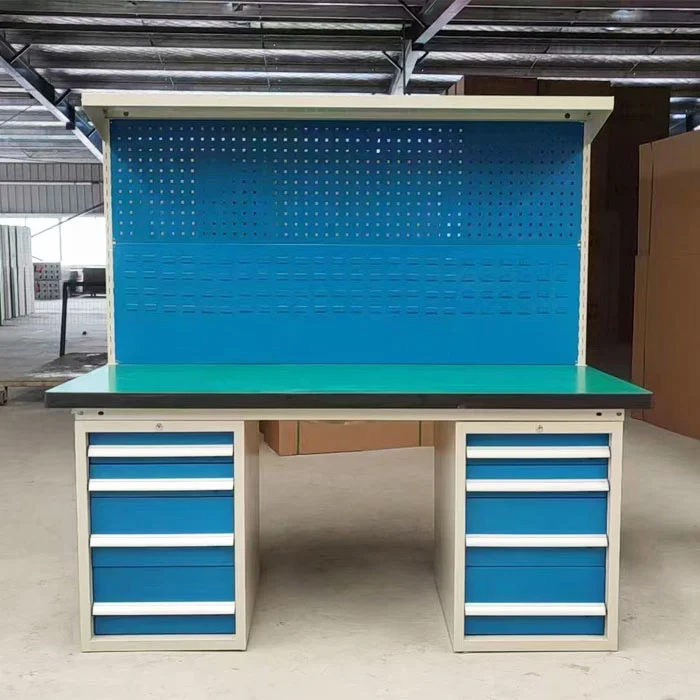
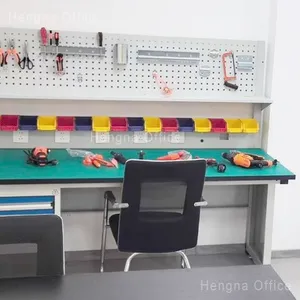
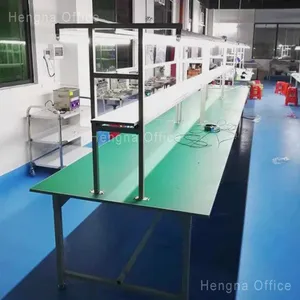
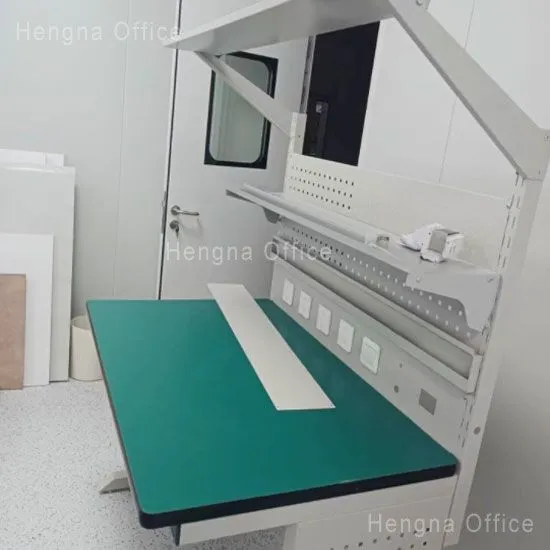
Our bench top is a 5mm polymer composite ESD laminate, bonded under heat and pressure to a high-density fiberboard core. The edges are sealed with black PVC banding.
Surface resistance holds at 10⁶–10⁹ ohms — within ANSI/ESD S20.20 spec. It connects to your lab earth ground through a steel ground chain on the frame.
But here's what matters for a university lab: the surface is hard to damage. Students will place hot soldering irons on it by accident. They'll drag Arduino boards with sharp header pins across it. They'll spill isopropyl alcohol while cleaning flux. The laminate handles all of that. It doesn't scorch easily. It doesn't scratch from PCB edges. It wipes clean with IPA.
The surface is forest green — chosen because it reduces eye strain under fluorescent classroom lighting. Students spend hours at these benches. Green is the easiest color on the eyes over long periods.
The frame: overbuilt because students are unpredictable
We use cold-rolled steel for the welded frame. The same frame we use in industrial benches rated for 3,000 kg uniform load. A makerspace bench will never see that kind of weight, but the frame's real advantage in a university setting is rigidity.
A student leaning on the edge of the bench while soldering shouldn't feel any wobble. A robotics team mounting a mechanical arm to the tabletop shouldn't strip the threads because the frame flexes. A 3D printer running on the bench shouldn't have its prints ruined by vibrations from the person working next to it.
Cold-rolled steel gives you that rigidity. The frame is consistent, smooth, and coated with electrostatic powder coating baked at 180°C. It won't chip, flake, or rust — even if students spill water or soda on it (which they will).
Adjustable leveling feet come standard. University lab floors are never perfectly level. Adjust the feet, the bench stays put.
| Parameter | Options |
|---|---|
| Width | 1200 / 1500 / 1800 / 2100 mm |
| Depth | 750 mm |
| Height | 800 mm |
| Pegboard | 450 mm, optional |
Storage: flexible because your curriculum changes
The beauty of a modular system for a university lab is that the bench adapts to the course, not the other way around.
This semester you're teaching embedded systems — students need soldering stations with tool holders and multimeter hooks. Next semester it's robotics — they need space for motor drivers, battery packs, and mechanical assemblies. The year after that, it's PCB design — they need magnifying lamps and programming cable organizers.
With our modular components, you reconfigure the bench in 20 minutes.
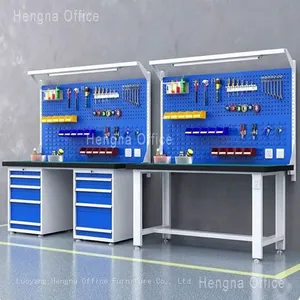
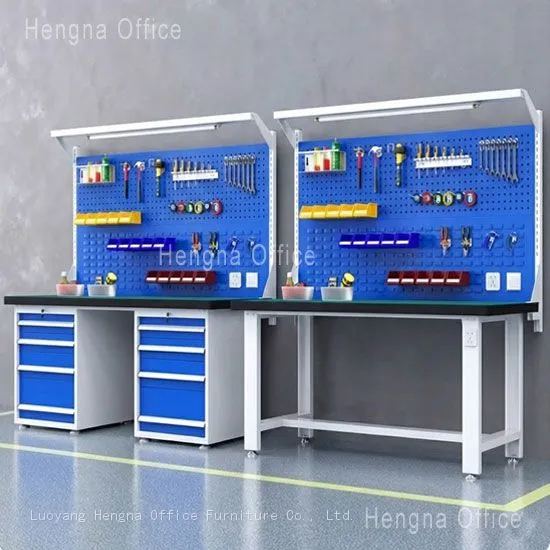
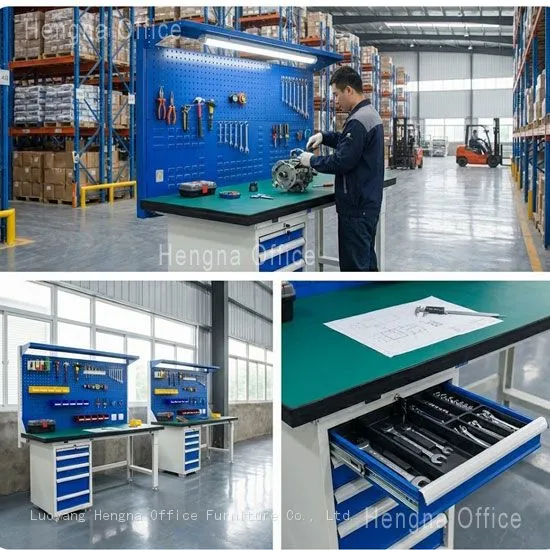
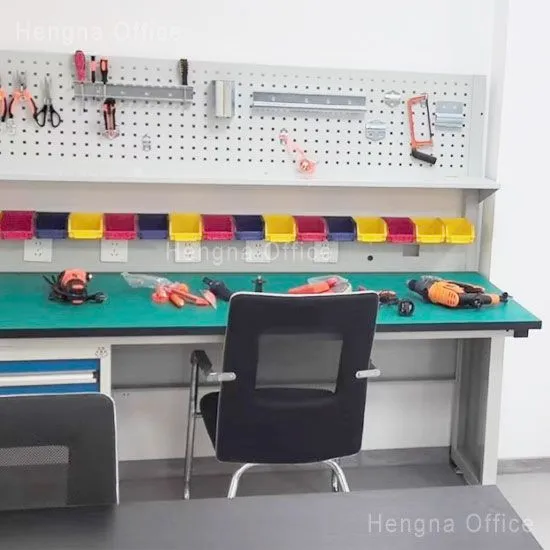
Square hole pegboard — 10×10mm holes on 28mm centers. Hang soldering irons, helping hands, wire cutters, multimeter probes. Everything visible, no digging through drawers.
Louver pegboard — 50×20mm slots for bin brackets. Keep resistors, capacitors, jumper wires, connectors sorted by type. Students can see what's available without opening anything.
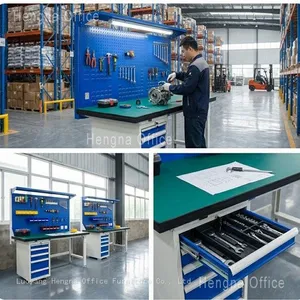
Drawer units — mount under the tabletop. Linked self-locking lock with one key. Keep expensive items — oscilloscope probes, programmer dongles, lab-only tools — locked between sessions.
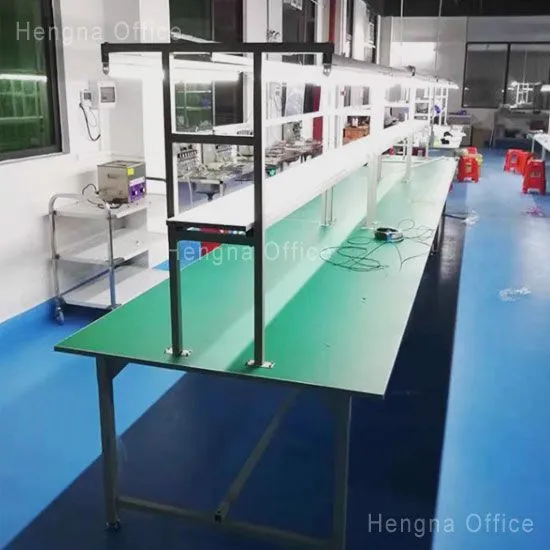
Light frame — top-mounted, provides even illumination. No shadows when students are inspecting solder joints or reading component labels on a PCB.
All components are interchangeable. Buy a set of benches with pegboards this year. When the curriculum changes, add louver boards and drawer units without replacing the tables.
Power: built into the frame, not on the table
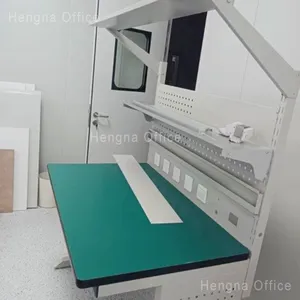
Recessed outlet panel on the back frame. One five-outlet socket (two-prong + three-prong) and one circuit breaker.
In a student lab, power strips sitting on the bench are a hazard. Cords get tangled. Strips get knocked off the table. Students plug in high-current devices without checking the load. Our panel is fixed to the frame, out of the way, with a built-in breaker for protection.
The socket placement also means each station has dedicated power. No daisy-chaining extension cords across the lab.
Packaging and assembly
KD packaging: each steel component wrapped in VCI moisture-proof film, foam edge protectors, hardware bagged and taped to the frame.
Assembly by your facilities team: roughly 20 minutes per bench. Printed photo guide included.
What our university customers tell us
A lab manager at a university in Malaysia recently ordered 24 benches for a new engineering building. His comment after the first semester: "The benches look as good as the day we installed them. Students have tried to damage them. They haven't succeeded."
That's the kind of feedback we design for.
FAQ
Can we buy with a university purchase order? Yes. We work with university procurement departments worldwide. PO-based invoicing is standard.
What's the typical order size for a university lab? Depends on the lab size. Common orders range from 10 to 50 benches for a full engineering wing. We also sell single units for pilot labs and research groups.
Do you offer educational pricing? Yes. Contact us with the quantity and department information. Educational discounts apply to accredited institutions.
Can the bench support a 3D printer? Yes. The frame is rigid enough for desktop 3D printers (Creality, Bambu Lab, Prusa, etc.). We recommend the 1800mm width for 3D printing stations to leave room for the printer plus a laptop and tooling.
Is the ESD surface replaceable? In theory yes, but in practice most universities never need to replace it. The bonded laminate outlasts the student turnover cycle by a wide margin.
How does it ship? KD package. Typical lead time 15–20 working days. FOB Shanghai or CIF destination port. Quote within 24 hours.
If you're equipping a new engineering lab, makerspace, or FabLab and need workbenches that survive student use — send the room dimensions and number of stations. We'll send back a layout recommendation and quote the same day.

Send Inquiry to This Supplier



You May Also Like
-
Modular Workbench With Pegboard for Tool OrganizationUS$ 600 - 1200MOQ: 5 Combos
-
Heavy-Duty Automotive Workbench - 1000 Lbs Capacity Steel Workbench for Car Repair ShopsUS$ 200 - 600MOQ: 5 Sets
-
Industrial Steel Workbench for Manufacturing - Heavy-Duty Assembly Workstation With StorageUS$ 200 - 600MOQ: 5 Sets
-
Hengna Welding Workbench Heavy-Duty - Fire-Resistant Steel Workbench for Metal FabricationUS$ 200 - 600MOQ: 5 Sets
-
Hengna Professional Woodworking Workbench - Heavy-Duty Bench With Vise for Carpenter ShopsUS$ 200 - 600MOQ: 5 Sets
-
Portable Heavy Workbench for Construction - Folding Steel Workbench for Job Sites SupplierUS$ 200 - 600MOQ: 5 Sets
-
Hengna Maintenance Workbench Heavy-Duty - Industrial Repair Bench With Tool Storage DistributorUS$ 200 - 600MOQ: 5 Sets
-
Hengna Educational Heavy Workbench - Student Steel Workbench for Vocational Training CentersUS$ 200 - 600MOQ: 5 Sets
-
Hengna Supplier Home Garage Blue Heavy Workbench - Professional Steel Workbench for DIY ProjectsUS$ 200 - 600MOQ: 5 Sets
-
Hengna Aviation Maintenance Workbench - Precision Heavy-Duty Bench for Aircraft RepairUS$ 200 - 600MOQ: 5 Sets

