








 Contact Platform Support
 Help Center
HACCP Compliant Food Grade Cleaning Cabinet — 304 SS, 500×400×1800mm, With Drain and Lock
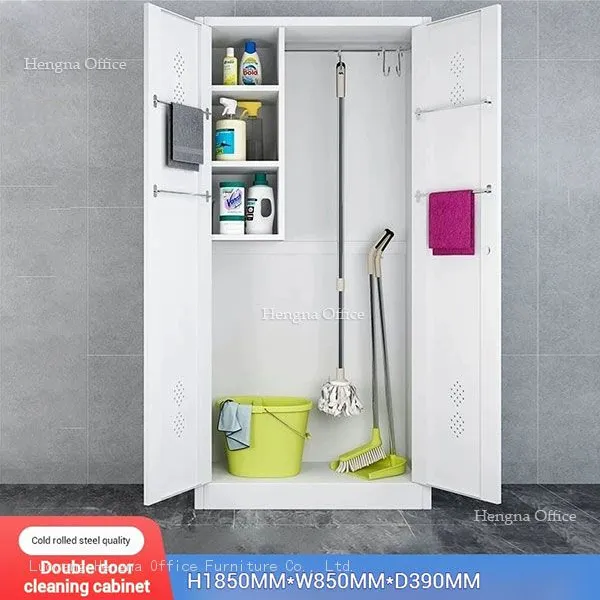
Product Spotlights



Related Products
-
 1800mm Stainless Steel Cleaning Cabinet With Floor Drain — Hang Wet Mops, Water Drains OutUS$ 80 - 200MOQ: 5 Combos
 -
Hospital Cleaning Cabinet 304 Stainless Steel Lock Drain | Janitorial Closet CE OEM HengnaUS$ 80 - 200MOQ: 5 Combos
-
Efficient Industrial-grade Heavy Tool Chest Machinery Tool Storage Cabinet -OEMNegotiableMOQ: 10 Pieces
-
High - Quality CNC Workshop Tool Cabinet Heavyweight Workshop Tool OrganizerNegotiableMOQ: 10 Pieces
-
Factory-based Heavy Tool Chest Robust Tool Storage Unit SupplierNegotiableMOQ: 20 Pieces
Food processing plants don't buy cleaning cabinets. They buy audit-proof storage for cleaning chemicals and wet tools that won't get them a finding during the next HACCP inspection.
This cabinet is built for that. 304 stainless steel—food grade, the same material used on prep tables and processing equipment. Drainage because standing water is a microbiological hazard. Lockable because cleaning chemicals and food production areas don't mix. If your facility has a HACCP plan, this cabinet checks three boxes on it.
What a HACCP auditor sees when they look at your cleaning cabinet
When the auditor walks the production floor, they're not just checking the processing line. They check the cleaning supply storage. They look for cross-contamination risks between cleaning chemicals and food contact surfaces. They check for standing water that can harbor Listeria. They check that the cabinet itself isn't rusting—because rust particles can become physical contaminants.
An HACCP auditor will open your cleaning cabinet door. Here's what they don't want to find:
Water pooled at the bottom. That's a microbiological risk. Standing water breeds bacteria that can transfer to mops, then to floors, then to anything that touches the floor.
Rust on the cabinet body or shelves. In a food facility, rust is a physical contaminant. If it flakes off and lands on a surface, it's a non-conformance.
Cleaning chemicals stored next to or above items that touch food-contact surfaces. Cross-contamination risk. Chemicals go low, food-contact items stay separate, ideally in a different cabinet entirely.
Chemicals unlabeled or unlocked. Anyone can access them. That's a chemical control failure.
This cabinet addresses every one of those. 304 stainless—no rust, no flaking. Drain pan—no standing water. Lockable—chemical access controlled. Separate shelves for different categories of supplies.
Why 304 stainless is non-negotiable in food facilities
Food processing environments use aggressive cleaning chemicals. Chlorinated alkaline cleaners for equipment. Acid-based descalers for hard water buildup. Quaternary ammonium sanitizers for surface disinfection. Peracetic acid for aseptic packaging lines.
201 stainless doesn't hold up to this chemical combination. It lacks molybdenum, which resists chloride pitting. In a food plant, 201 will show corrosion at the weld points within a year. Once corrosion starts, it becomes a physical contaminant source and a microbiological harborage point—bacteria can live in the pits.
304 stainless contains 8-10% nickel and molybdenum. It resists the full range of food plant cleaning chemicals. It doesn't pit. It doesn't rust. It doesn't provide a surface for biofilm to form on. When the auditor runs a swab test on the cabinet surface, 304 stainless passes.
This is also why the drain pan is 304, not plastic. Plastic pans develop micro-scratches over time that harbor bacteria. 304 pans can be sanitized with the same quaternary ammonium used on production equipment. One cleaning chemical, one procedure, no separate SOP needed.
Drainage: the difference between a finding and a pass
HACCP plans classify standing water as a microbiological hazard. If your cleaning cabinet has water pooled at the bottom, that's a finding. It doesn't matter if you clean it weekly. The auditor sees standing water during the inspection, they write it up.
The drain hole and removable drain pan solve this structurally. Water from wet mops and cleaning tools drains immediately to the pan. The pan gets emptied at end of shift as part of the sanitation SOP. The cabinet interior stays dry. The auditor opens the door and sees a dry, clean interior.
Document it in your sanitation schedule. "Drain pan emptied and sanitized at end of each production shift." Add a sign-off column. Now it's a controlled process, not something that happens when someone remembers.
Specs
| Item | Spec |
|---|---|
| Material | 304 stainless steel (food grade, HACCP compliant) |
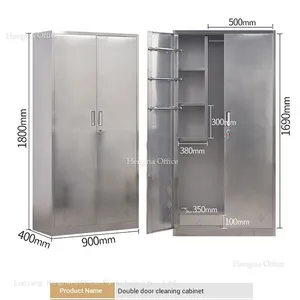
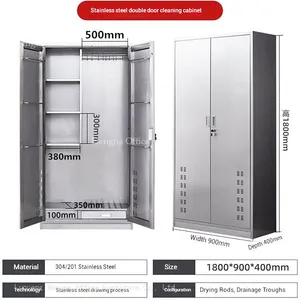
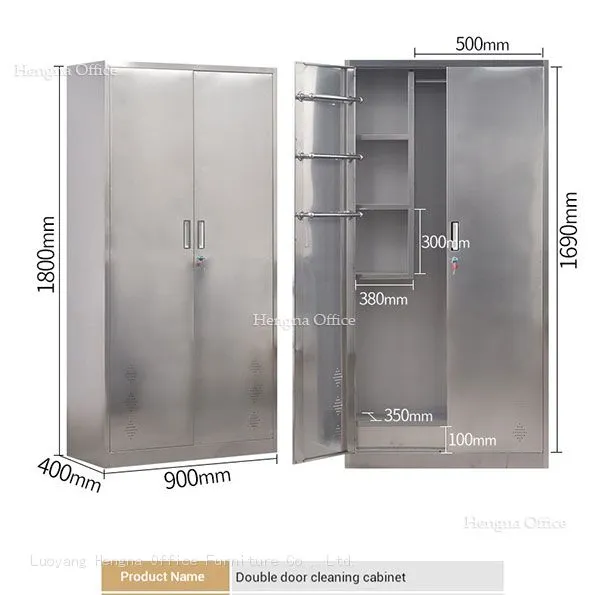
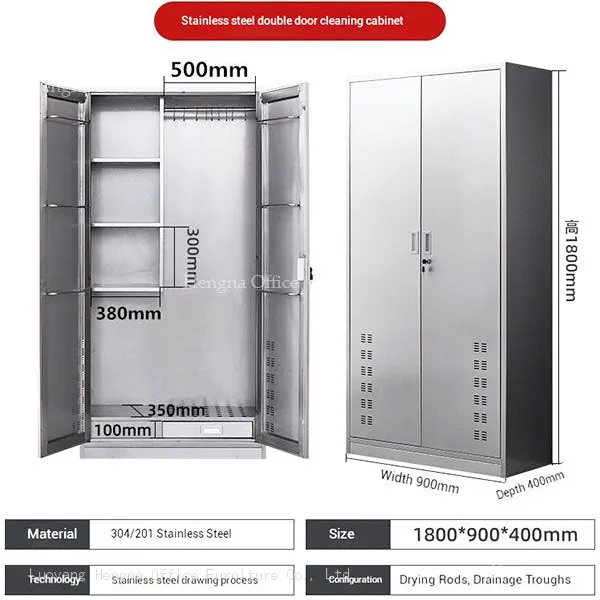
| Dimensions | W500 × D400 × H1800mm (with feet) / H1690mm (body) |
| Door | Double door, key lock |
| Shelf spacing (top to bottom) | 300 / 380 / 350 / 100mm |
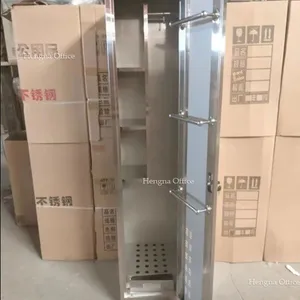
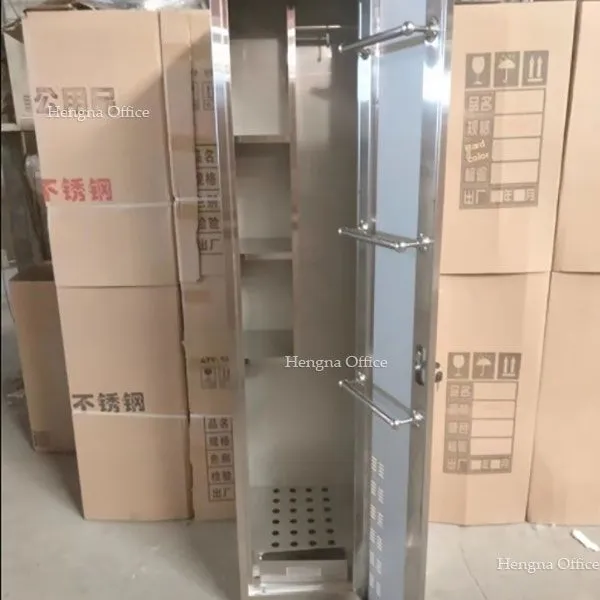
| Drainage | Bottom drain hole + removable drain pan (304 SS) |
| Drying rod | 304 stainless steel bar |
| Hooks | Side panel hooks (304 SS) |
| Lock | Steel cylinder, anti-pry |
Where this cabinet sits in your HACCP plan
Your HACCP plan already has sections for chemical control, sanitation, and physical hazard prevention. This cabinet maps to all three.
Chemical control: Cleaning chemicals stored in a lockable, labeled cabinet. Access limited to sanitation team. Chemical inventory tracked separately from production supplies. Lock and key management satisfies the "controlled access" requirement.
Sanitation: Wet cleaning tools stored in a way that allows drainage and drying. No standing water. Drain pan emptied and sanitized per SOP. Cabinet exterior wiped down during pre-op sanitation. All of this is documentable.
Physical hazard prevention: 304 stainless steel—no rust, no flaking, no particle generation. Cabinet body is smooth and non-porous. Cleanable with standard plant sanitation chemicals. No coating or paint that could peel into product.
When the auditor asks about cleaning tool storage, you show them this cabinet. When they ask for the sanitation log for the cabinet, you show them the sign-off sheet. When they ask about the material, you show them the 304 stainless certification. Three questions, three answers, no findings.
What goes where in a food plant cleaning cabinet
In a food facility, segregation isn't organization. It's contamination prevention.
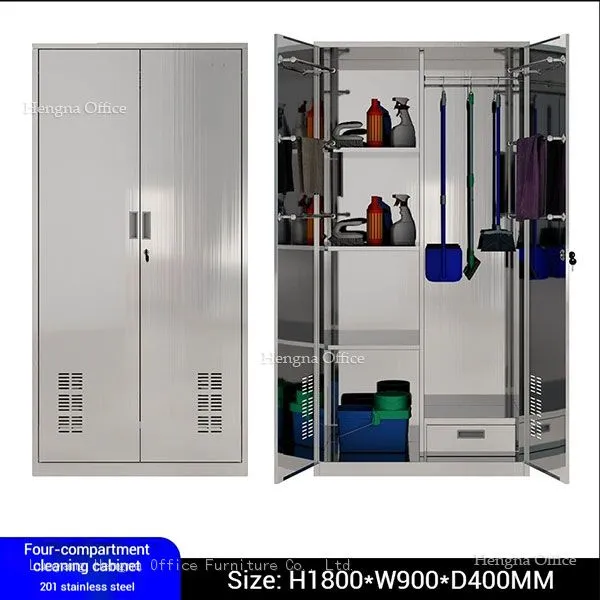
Top shelf: backup PPE—gloves, aprons, hairnets. Not chemicals. PPE goes above chemicals so it can't get dripped on.
Middle shelf with drying rod: color-coded cleaning tools hung to dry. Red tools for raw processing areas, white for finished product areas, blue for general facility. Color zones prevent cross-contamination between high-risk and low-risk zones.
Bottom shelf with drain pan: mop heads and floor squeegees hung above the pan. Any water drips into the pan, not onto the shelf. Wet tools dry overnight. Dry tools don't grow bacteria.
Side hooks: dedicated brushes for equipment cleaning, separate from floor brushes. Labeled. Nobody grabs the floor brush to clean a conveyor belt.
If your plant uses a zoning system—low-care, high-care, high-risk—each zone gets its own cabinet. Tools don't cross zones. Each cabinet is labeled with the zone name and the color code. The auditor walks through, sees the system, moves on.
The sanitation schedule: what to include
Add these lines to your master sanitation schedule:
End of each production shift: empty and sanitize drain pan, wipe down cabinet exterior with approved sanitizer.
Weekly: remove all items from cabinet, sanitize interior surfaces including shelves and drying rod, record in sanitation log.
Monthly: inspect cabinet body and welds for any signs of wear, verify lock function, verify drain hole is clear, record in maintenance log.
That's it. The cabinet itself doesn't need special treatment beyond what your facility already uses for 304 stainless equipment. Same chemicals. Same schedule. Same documentation.
Questions from QA managers and plant engineers
Q: Will 304 hold up to our sanitation chemicals? A: Yes. 304 stainless is rated for chlorinated alkaline cleaners, quaternary ammonium sanitizers, peracetic acid, and iodine-based sanitizers at standard concentrations. If your facility uses highly concentrated acid washes or bleach at concentrations above 200 ppm for extended contact, let us know and we'll verify compatibility. For standard food plant sanitation, 304 is the industry standard.
Q: Can we get material certification for our supplier audit file? A: Yes. We provide a material certificate confirming 304 stainless steel composition including nickel and molybdenum content. This goes in your supplier approval file and your HACCP supporting documentation.
Q: We run 24/7 with four shift cleanings. How often should the drain pan be emptied? A: End of every shift, as part of the shift-change sanitation procedure. Four shifts means four drain pan emptyings per day. Put it in the SOP, put a sign-off sheet on the cabinet, and make it part of the shift handoff checklist.
Q: We need each production zone color-coded. Can the cabinet exterior be marked? A: Yes. We can apply zone labels and color indicators at the factory. Red zone, white zone, blue zone—tell us the scheme. Alternatively, we ship the cabinet unmarked and your facility team applies the labels per your internal system.
Q: This is for a new facility. Can you hold delivery until construction is complete? A: Yes. Standard lead time is 2-4 weeks from order. We can schedule delivery to match your construction completion window. Order early, specify the delivery date.
Q: Minimum order for a plant-wide rollout? A: Samples: 1 unit. Plant-wide orders: 10+ units for volume pricing. Contact us with your zone count and facility layout.
About us
Luoyang Hengna Office Furniture Co., Ltd. 9 years in steel furniture. We supply food processing facilities across North America, the Middle East, and Southeast Asia—from single-plant orders to multi-facility rollouts. Our HACCP-compliant line was developed with input from QA managers who told us exactly what auditors look for.
We work directly with our production base. CE certified. Material certification provided with every order. OEM available for plant-specific labeling and zone marking.
Need a quote for your facility? Send the number of units and delivery destination. Response within 24 hours.

Send Inquiry to This Supplier



You May Also Like
-
Industrial-strength Tool Chest in Factory High-capacity Tool CabinetNegotiableMOQ: 25 Pieces
-
Durable Tool Storage in Factory HNGJ703 Hard Wearing Metal Industrial Tool ChestNegotiableMOQ: 18 Pieces
-
Juntuo -CNC Tool Storage Cabinet With Full Extension Drawers for Machine Shop Use | OEM/ODMUS$ 150 - 500MOQ: 5 Pieces
-
Heavy Duty Tool Cabinet With Multiple Drawers for Industrial Workshop Storage|Mold Workshop Tool CabinetUS$ 150 - 500MOQ: 5 Pieces
-
CNC Tool Holder Cabinet for Precision Tool Management in Manufacturing Plants| Garage Tool Storage CabinetUS$ 150 - 500MOQ: 5 Pieces
-
Industrial Metal Tool Storage Cabinet With Lock | Factory Direct Supply|Small Parts Storage CabinetUS$ 150 - 500MOQ: 5 Pieces
-
Rolling Tool Cart With Drawers for Automotive Repair Workshops|Pegboard Tool Cabinet-Blue & WhiteUS$ 150 - 500MOQ: 5 Pieces
-
Mobile Tool Trolley Cabinet for Garage and Assembly Line Workstations|Drawer Tool CabinetUS$ 150 - 500MOQ: 5 Pieces
-
Industrial Drawer Tool Cabinet With Double-Rail Slide System | Custom Sizes|Triple Rail Drawer Tool CabinetUS$ 150 - 500MOQ: 5 Pieces
-
Mobile Tool Trolley Cabinet for Garage and Assembly Line Workstations|Drawer Tool CabinetUS$ 150 - 500MOQ: 5 Pieces


