








 Contact Platform Support
 Help Center
Saman Permanent Magnet Variable Frequency Screw Air Compressor MV-150A

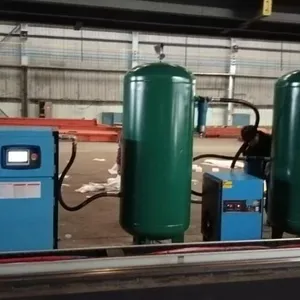

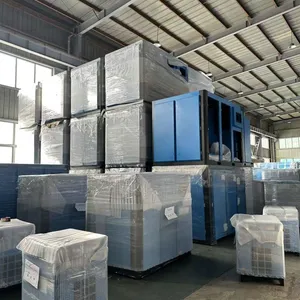

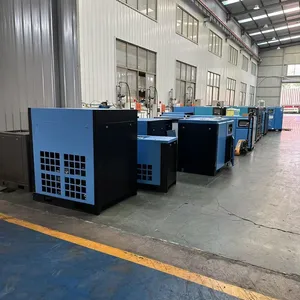
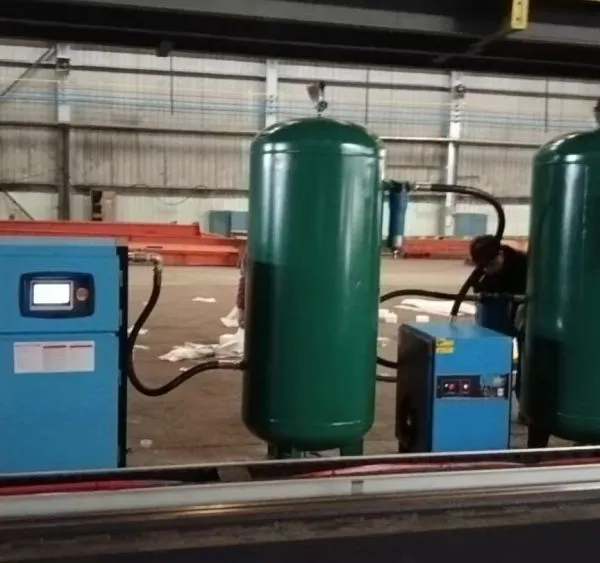

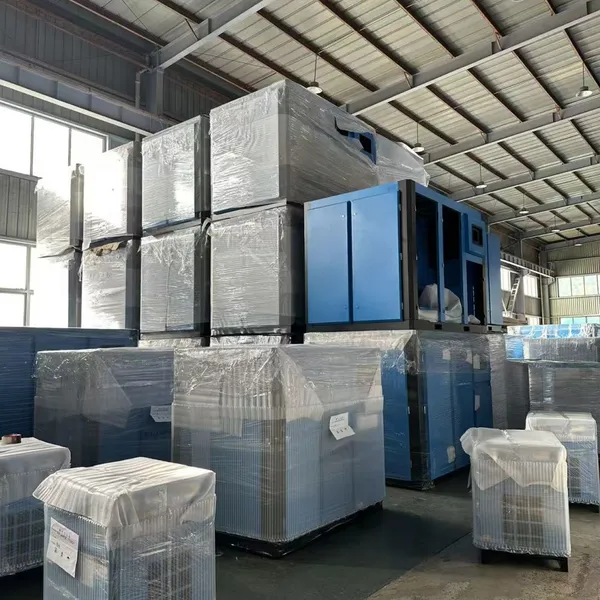

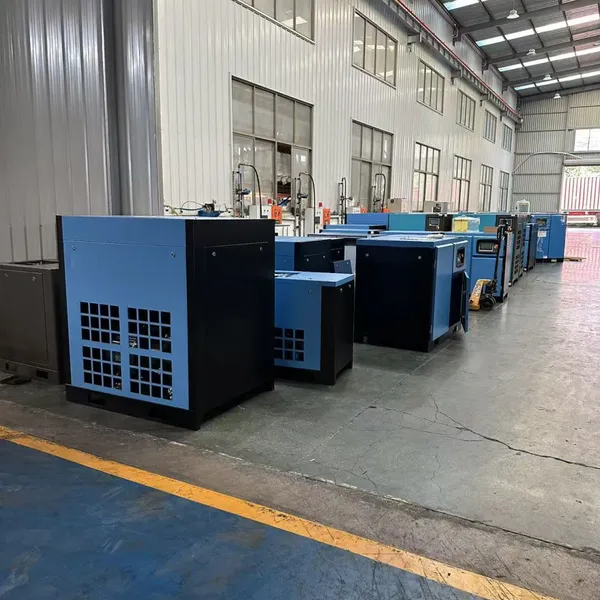
Product Spotlights


Related Products
-
 Saman MV-10A Permanent Magnet Variable Frequency Screw Air CompressorNegotiableMOQ: 1 Piece
 -
MA-10A Saman Screw-type Air CompressorNegotiableMOQ: 1 Piece
-
Saman Permanent Magnet Variable-frequency Screw Air Compressor MV-20A is Energy-saving and Environmentally Friendly.NegotiableMOQ: 1 Piece
-
Saman MV-30A Permanent Magnet Variable Frequency Screw Air Compressor - Energy-saving and Environmentally FriendlyNegotiableMOQ: 1 Piece
-
Saman Screw Permanent Magnet Variable-frequency Air Compressor, With Low Rotational Speed and High EfficiencyNegotiableMOQ: 1 Piece
1. Overview
A screw air compressor is a rotary positive-displacement machine that uses two intermeshing helical rotors (male & female) to continuously compress air. It delivers pulsation-free, stable pressure and is widely used in industrial settings for its high efficiency, reliability, and low maintenance.
2. Working Principle
The compression process follows four core stages:
Air IntakeAtmospheric air enters the compression chamber via an inlet valve, which regulates flow volume.
Trapping & TransportTwo synchronized helical rotors (male with fewer convex lobes, female with more concave cavities) rotate in opposite directions, trapping air between their lobes and the casing.
Volume Reduction & CompressionAs air moves toward the discharge end, the inter-lobe volume progressively decreases, raising air pressure (positive displacement).
DischargeFully compressed air exits through a discharge valve for end use.
Key Feature: Continuous rotary motion ensures steady, non-pulsating airflow (unlike piston compressors).
3. Main Components
| Component | Function |
|---|---|
| Air End (Compression Chamber) | Houses the male/female rotors; core compression unit. |
| Male Rotor | Drive rotor (5 lobes typical); transfers torque to female rotor. |
| Female Rotor | Driven rotor (6 lobes typical); meshes with male rotor to form compression spaces. |
| Inlet Regulating Valve | Controls air intake volume; matches output to demand. |
| Oil System (Oil-Injected Models) | Injects oil for sealing, cooling, lubrication, noise damping. |
| Oil-Gas Separator | Multi-stage unit removes oil from compressed air (residual oil |
| Motor | Drives the rotors; standard fixed-speed or VSD (Variable Speed Drive) for energy savings. |
| Cooling System | Air-cooled (fans) or water-cooled (jackets); dissipates compression heat. |
| Control Panel | Monitors pressure, temperature, runtime; enables auto start/stop and fault diagnosis. |
4. Types of Screw Air Compressors
4.1 Oil-Injected (Oil-Lubricated)
Design: Oil injected into the compression chamber to seal, cool, and lubricate.
Air Quality: Residual oil
Pros: Low cost, high efficiency, mature technology, simple maintenance.
Applications: General manufacturing, workshops, automotive, construction.
4.2 Oil-Free (Oil-Less)
Design: No oil in the compression chamber; timing gears synchronize rotors to avoid contact.
Air Quality: 100% oil-free (ISO 8573-1 Class 0).
Pros: Ultra-clean air for sensitive processes.
Cons: Lower efficiency (dry meshing), higher cost, complex maintenance.
Applications: Food & beverage, pharmaceuticals, electronics, medical, aerospace.
4.3 By Drive Type
Fixed Speed: Constant motor speed; simple, low cost.
VSD (Variable Speed Drive): Adjusts motor speed to match air demand; saves 20–30% energy under partial load.
5. Key Advantages
Stable Output: Pulsation-free airflow, constant pressure, low noise/vibration.
High Efficiency: Large compression cavity, high speed, large displacement; outperforms piston compressors above 15kW.
Low Maintenance: Few moving parts (only two rotors), no reciprocating components; low wear, long service life.
Compact & Lightweight: High-speed operation reduces footprint.
Wide Adaptability: VSD models adjust to variable load demands.
6. Technical Specifications (Typical)
Power Range: 7.5kW – 400kW (10HP – 535HP)
Working Pressure: 0.7MPa – 1.3MPa (7–13 bar)
Air Displacement: 0.8m³/min – 60m³/min
Drive: Direct drive or belt drive
Cooling: Air-cooled / Water-cooled
Noise Level: 65–75 dB(A)
Vibration:
7. Applications
Manufacturing: Pneumatic tools, assembly lines, painting, sandblasting.
Food & Beverage: Packaging, fermentation, cleaning (oil-free).
Pharmaceuticals: Sterilization, drying, pneumatic conveying (oil-free).
Electronics: Chip manufacturing, cleanrooms, precision instruments (oil-free).
Construction: Jackhammers, concrete breakers, spray guns.
Automotive: Spray painting, tire inflation, assembly tools.
8. Maintenance Tips
Daily: Check oil level, pressure, temperature, and for leaks.
500 Hours: Replace air filter, oil filter, and check belt tension (if belt-driven).
2000 Hours: Replace lubricating oil and oil separator element.
4000 Hours: Inspect rotors, bearings, and cooling system; clean heat exchangers.
VSD Models: Regularly check electrical components and wiring.
9. Summary
Screw air compressors are the preferred choice for industrial compressed air systems, balancing efficiency, reliability, and cost. Oil-injected models suit general use, while oil-free versions meet strict air purity requirements. With proper maintenance, they deliver long-term, trouble-free operation.

Send Inquiry to This Supplier

You May Also Like
-
Saman Screw Air Compressor, With Low Rotational Speed and High EfficiencyNegotiableMOQ: 1 Piece
-
Saman Screw Compressor, High Efficiency, Energy-saving and Environmentally Friendly, Low NoiseNegotiableMOQ: 1 Piece
-
Saman Screw Air Compressor With Permanent Magnet Variable Frequency Technology is Energy-saving and Environmentally Friendly.NegotiableMOQ: 1 Piece
-
Saman Screw Air Compressor, Highly Efficient and Energy-saving, Quiet and Environmentally FriendlyNegotiableMOQ: 1 Piece
-
Saman Screw Air Compressor, Permanent Magnet Variable Frequency Air Compressor, Mobile Screw Air CompressorNegotiableMOQ: 1 Piece
-
The Saman Screw-type Air Compressor Starts Smoothly Without Any Shock.NegotiableMOQ: 1 Piece
-
Saman Permanent Magnet Variable-frequency Screw Air Compressor, Featuring High Efficiency, High Gas Output and Low Rotational Speed.NegotiableMOQ: 1 Piece
-
Saman Screw Air Compressor, With Stable Performance and a Complete Range of ModelsNegotiableMOQ: 1 Piece
-
Variable-frequency Screw Air Compressor, Highly Efficient and Energy-saving, With High Gas Output and Low Noise.NegotiableMOQ: 1 Piece
-
Saman Screw Air Compressor, Permanent Magnet Variable Frequency Screw Air CompressorNegotiableMOQ: 1 Piece


