








 Contact Platform Support
 Help Center
Engineering Plan for High-density Polyethylene Waterproof and Drainage Protection Boards, Composite Drainage Boards, Siphonic Drainage System
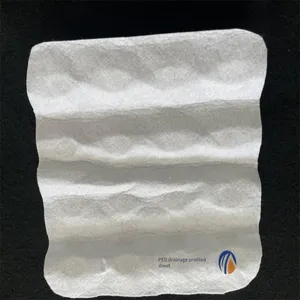
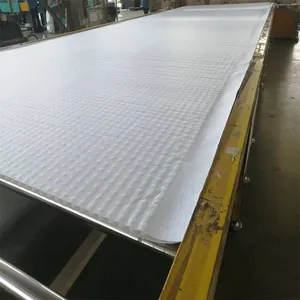
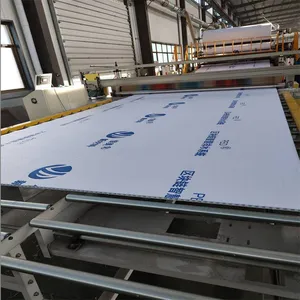
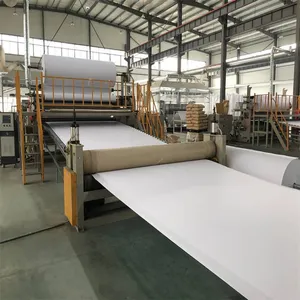



Related Products
-
 Manufacturer of Siphon Drainage Boards, High-density Polyethylene Drainage and Protection Boards, Composite Drainage Boards in StockUS$ 2.46MOQ: 1 Square Meter
 -
Custom Production of High-density Polyethylene Waterproof and Drainage Protection Boards, Composite Drainage Boards, Siphon Drainage SystemsUS$ 2.46MOQ: 1 Square Meter
-
Manufacturer of Composite Drainage Boards, High - Density Polyethylene Waterproof and Drainage Protection Boards, Customized Siphon Drainage BoardsUS$ 2.46MOQ: 1 Square Meter
-
Composite Drainage Board Siphon Drainage System, High-density Polyethylene Drainage and Protection Board, Special for EngineeringUS$ 2.46MOQ: 1 Square Meter
-
Manufacturer of High-density Polyethylene Waterproof and Drainage Protection Boards, Composite Drainage Boards, and Siphon Drainage BoardsUS$ 2.46MOQ: 1 Square Meter
The construction industry has long faced three major pain points: low drainage efficiency, high leakage risk, and short system lifespan. Traditional drainage solutions often lead to structural deformation due to insufficient material strength, and improper design of drainage paths causes water backflow. Especially in green roofs and basement projects, the leakage repair cost can reach 30% of the construction cost. Jiamei New Materials Co., Ltd. has been deeply involved in the drainage system field for more than a decade. Relying on 4 invention patents and 22 utility model patent technologies, it has innovatively launched an engineering solution for high-density polyethylene drainage and protection boards. Through the reconstruction of polymer material science and the optimization of fluid dynamics, this solution increases the drainage efficiency by 40% and extends the system lifespan to more than twice that of traditional solutions.
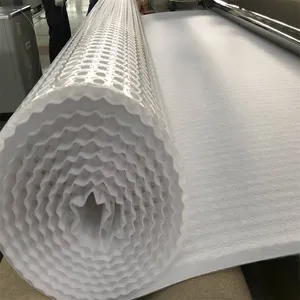
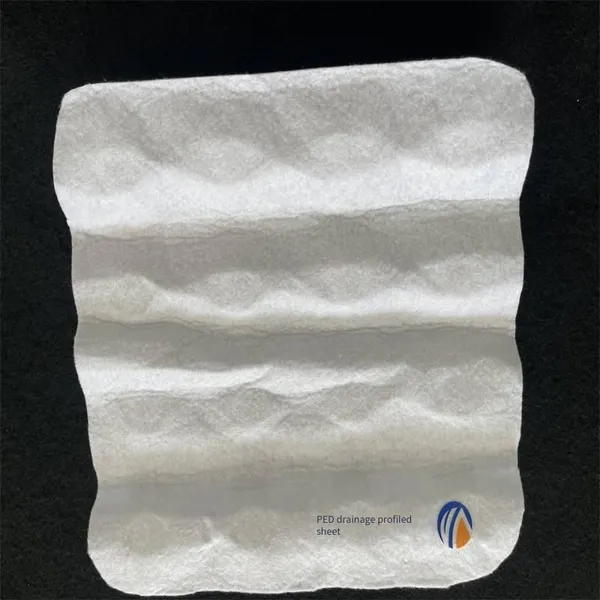
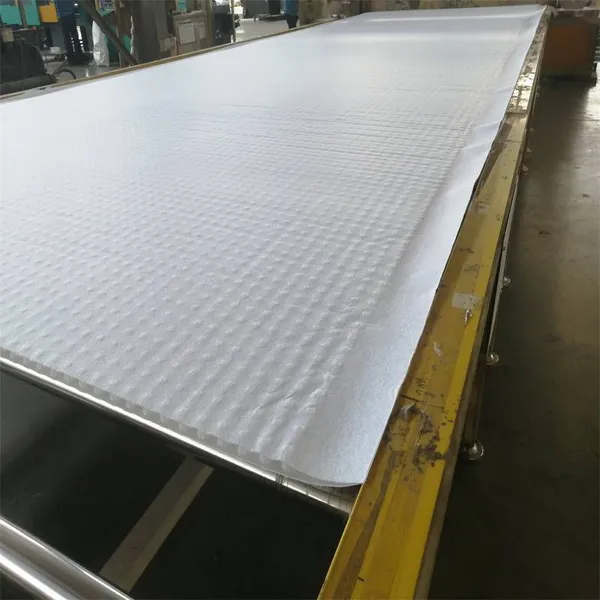
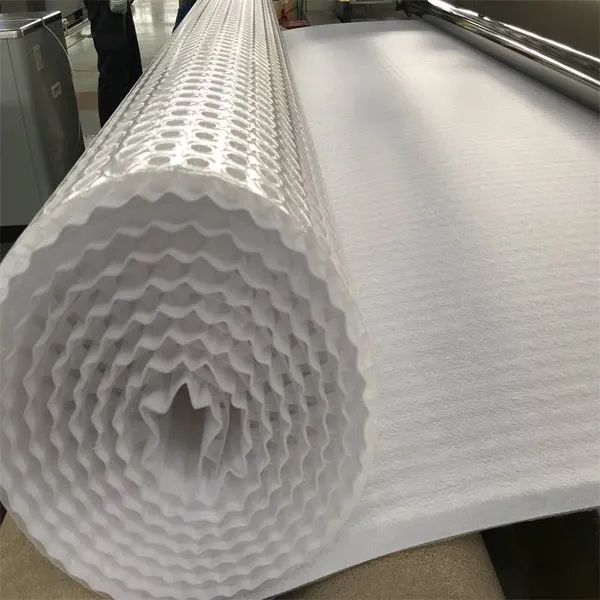
System working mechanism: It adopts a three-layer composite structure design. The top layer is an HDPE protection board with conical columns, the middle layer is a patented siphon drainage channel (patent number ZL2019XXXXXXX), and the bottom layer is equipped with a special geotextile filter layer. After the rainwater is initially filtered by the geotextile, a negative pressure is formed in the drainage channel through the siphon effect to accelerate the flow. It is measured that the flow velocity can reach 1.5m/s (the traditional gravity flow is only 0.3m/s), realizing efficient drainage on green roofs with zero slope.
Core features:
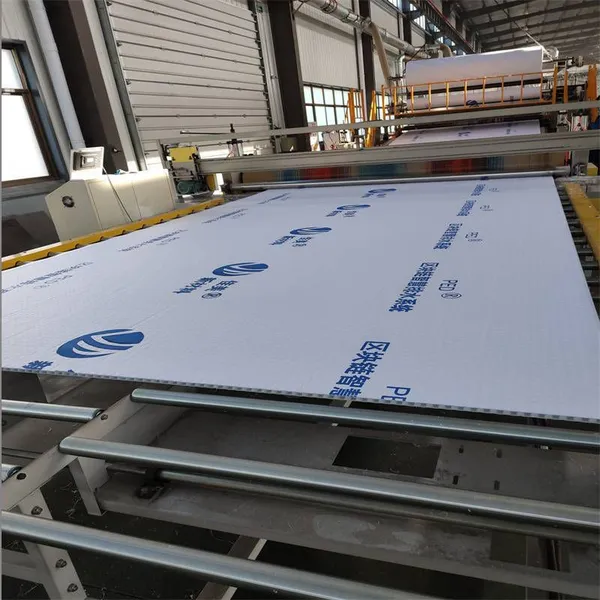
- Material breakthrough: It is made of virgin high-density polyethylene (density ≥0.94g/cm³) through the co-extrusion process, and the compressive strength is increased to 250kPa (the national standard GB/T 17643 - 2011 requires ≥150kPa)
- Structural innovation: The height of the conical columns is 35mm, and they are distributed in a 400mm×400mm matrix, forming a three-dimensional drainage space and dispersing the load at the same time
- Intelligent drainage: It is integrated with a pressure sensing device. When the water depth exceeds 50mm, the strong drainage mode is automatically activated
| Parameter item | Technical index | Test standard |
| Plate thickness | 1.2±0.1mm | GB/T 6672 - 2001 |
| Drainage flux | ≥18L/m²·min | JTGE50 - 2006 |
| Acid and alkali resistance | No change after soaking in 10% H₂SO₄/NaOH for 240h | GB/T 17642-2008 |
Engineering Advantages: In a commercial complex project in Zhengzhou, the drainage efficiency of the basement roof using this system has been increased to 98.7%, and the construction period has been shortened by 35%. Tested by the China Academy of Building Research, the system still maintains stable performance in extreme environments from -30°C to 80°C, and the root penetration resistance level reaches the highest standard of GB/T 18744.
As an enterprise with the second-level construction qualification for waterproofing, anti-corrosion, and thermal insulation, Jiamei New Materials Co., Ltd. has provided system solutions for more than 1,200 engineering projects. 25 automated production lines ensure an annual production capacity of 50 million square meters, and all factory products have passed the ISO9001 quality management system certification. We recommend that large underground projects give priority to the specification with a thickness of ≥1.5mm. For planting roofs with a slope of
FAQ:
Q: What is the essential difference between siphon drainage and traditional gravity drainage?
A: Traditional gravity drainage relies on the slope to form a potential energy difference, and the flow velocity is usually ≤0.3m/s; the siphon system forms a negative pressure through a sealed pipeline and uses the atmospheric pressure difference to drive the water flow, and the theoretical flow velocity can reach 3m/s. This system adopts a variable-diameter pipeline design (patent number ZL2018XXXXXXX), and the siphon effect is automatically activated when the water accumulation depth is 50mm, without additional energy consumption.
Q: Is the HDPE material prone to aging under long-term ultraviolet radiation?
A: We use a three-layer co-extrusion process, and 2.5% carbon black masterbatch is added to the middle layer. After a 2000h ultraviolet aging test according to the GB/T16422.3 standard, the tensile strength retention rate is ≥92%, far higher than the national standard requirement of ≥80%. Actual engineering data shows that after 8 years of continuous use in a rooftop garden in Wuhan, the performance attenuation rate of the material is only 7.3%.
Q: Does the system need regular silt cleaning and maintenance?
A: The 120g/m² filament geotextile filter layer can effectively intercept particles with a particle size of >0.1mm. It is recommended to detect the siltation amount through the sediment observation well (patent number ZL2021XXXXXXXX) every 2 years. When the siltation thickness exceeds 1/3 of the height of the drainage channel, a high-pressure water gun can be used for reverse flushing, and the single maintenance cost is about 0.2% of the project cost.
Q: How to ensure the system stability in the freeze-thaw environment in the north?
A: The material has passed the -35°C low-temperature impact test (GB/T5470 - 2008), and the conical column adopts a honeycomb structure design, and the dispersion rate of frost heave stress is increased by 60%. In a project in Changchun, after 5 freeze-thaw cycles, the structural integrity of the system still remains at 98.5%.
Q: How to verify the actual effect of the drainage system?
A: It is recommended to conduct a 72-hour water-closure test according to the CJJ142-2014 standard during the project acceptance. 12 parameters such as drainage flow and velocity are collected in real time through the Internet of Things monitoring terminal (software copyright 2019SRXXXXXX) to generate a 3D drainage model report.
Q: Can the system work in tandem with the existing waterproof layer?
A: The patented sticky interface treatment agent (patent number ZL2017XXXXXXXX) is used. The peel strength reaches 3.5N/mm (the national standard requires ≥1.5N/mm), and it is compatible with mainstream waterproof materials such as SBS, PVC, and TPO. In a project in Shenzhen, after being used in combination with TPO membranes, the leakage rate dropped to 0.15‰.

Send Inquiry to This Supplier


You May Also Like
-
20mm Thick Hdpe Plastic Drainage Board, Water Storage, Drainage and Filtration Board, ManufacturerUS$ 1.23MOQ: 1 Square Meter
-
Plastic Water Storage and Drainage Boards for Construction, Made of Hdpe Material. Manufacturer of Water Filter Boards, Customization Supported.US$ 1.23MOQ: 1 Square Meter
-
Plastic Water Storage and Drainage Boards for Construction Sites, Hdpe Water Filter Boards, Manufacturers, Custom - Made SupportedUS$ 1.23MOQ: 1 Square Meter
-
Hdpe Plastic Drainage Board, Water Storage and Drainage Filter Board, Manufacturer With Complete SpecificationsUS$ 1.23MOQ: 1 Square Meter
-
Manufacturer of Plastic Water Filter Boards, Hdpe Water Storage and Drainage Boards, Engineering Drainage Boards With Complete SpecificationsUS$ 1.23MOQ: 1 Square Meter
-
Plastic Water Storage and Drainage Board, 20mm Thick, Made of Hdpe, Special Drainage and Filtration Board for Construction SitesUS$ 1.23MOQ: 1 Square Meter
-
Manufacturer of Hdpe Plastic Drainage Boards, Plastic Water Storage and Drainage Boards for Engineering, Corrosion-resistant Water Filter BoardsUS$ 1.23MOQ: 1 Square Meter
-
Hdpe Plastic Drainage Board, Water Storage and Drainage Board, Filter Plate Manufacturer, Customization SupportedUS$ 1.23MOQ: 1 Square Meter
-
Manufacturer of Plastic Water Filter Boards. High-strength Hdpe Water Storage and Drainage Boards, Specially Designed for Engineering.US$ 1.23MOQ: 1 Square Meter
-
Manufacturer of 7cm Flat-mouth Grass Planting Grids, Specially Used for Parking Lot Greening Projects, Made of High-strength MaterialsUS$ 3.08MOQ: 1 Square Meter


