








 Contact Platform Support
 Help Center
Reliable Skin Effect Electric Heating System for Tank Farm & Pipelines
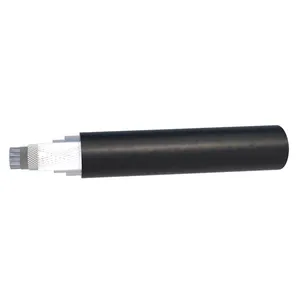
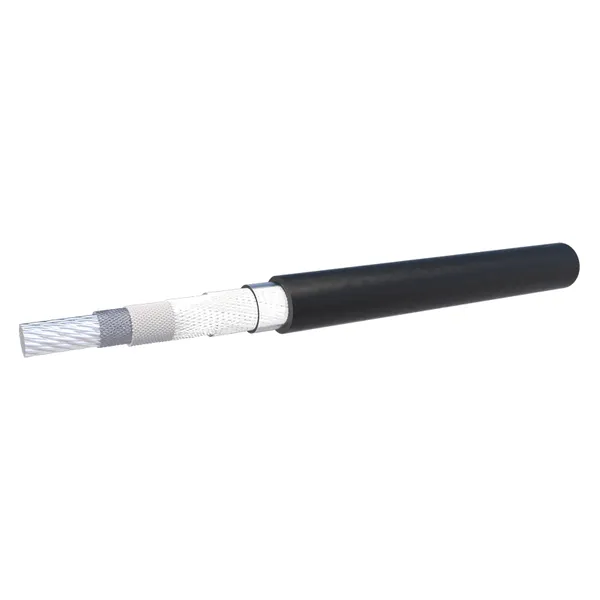
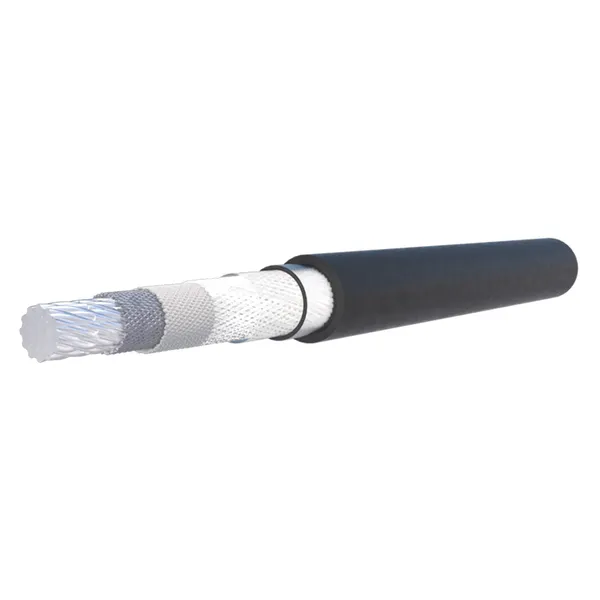
Product Spotlights


Related Products
-
 Custom Skin Effect Heat Tracing System Manufacturer for Oil & Gas IndustryNegotiableMOQ: 100 Meters
 -
CE & IEC & EAC Certified Skin Effect Heat Tracing System for Oil & Gas PipelinesNegotiableMOQ: 100 Meters
-
International Certified Skin Effect Heat Tracing System (CE, IEC, EAC)NegotiableMOQ: 100 Meters
-
Reliable Skin Effect Heat Tracing Cable for Pipeline Freeze ProtectionNegotiableMOQ: 500 Meters
-
Premium Skin-Effect Electric Heating Cable for Industrial Pipeline EfficiencyNegotiableMOQ: 500 Meters
Product Description:
Principle:
The principle of SETS is based on the "skin effect" and "proximity effect" of alternating current. Since steel pipes have extremely strong magnetic permeability, significant skin effects will occur even under power frequency voltage. The so-called skin effect is a phenomenon that occurs when an alternating current passes through a carbon steel conductor and the current gradually approaches the surface of the conductor, while the proximity effect is an electromagnetic phenomenon between a pair of electrical bodies carrying opposite equal currents. In the heating tube When a current passes between the cable and the heat pipe, the current on the heating pipe gradually flows to the inner wall of the heating pipe, and it is the Joule heat generated by this thin inner wall that meets the need for heat tracing. The Joule heat generated by the skin effect electric heating system mainly comes from three parts:
When the skin cable is energized, the heat emitted from the carbon steel pipe is the main heat source of the skin electric heating system.
The heat generated by the cables inside the carbon steel pipe.
-
Hysteresis loss in the carbon steel pipe generates some heat.
In a skin effect device, an insulated wire (SETS wire) passes through a highly magnetic steel pipe and is connected to the tail end of the steel pipe. The first end of the steel pipe and the insulated wire are connected to the power supply respectively. The neutral line and phase line are applied with industrial frequency or medium frequency AC voltage, and the current forms a loop through the wire and steel pipe to generate Joule heat. Due to the certain relationship between the size, material and AC frequency of the steel pipe, the AC does not flow uniformly through the steel pipe. Cross-section, but concentrated flow within a certain depth from its inner surface, the current density decreases exponentially, and the voltage and current on the outer surface of the steel pipe are almost zero, which is very safe. Therefore, the SECT pipe can be welded directly to the conveyor pipe. making it an efficient heat source.The heat generated by the SETS pipe is quickly transferred to the delivery pipe through the welding seam and thermal conductive cement, playing a heat tracing role. wire) passes through a steel pipe with strong magnetism and is connected to the end of the steel pipe. The head end of the steel pipe and the insulated wire are connected to the neutral line and phase line of the power supply respectively. Power frequency or medium frequency AC voltage is applied, and the current forms a loop through the wire and steel pipe. Produces Joule heat. Due to the certain relationship between the size, material, and alternating current frequency of the steel pipe, the alternating current does not flow uniformly through the steel pipe cross-section, but flows concentratedly within a certain depth from its inner surface. The current density decreases exponentially. In the steel pipe The voltage and current on the outer surface are almost zero, which is very safe. The SECT tube can therefore be welded directly to the delivery pipe, making it an efficient heat source. The heat generated by the SECT pipe is quickly transferred to the delivery pipe through the welding seam and thermal conductive cement, playing a heat tracing role.
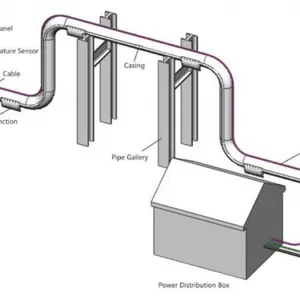
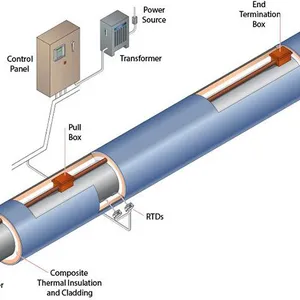
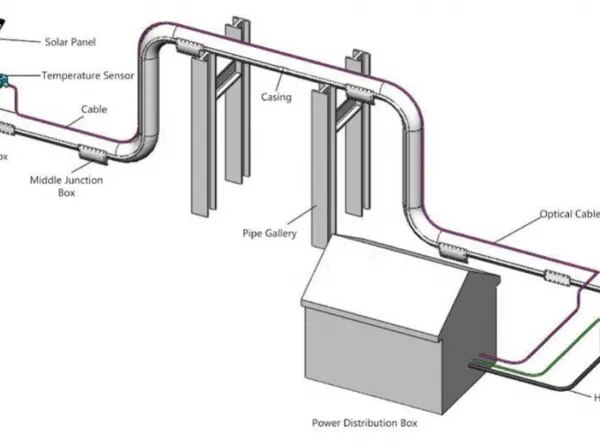
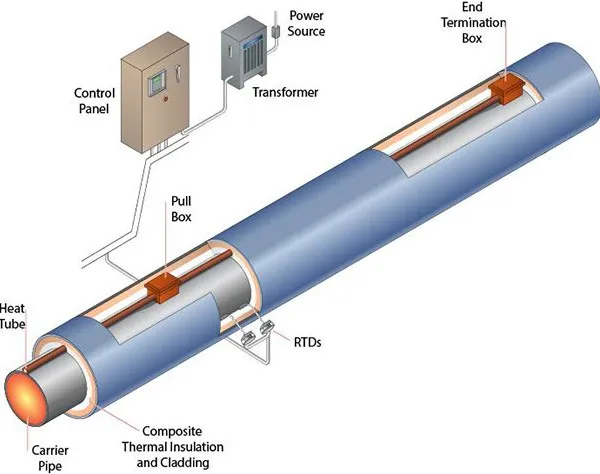
Schematic diagram of skin heating:
①Heat Tracing Steel Pipe; ②Middle Junction Box; ③Skin-effect Cable; ④Power Junction Box; ⑤Terminal Junction Box; ⑥Temperature Sensor; ⑦Control Cabinet; ⑧Special Transformer
Specification & Performance:
| No. | Item | Silane Cross-linking(Temp.Resist Grade 126℃) | FEP Fluoroplastic(Temp. Resist Grade 205℃) | PFA High Temp.Fluoroplastic (Temp.Resist Grade 260℃) | Armoured Skin-effect(Temp.Resist Grade 600℃) |
| 1 | Cable Model | JFHCL1-J2 | JFHCL1-J3 | JFHCL1-J4 | JFHCL1-J5 |
| 2 | Nominal cross-sectional area(mm²) | 5-50 | 5-50 | 5-50 | 10-40 |
| 3 | Insulated jacket(layer) | 2-5 | 2-5 | 2-5 | 1 |
| 4 | Power supply voltage | 220-35000V | 220-35000V | 220-35000V | 380-35000V |
| 5 | Rated voltage(V) | 0.3V-6kV | 0.3V-6kV | 0.3V-6kV | 0.3V-2.5kV |
| 6 | Work frequency(Hz) | 50-4000 | 50-4000 | 50-4000 | 50-4000 |
| 7 | The insulation resistance at 20℃ is not less than(MΩ) | 2500 | 2500 | 2500 | 2500 |
| 8 | Breakdown test(kV) | 25 | 25 | 25 | 7.5 |
| 9 | Work temperature(℃) | -40-110℃ | -40-180℃ | -40-230℃ | 0-500℃ |
| 10 | Overall breaking force is not less than(N) | 20000 | 20000 | 20000 | 50000 |
| 11 | Minimum bending radius mm | 260 | 260 | 260 | 00 |
| 12 | Heating power(w/m) | 10-270 | 10-270 | 10-270 | 10-90 |
Contrast with other heat tracing system:
| No. | Future | Skin-effect Heat Tracing | Electric Heat Tracing | Steam Heat Tracing |
| 1 | Heating Trace Distance | Long | Short | Short (Low Terminal Temperature) |
| 2 | Power Supply Point | Few | More | No need |
| 3 | Heating Tracing Power | Big | Small | Small |
| 4 | Heat Tracing Effect | good | good | common |
| 5 | Heat Tracing Pipe Laying | Weld or Bundle | Bundle | Bundle |
| 6 | Automatic Control | Convenient | Convenient | Cannot realize |
| 7 | Repair | Convenient | Convenient | Difficult |
| 8 | Local Heating | Common | Good | Good |
| 9 | Safety&Reliability | Good | Good | Good |
| 10 | Construction Cost | Higher | Higher | Lower |
| 11 | Running Cost | Low | Low | High |
| 12 | Repair Cost | Low | Low | Low |
| 13 | Manage | Convenient | Convenient | Not Convenient |
| 14 | Service Lift | 20-30 Year | 5-15 Year | 2-3 Year |
| 15 | Underground Pipeline | Suitable | Suitable | Not Suitable |
Application:
Company Profile
Shandong Huaning Electric Heating Technology Co., Ltd.
It is located in the famous Spring City — Jinan. It is a comprehensive high-tech manufacturing enterprise integrating research and development, design, sales, system integration, and operation & maintenance services for electric heating, heating, and integrated control. The company has obtained qualifications in building electromechanical installation and waterproof, anti-corrosion, and thermal insulation engineering. As a leader in the domestic Electric Heating field, our company has long been committed to providing complete electric heating solutions for industrial, commercial, and civil markets.
Certifications
Our Customers
FAQ
Q: What's the lead time for orders?
A: Standard models ship in 10–15 days; customized units require 30–45 days.
Q: Do you have international certification?
A: Yes, we have EAC,IECEX,ATEX,CE,ISO,etc.
Q: Do you have past performance list overseas?
A:Yes,we have participated many oversea projects now.
Q: How do you assure the product quality?
A: we have international sandard laboratory and each batch cargo will be inspected.
Q: How do I place an order?
A: Contact us via email/phone for a quote, then confirm with a PO.

Send Inquiry to This Supplier



You May Also Like
-
Long-Distance Pipeline Heating Solution With Skin Effect Heat Tracing CablesNegotiableMOQ: 500 Meters
-
Overhead Pipeline Skin Effect Heat Tracing Cable With Superior InsulationNegotiableMOQ: 500 Meters
-
Single-Core Skin Effect Electric Heating Cable for Oil Well ApplicationsNegotiableMOQ: 500 Meters
-
Advanced Skin-Effect Trace Heating Cable for Overhead Pipeline SystemsNegotiableMOQ: 500 Meters
-
High-Efficiency Skin Effect Heating Cable for Enhanced Pipeline Thermal ManagementNegotiableMOQ: 500 Meters
-
Dual-Purpose Skin Effect Heating Cable for Overhead and Buried PipelinesNegotiableMOQ: 500 Meters
-
IEC & CE Certified Skin Effect Heating Cable for Petrochemical PipelinesNegotiableMOQ: 500 Meters
-
High-Performance Skin-Effect Heating Cable for Buried Pipeline ProtectionNegotiableMOQ: 500 Meters
-
Energy-Efficient Skin-Effect Heating Cable for Long Pipeline Heat CompensationNegotiableMOQ: 50 Meters
-
Skin Effect Heating System for Long-Distance Pipe Tracing - 1000m Max LengthNegotiableMOQ: 50 Meters


