Home > Electrical & Electronics > Electrical Control System > ABB PFEA111-20 3BSE050090R20 Tension Controller

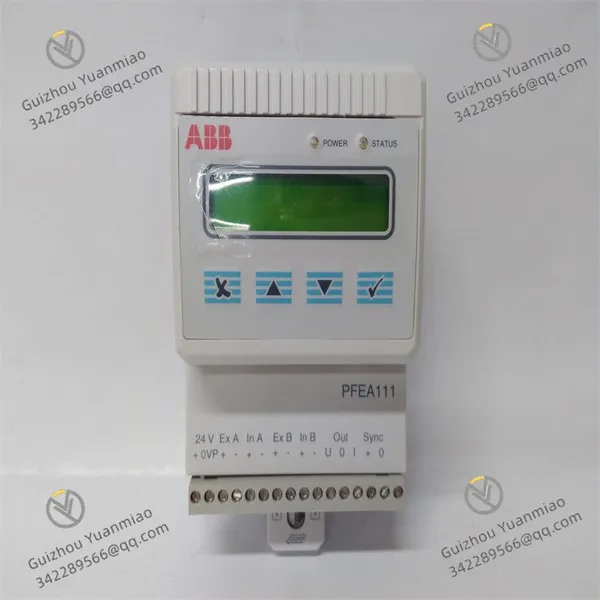
ABB PFEA111-20 3BSE050090R20 Tension Controller
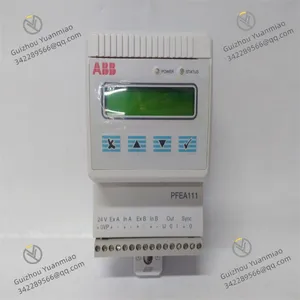
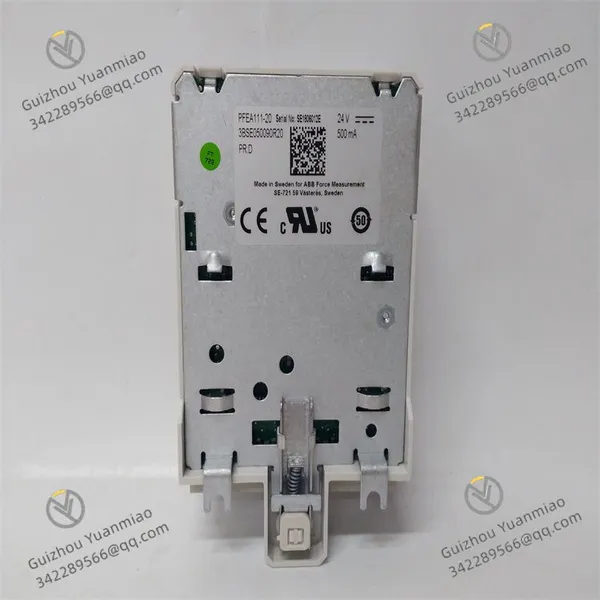
ABB PFEA111-20 3BSE050090R20 Tension Controller photo-1
ABB PFEA111-20 3BSE050090R20 Tension Controller photo-2
Negotiable MOQ: 1 Piece (Price negotiable depending on order volume and customization)
Key Specifications
Get Latest Price
Material:
Other, Global universal model
Condition:
Other, Global universal model
Task:
Other, Global universal model

Payment & Shipping
Payment Methods:
Port of Shipment:
China
Delivery Detail:
Delivery time depends on order quantity.
Material Other, Global universal model
Condition Other, Global universal model
Task Other, Global universal model
Mathematical Model Other, Global universal model
Signal Other, Global universal model
Customized Non-Customized
Structure Other, Global universal model
The ABB PFEA111-20 3BSE050090R20 is a module for industrial tension control. It is mainly applied in scenarios requiring precise tension control in industrial production, such as papermaking, textiles, printing, cable manufacturing and other industries. It accurately measures and controls the tension of materials during unwinding, rewinding and processing to ensure product quality.
Core Functional CharacteristicsInput/Output Functions
  • Supports input from 2 load cells for accurate tension measurement.

  • Provides voltage and current outputs (A+B), adapting to various actuators for precise tension control.

Signal Processing Capability
  • Equipped with adjustable filtering to ensure precise signal processing, effectively removing interference signals and improving measurement and control accuracy.

Display Function
  • Displays readings of A, B, A+B or A-B, facilitating users to understand tension measurement information for debugging and monitoring.

Fieldbus Interaction Function
  • Enables communication and data exchange with other devices, facilitating integration into the entire industrial automation control system.

Working Principle and Control Logic
Based on the effect of coils and magnetic powder, tension control is achieved by adjusting input current to change output. During operation:
  1. Physical tension signals detected by tension sensors are converted into electrical signals, processed through signal conditioning and ADC conversion, and then sent to the controller for calculation.

  2. The controller compares the target tension value with the real-time measured value to generate an error signal, calculates the control quantity through PID adjustment, and outputs it to the actuator to achieve closed-loop control, maintaining tension near the set value.

PFEA111-20 3BSE050090R20 (2)

PFEA111-20 3BSE050090R20 (1)

Parameter Setting and Debugging Key PointsParameter Setting
  • Communication Parameters: Configured according to connection requirements with other devices.

  • Sensor Configuration Parameters: Adjusted based on the actual sensor model, including input channel selection, signal type, range, sensitivity coefficient, etc.

  • Core Tension Control Parameters: Such as proportional coefficient (P), integral time (I), derivative time (D), which need to be debugged and optimized according to specific application scenarios and control requirements.

Debugging Key Points
  1. Ensure correct module installation and wiring, then power on and check the tension detector signal.

  2. Program and set relevant parameters, calibrate the zero point and full scale of the tension signal.

  3. Inspect the system through manual adjustment and operation to confirm normal tension display and actuator operation.

  4. Switch to automatic control mode and adjust PI parameters based on operation to ensure stable tension system operation.

Typical Faults and SolutionsAbnormal Tension Display
  • Possible Cause: Incorrect installation/wiring of the tension detector or signal interference.

  • Solution: Check installation and wiring, identify interference sources, and adopt anti-interference measures (e.g., adding shielded wires or filters).

Unstable Tension Control
  • Possible Cause: Unreasonable PID parameter settings.

  • Solution: Readjust PID parameters, gradually adjusting P, I, and D coefficients based on system response to achieve stable control.

Communication Failure
  • Possible Cause: Incorrect communication parameter settings, damaged communication lines, or compatibility issues between devices.

  • Solution: Verify communication parameters and lines, ensure consistent communication protocols, and update device drivers/firmware if necessary.

Difference Comparison with PFEA112-20 and PFEA113-65
Compared with PFEA112-20 and PFEA113-65, PFEA111-20 differs in communication interfaces, control algorithms, and roll diameter tracking capabilities:
  • Communication Interfaces: Relatively fewer interfaces compared to the others.

  • Control Algorithm: Uses basic PID control instead of advanced adaptive algorithms.

  • Roll Diameter Tracking: Requires external roll diameter signals (not built-in).

  • Sensor Compatibility: Supports fewer AI channels without redundant configuration (unlike PFEA113-65's 4 AI channels).


In contrast, PFEA112-20 and PFEA113-65 offer advanced features such as:
  • PFEA113-65: New EtherNet/IP, Profinet interfaces, adaptive PID + fuzzy control, built-in roll diameter calculation, and multi-sensor redundancy support.

Product Tags: PFEA111-20 , 3BSE050090R20 , 3BSE028140R0020

Send Inquiry to This Supplier

* Message
0/5000

Want the best price? Post an RFQ now!
Verified Business License
Business Type
Trading Company
Year Established
2014
Factory Size
1,000-3,000 square meters
Product Certifications
SA8000