








 Contact Platform Support
 Help Center
Sodium Gluconate--Washing Glass Bottle



Related Products
-
 Sodium Gluconate--- CONCRETE ADMIXTUREUS$ 510 - 520MOQ: 1 Metric Ton
 -
Sodium Gluconate--METAL CLEANING & FINISHINGUS$ 875 - 880MOQ: 1 Metric Ton
-
Allulose ManufactureUS$ 2250 - 2270MOQ: 1 Metric Ton
-
Allulose Syrup ManufactureUS$ 1350 - 1400MOQ: 1 Metric Ton
-
Natural Sweetener--alluloseNegotiableMOQ: 1000 Kilograms
General information
Sodium gluconate is the sodium salt of gluconic acid, produced by fermentation of glucose. It is a white to tan, granular to fine, crystalline powder, very soluble in water. Non corrosive, non-toxic and readily biodegradable (98 % after 2 days), sodium gluconate is more and more appreciated as chelating agent.
The outstanding property of sodium gluconate is its excellent chelating power, especially in alkaline and concentrated alkaline solutions. It forms stable chelates with calcium, iron, copper, aluminium and other hey metals, and in this respect, it surpasses all other chelating agents, such as EDTA, NTA and related compounds.
Aqueous solutions of sodium gluconate are resistant to oxidation and reduction, even at high temperatures. However, it is easily degraded biologically (98 % after 2 days), and thus presents no wastewater problem.
Sodium gluconate is also a highly efficient set retarder and a good plasticiser / water reducer for concrete, mortar and gypsum.
Specification
Fuyang offers a food as well as a technical grade of sodium gluconate. The sodium gluconate food grade is supplied in accordance with the latest requirements of the Food Chemicals Codex (FCC) and of Commission Regulation (EU) No. 231/2012.
The product is ailable as granular material and powder. Special granulations are ailable upon request.
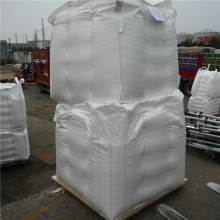
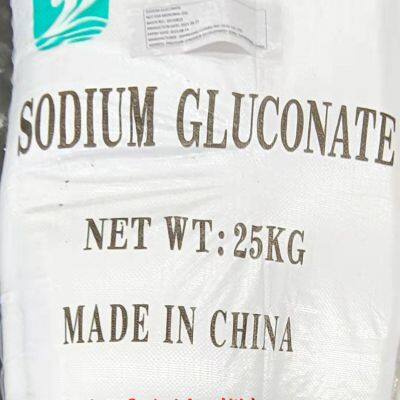
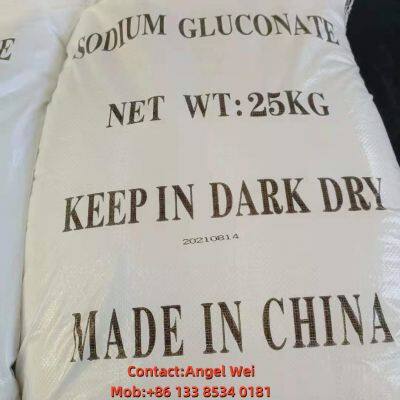
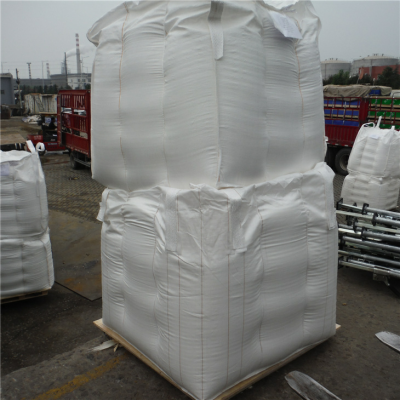
Fuyang sodium gluconate is ailable in 25 kg net polyethylene (LDPE) bags or in 1000 kg net polypropylene big bags.
Properties
Non-toxic
Easily biodegradable (98% after 2 days)
Main functions
Excellent chelating agent
Highly efficient set retarder
Efficient plasticiser / water reducer
Bitterness inhibitor
Applications
Industrial Applications
Agrochemicals, Fertilisers
Construction
Fine Chemicals
Inks, Paints, Coatings
Metal Surface Treatment
Paper
Textile, Leather
Food
Baby Food, Infant Formula
Cereals, Snacks
Confectionery
Dairy Alternatives
Flours
Fruits, Vegetables
Meat Alternatives
Meat, Seafood
Ready Meals, Instant Food
Sauces, Dressings, Seasonings
Table Top Products
Beverages
Carbonated Soft Drinks
Plant-based
RTD Tea and Coffee
Sports and Energy Drinks
Waters
Personal Care
Colour Cosmetics
Hair Care
Oral Care
Skin Care
Soap and Bath Products
Cleaners & Detergents
Dish Washing
Industrial Cleaners
Laundry Care
Surface Care
Feed & Pet Food
Feed
Pet Food
Healthcare
OTC, Food Supplements
Sodium Gluconate ----BOTTLE WASHING
Sodium gluconate is widely used in industrial cleaning formulations across several applications. Gluconate in an alkaline solution is used to clean glass bottles used in the food and beverage industry.
Sodium gluconate is used because of its excellent chelating properties. This makes it desirable in areas where hard water is an issue.Calcium, magnesium and iron deposits can ruin materials due to rust or scale that can build up on equipment such as washer chains, pockets, heating coils,tanks and carrier sections.
As a sequestrant in a caustic bottle washing gluconate has been found to
*Prevent precipitation of the hardness constituents of water(calcium and magnesium)that cause bottle haze.
*Eliminate rust spots on bottle necks.
*Increase the efficiency of aluminum label removal.
*Provide free rinsing reducing caustic carry-over.
*Lower maintenance cost.
Before converting to a caustic-gluconate system, it is advisable to thoroughly descale the equipment using acid to standard industry practice.If scale remains,it will gradually dissolve in the gluconate-caustic solution reducing the concentration in the soaker.
Several factors need to be considered in order to obtain maximum efficiency including type of equipment, temperature,caustic concentration, hours of operation and cleaning amount.
Guconate sequesters calcium and magnesium on a one to one mole basis in 1% to 5% caustic solutions.Approximately 100 parts gluconate will sequester 20parts calcium.
Guconate Sources
Because the gluconate anion is the active sequestrant it does not matter whether the gluconate is introduced as sodium gluconate crystals, liquid gluconate or gluconic acid. Each product form does have a different use level based on molecular weight. Each pound of sodium gluconate crystal is equivalent to 1.8lbs gluconic acid or 1.66 lbs liquid gluconate.
The table shows usages based on water hardness and product used.
The levels have been adjusted to provide for variations in water hardness and the presence of a
small amount of other minerals, i.e. iron and aluminum frequently found in cleaning baths.
Dilution
While the table shows the pounds of product to be mixed with caustic for dilution as a 4% solution,adjustments can be made to dilute the mixture fora lower percent caustic. Solutions of 1% to 5% are highly effective, but it is critical to remember that the gluconate level must be proportional to the mineral level you wish to sequester. If you decrease the caustic percent, you must increase the gluconate. lf100 lbs gluconate in 4% works, but you want to use 2% caustic, you must use 200 lbs gluconate.
Specifications
Sodium gluconate is available is solid or liquid form Sodium Gluconate comes in both granular and powder form. liquid Gluconate 60 (LT) is available in drums, totes or bulk. Gluconic Acid 50% is also available in drums or bulk.

Send Inquiry to This Supplier


You May Also Like
-
Zero Calories Sugar--D-allulose SyrupNegotiableMOQ: 1000 Kilograms
-
Allulose--zero Sugar ProductsUS$ 2270 - 2300MOQ: 1 Metric Ton
-
Allulose Syrup--zero Sugar ProductsUS$ 1370 - 1380MOQ: 1 Metric Ton
-
TrehaloseUS$ 700 - 710MOQ: 1 Metric Ton
-
Glucono Delta Lactone--Protein Coagulant and Leavening AgentUS$ 875 - 880MOQ: 1 Metric Ton
-
Erythritol--natural SweetenersUS$ 1210 - 1220MOQ: 1 Metric Ton
-
Sodium Gluconate 25kgUS$ 100 - 2000MOQ: 1 Ton
-
Sodium GluconateUS$ 750 - 780MOQ: 24 Tons
-
Sodium GluconateNegotiableMOQ: 27 Tons
-
Sodium GluconateUS$ 560 - 575MOQ: 26 Tons


