








 Contact Platform Support
 Help Center
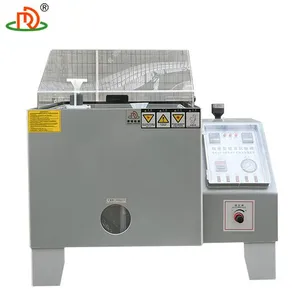
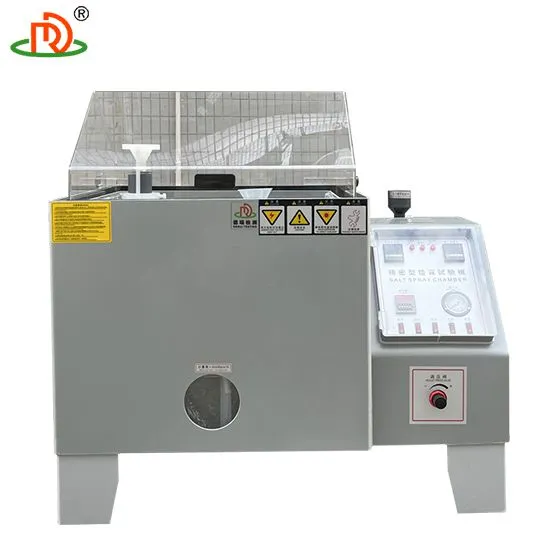
Salt Spray Corrosion Test Chamber for Photovoltaic Modules


Related Products
-
 Salt Spray Test Chamber for Hardware ProductsUS$ 1250 - 6250MOQ: 1 Set
 -
Multi Sided Spray Salt Spray SystemUS$ 1250 - 6250MOQ: 1 Set
-
Salt Spray Testing Equipment for New Energy BatteriesUS$ 1250 - 6250MOQ: 1 Set
-
Touch Screen Operated Salt Spray Test ChamberUS$ 1250 - 6250MOQ: 1 Set
-
Anti Corrosion Coating Salt Spray BoxUS$ 1250 - 6250MOQ: 1 Set
Model |
DR-H304-90 |
Internal Size (W*D*H) |
900x600x500mm |
External Size (W*D*H) |
1410x880x1280mm |
Chamber material |
P.V.C rigid plastic plate, thickness 8mm |
Sample tray |
Diameter 10mm glass fiber rod, anti-rust V-shape plastic steel to make sure sample in 15~30 degree inclined |
Temperature Range |
Room temperature ~ 55℃ |
Temperature Fluctuations |
≤±0.5℃ |
Temperature Uniformity |
≤±2℃ |
Temperature Precision |
±1℃ |
Spraying method |
Continuous and Periodic spray type |
Test Chamber Temperature |
Salt Spray Method (NSS ACSS)35±1℃ |
Saturated air Barrel Temperature |
Salt Spray Method (NSS ACSS)47±1℃ |
Brine Temperature |
35℃±1℃ |
Spray Quantity |
1.0~2.0 ml / 80cm2 / hr |
PH value |
Salt Spray Method (NSS ACSS6.5~7.2) |
Lab Volume |
108L |
Brine Tank Capacity |
25L |
Multiple Safety Protection Devices |
Current discharge protection, over pressure protection, over temperature protection, over load fuse protection |
Accessories |
Testing Salt/ Measuring tank/Nozzle Equipment x 1 set |
Air source |
1HP Air pump (provided by buyer) |
In the photovoltaic industry, the corrosion resistance of photovoltaic modules is directly related to their service life and power generation efficiency. As a professional testing equipment, PV module salt spray corrosion tester can simulate the harsh oceanic climate and industrial atmospheric environment, and carry out strict corrosion resistance test for PV modules. The following content will introduce in detail the functions, advantages, application scenarios and maintenance points of the salt spray corrosion tester for photovoltaic modules.
First, the function of the equipment: accurate simulation of the corrosive environment of the photovoltaic module
1. Salt spray system
Continuous salt spray test: the equipment is capable of continuous salt spray test, simulating the corrosion of photovoltaic modules in the marine climate or high humidity environment. Through the spray system, the brine solution is atomized into fine salt spray particles, which are evenly sprayed on the surface of the PV module to test its corrosion resistance under the continuous salt spray environment.
Cyclic Salt Spray Test: In addition to continuous salt spray test, the equipment also supports cyclic salt spray test mode. In this mode, the equipment can simulate the salt spray and dry environment that PV modules face alternately in actual use, such as the corrosion of PV power plants in different climatic conditions in coastal areas and inland areas. Through cyclic salt spray test, the corrosion resistance of PV modules can be assessed more realistically.
2. Temperature and humidity control system
Temperature control: The equipment is equipped with a high-precision temperature control system, which can precisely control the temperature inside the test chamber. The temperature range is usually between room temperature and 60℃ to ensure the stability of the test environment. Temperature control is essential to simulate the climatic conditions of different regions, such as tropical oceanic climate or temperate oceanic climate.
Humidity control: The equipment also features humidity regulation to simulate different humidity environments. The humidity range is between 30% - 98% RH to ensure the accuracy of the test environment. Humidity control is particularly important for evaluating the corrosion performance of PV modules under high humidity conditions.
3. Data Recording and Analysis
Automatic Recording: The equipment is able to automatically record key data during the test, such as temperature, humidity, salt spray concentration, test time, etc. These data are essential for evaluating the corrosion resistance of PV modules.
Data Analysis: With the built-in data analysis software, users can quickly assess the degree of corrosion and corrosion resistance of PV modules. Test reports can be exported to a variety of formats, such as PDF, Excel, etc., for easy data sharing and archiving.
Application Scenario: Comprehensive coverage of PV module corrosion resistance testing
1. Photovoltaic cells and modules
-Battery testing: PV cells are the core components of PV modules.
Battery cell test: PV battery cell is the core component of PV module, and its corrosion resistance directly affects the service life and power generation efficiency of PV module. The salt spray corrosion tester can simulate the corrosion of battery cells in the marine climate and high humidity environment to assess their corrosion resistance.
-
Component testing: PV modules are composed of multiple cells, and their overall corrosion resistance is equally important. Through the salt spray corrosion tester, the corrosion of PV modules in actual use can be simulated to ensure their reliability and stability in harsh environments.
2. PV System and Inverter
-
PV system test: PV system includes PV modules, inverters, racking and other components, and its overall corrosion resistance directly affects the service life of the system and power generation efficiency. Through the salt spray corrosion tester, we can simulate the corrosion of PV system in the marine climate and high humidity environment to assess its corrosion resistance.
-
Inverter test: Inverter is one of the core components of PV system, its corrosion resistance directly affects the stability and reliability of the system. Through the salt spray corrosion test chamber, it can simulate the corrosion of inverter under high humidity and salt spray environment to evaluate its corrosion resistance.
3. Photovoltaic support and frame
-
Bracket test: PV bracket is exposed to outdoor environment for a long time and is easy to be corroded. The salt spray corrosion tester can simulate the corrosion of the bracket in the marine climate and high humidity environment to evaluate its corrosion resistance.
-
Bezel test: The bezel of a PV module also needs to have good corrosion resistance. The salt spray corrosion tester can simulate the corrosion of the frame in actual use to ensure its reliability and stability in harsh environments.

Send Inquiry to This Supplier


You May Also Like
-
Salt Spray Testing Machine for Shipbuilding IndustryUS$ 1250 - 6250MOQ: 1 Set
-
Food Packaging Salt Spray Testing MachineUS$ 1250 - 6250MOQ: 1 Set
-
Intelligent Touch Screen Ozone Testing MachineUS$ 4280 - 8870MOQ: 1 Set
-
Rubber Product Ozone Aging Resistant BoxUS$ 4280 - 8870MOQ: 1 Set
-
Ozone Testing Chamber for the Paint IndustryUS$ 4280 - 8870MOQ: 1 Set
-
Ozone Testing Chamber for the Paint IndustryUS$ 4280 - 8870MOQ: 1 Set
-
IoT Remote Monitoring of Ozone EquipmentUS$ 4280 - 8870MOQ: 1 Set
-
Static Tensile Ozone Aging Test ChamberUS$ 4280 - 8870MOQ: 1 Set
-
Dynamic Cycle Ozone Testing EquipmentUS$ 4280 - 8870MOQ: 1 Set
-
Crack Propagation Rate Ozone Test ChamberUS$ 4280 - 8870MOQ: 1 Set


