








 Contact Platform Support
 Help Center
E Polylysine


Related Products
-
 Halal Food Emulsifier Diacetyl Tartaric Acid Esters of Mono and DiglyceridesUS$ 2300 - 2800MOQ: 5 Metric Tons
 -
RSPO Product Distilled Monoglyceride(DMG)US$ 1200 - 1230MOQ: 17 Metric Tons
-
Sodium Stearoyl Lactylate(SSL)US$ 2200 - 2300MOQ: 5 Metric Tons
-
Succinylated Monoglycerides(SMG)US$ 2500 - 25500MOQ: 5 Metric Tons
-
Polyglycerol Polyricinoleate(PGPR)US$ 3800 - 3900MOQ: 5 Metric Tons
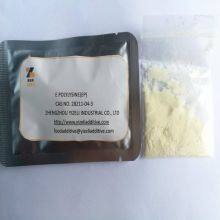
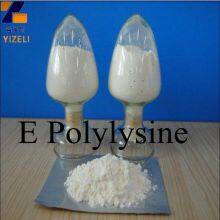
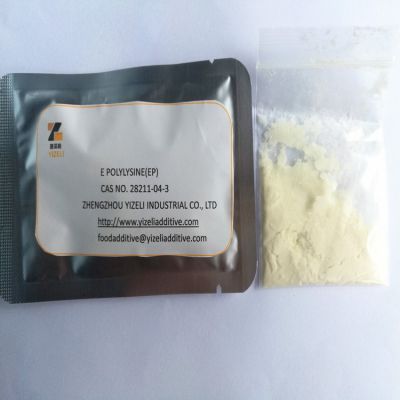
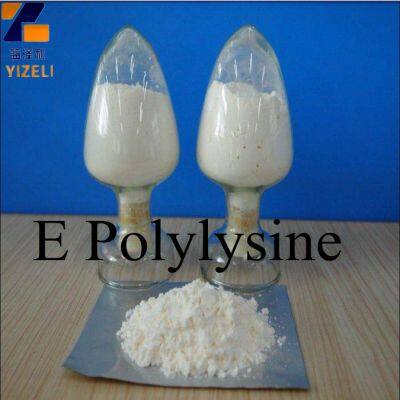
Epsilon Polylysine
Epsilon Polylysine Introduction
Epsilon Polylysine is a naturally produced, cationic homopolymer of 25-30 L-lysine(due to Streptomyces albulus fermentation.), which was connected by ε-amido bond compounded by a e-amido of l-lysine and a e-carboxyl of another l-lysine.
Characteristics
◆Various functions: Polylysine molecules are cationic, surface active agents in water due to their positively charged amino groups. This property imports many benefits when used as an ingredient in cosmetics.
◆Very safe.
◆Easy to use: readily soluble in water, highly heat-stable and useable over a wide pH range (5-8).
molecular weight:3600~4300 DA
Antibacterial Spectrum
Table 1 ε-PL MIC (minimum inhibition concentration) Test
Different Types of Microorganisms |
Bacteric |
MIC μg/ml |
pH |
|
Fungi |
Aspergillus niger IFO4416 |
250 |
5.6 |
Trichophyton mentagrophytes IFO7522 |
60 |
5.6 |
|
|
Yeast |
Candida acutus IFO1912 |
6 |
5.0 |
Phaffia rhodozyma IFO10129 |
12 |
5.0 |
|
Pichia anomala IFO0146 |
150 |
5.0 |
|
Pichia membranaefaciens IFO0577 |
5.0 |
||
Rhodotorula lactase IFO1423 |
25 |
5.6 |
|
Sporobolomyces roseus IFO1037 |
5.0 |
||
Saccharomyces cerevisiae |
50 |
5.0 |
|
Zygosaccharomyces rouxii IFO1130 |
150 |
5.6 |
|
|
Gram+ bacteria |
Geobacillus stearothermophilus IFO12550 |
5 |
7.0 |
Bacillus coagulans IFO12583 |
10 |
7.0 |
|
Bacillus subtilis IAM1069 |
7.3 |
||
Clostridium acetobutylicum IFO13948 |
32 |
7.1 |
|
Leuconostoc mesenteroides |
50 |
6.0 |
|
Lactobacillus brevis IFO3960 |
10 |
6.0 |
|
L1 plantarum IFO12519 |
5 |
6.0 |
|
Micrococcus luteus IFO12708 |
16 |
7.0 |
|
Staphylococcus aureus IFO13276 |
12 |
7.0 |
|
Streptococcus lactis IFO12546 |
100 |
6.0 |
|
|
Gram- bacteria |
Raoultella planticola IFO3317 |
8 |
7.0 |
Campylobacter jejuni |
100 |
7.0 |
|
Escherichia coli IFO13500 |
50 |
7.0 |
|
Pseudomonas aeruginosa IFO3923 |
3 |
7.0 |
|
Salmonella typhymurium |
As can be seen, ε-PL has wide range of antimicrobial spectrum with minimum inhibitory concentration of bacteria less than 100μg/ml, and to Fungi, the MIC is higher.
Table-2 Effect of temperature on the Minimum Inhibition Concentration (MIC) of ε-Polylysine against Growth of Escherichia coil
Treatment Condition |
MIC (μg/ml) |
Untreated |
50 |
80 ℃,60 min |
50 |
100 ℃,30 min |
50 |
120 ℃,20 min |
50 |
Table 3 PH on ε-PL MIC
Bacteria for Test |
MIC (μg/ml) |
|||
pH =5.0 |
pH =6.0 |
pH =7.0 |
pH =8.0 |
|
Bacillus subtilis |
3.0 |
3.0 |
3.0 |
3.0 |
Bacillus cereus |
25.0 |
100.0 |
50.0 |
12.5 |
Escherichia coli |
25.0 |
25.0 |
50.0 |
50.0 |
Staphylococcus aureus |
12.5 |
25.0 |
12.5 |
|
|
Table 4 MIC test (minimum inhibition concentration test) in cosmetics |
||
2% Polylysine(78% water) |
% |
|
P.aeroginosa |
0.06 |
|
E.coli |
0.03 |
|
Candida |
0.5 |
|
S.aureus |
0.007 |
|
Ε-PL can effectively inhibit the growth of undesirable microorganisms in foods, such as bakery food( bread , cake etc.), beverage( soybean milk, fruit beverage) and meat products.

Send Inquiry to This Supplier


You May Also Like
-
Polyglycerol Esters of Fatty Acids(PGE)US$ 2100 - 2200MOQ: 5 Metric Tons
-
Propylene Glycol Esters of Fatty Acid(PGMS)US$ 2500 - 2600MOQ: 5 Metric Tons
-
Citric Acid Esters of Mono-and Diglycerides (CITREM)US$ 2550 - 2680MOQ: 5 Metric Tons
-
BREAD IMPROVERUS$ 2600 - 2800MOQ: 5 Metric Tons
-
Glycerol Monooleate(GMO)US$ 2900 - 2950MOQ: 16 Metric Tons
-
China Additive Halal DATEMUS$ 2000 - 2100MOQ: 5 Metric Tons
-
BAKERY COMPOUND ADDITIVE BREAD IMPROVERUS$ 2650 - 2800MOQ: 5 Metric Tons
-
BREAD IMPROVERUS$ 2650 - 2800MOQ: 5 Metric Tons
-
New Product Glycerol Monooleate(GMO)US$ 1500 - 1600MOQ: 16 Metric Tons
-
China Food Emulsifier Citric Acid Esters of Mono-and Diglycerides (CITREM)US$ 2550 - 2680MOQ: 5 Metric Tons


