








 Contact Platform Support
 Help Center
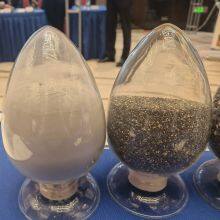
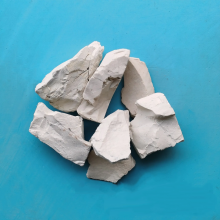
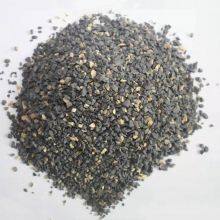
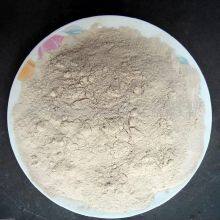
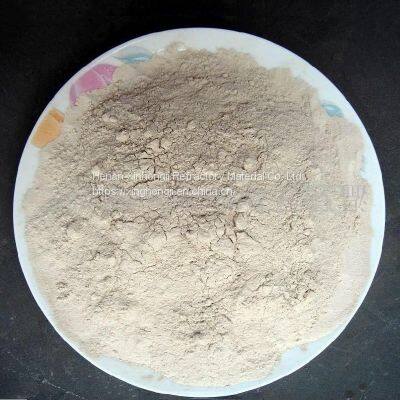
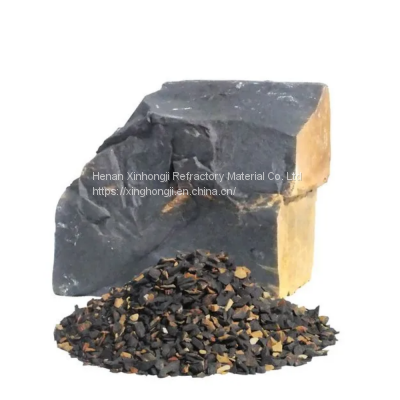
Calcined Diaspore Clay Flint Clay Bauxite Ore Aggregate High Alumina Raw Materials for Refractories



Related Products
-
 Wholesales Calcined Cordierite Ore High Alumina Raw Materials Aggregate BauxiteUS$ 180 - 260MOQ: 1 Ton
 -
High Alumina Homogenized Bauxite Compound AggregateUS$ 180 - 350MOQ: 1 Ton
-
High Alumina Homogenized Bauxite Compound AggregateUS$ 180 - 330MOQ: 1 Ton
-
95% Al2O3 High Alumina Hollow Sphere Ceramics Balls Refractory Aggregate Raw MaterialsUS$ 900 - 1300MOQ: 1 Ton
-
High Alumina Hollow Sphere Balls Pure Refractory Aluminum Oxide Bubble BallsUS$ 1500 - 1800MOQ: 1 Ton
High Alumina Aggregate Raw Materials
Introduction
High Alumina Raw Materials (also called bauxite or flint clay) are used to improve the performance of refractories by imparting properties such as strength, protection from chemical and physical attack, and slag resistance. Refractory products can be broadly divided into basic, neutral and acidic groups, which relate to the type of refractory environment the product has been designed for (e.g., basic oxygen steelmaking) and hence the minerals used in its manufacture.
Minerals commonly used for refractories include (but are not limited to) alumina, bauxite, graphite, kaolin, magnesia and zirconium. These minerals are produced globally but, in some cases, not always of grades suitable for refractory applications (e.g., magnesite and bauxite).
One of the most robust refractories is alumina, which consists of aluminum oxide and traces of other materials. Alumina is highly stable chemically and has superior hardness, strength and spalling resistance. Refractory suppliers manufacture alumina that is suitable for lining furnaces operating at temperatures up to 1843 centigrade degree.
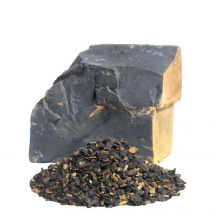
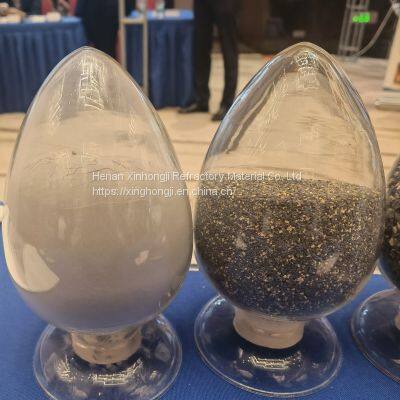
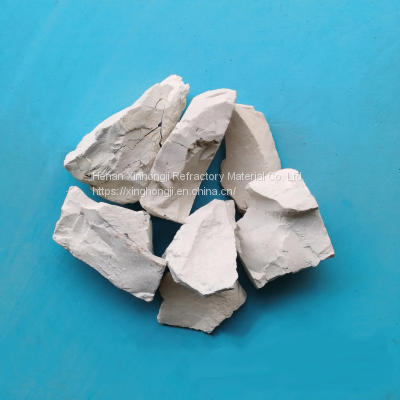
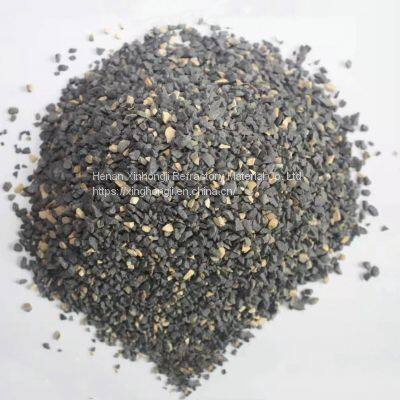
The raw ores of alumina are mainly bauxite or flint clay, or the mixed homogeneous materials.
Our calcined bauxite products have high alumina and low iron content, making them ideal refractory materials. We use our crushing and sizing technology to supply customers with the highest quality sized calcined bauxite and brown fused alumina. Quality is of the utmost importance and we are constantly aware that any deviation from our high standards could have major implications for refractory lining stability.
Features
High alumina bauxite, iron bauxite, industrial alumina and clay as raw materials, which are made into mullite refractory bricks or High Alumina Bricks. The bauxite raw materials should be pre-fired to remove the structural water to avoid popping and splashing when the electric arc is concentrated and decomposed in the electric arc furnace.
Chemical & Physical Index
Physical Parameters
Color | White, gray, sometimes stained yellow, orange, red, pink, or brown by iron or included iron minerals |
Streak | Usually white, but iron stain can discolor |
Luster | Dull, earthy |
Diaphaneity | Opaque |
Cleavage | None |
Mohs Hardness | 1 to 3 |
Specific Gravity | 2 to 2.5 |
Diagnostic Properties | Soft, low specific gravity, color. Often exhibits pisolitic habit. |
Chemical Composition | Variable but always rich in aluminum oxides and aluminum hydroxides |
Crystal System | n/a |
Uses | The primary ore of aluminum. Synthetic bauxite is used as an abrasive and as a fracking proppant. |
Chemical Parameters
Grades | Al2O3(%) | Fe2O3 (%) | Ti2O(%) | CaO+MgO(%) | K2O+Na2O(%) | Bulk Density (g/cm³) | Water Absorption (%) | Refractoriness (℃) |
90 | ≥90 | ≤1.4 | ≤2.5 | ≤0.2 | ≤0.2 | ≥3.4 | ≤3 | 1910 |
87 | ≥87 | ≤1.8 | ≤3.1 | ≤0.2 | ≤0.2 | ≥3.2 | ≤3 | 1850 |
85 | ≥85 | ≤1.9 | ≤3.2 | ≤0.2 | ≤0.2 | ≥3.1 | ≤4 | 1800 |
80 | ≥80 | ≤2.0 | ≤3.5 | ≤0.3 | ≤0.3 | ≥2.9 | ≤5 | 1750 |
70 | 70-80 | ≤2.0 | ≤3.8 | ≤0.6 | ≤0.6 | ≥2.75 | ≤5 | 1710 |
60 | 65-70 | ≤2.0 | - | ≤0.6 | ≤0.6 | ≥2.45 | ≤6 | 1650 |
50 | 55-65 | ≤2.2 | - | ≤0.6 | ≤0.6 | ≥2.45 | ≤6 | 1610 |
45 | 45-55 | ≤2.5 | - | ≤0.6 | ≤0.6 | ≥2.40 | ≤7 | 1550 |
Production procedure
The production procedure of a refractory brick is divided into the raw material selection, calcining, forming, crushing, batching, mixing, placing material, molding, drying, burning, assessment and packing.
The rate of refractory brick and raw material price, physical and chemical index, and production procedure is quickly specified.
Raw material choice, beneficiation, and purification, High purity raw materials are the premise for producing high-quality refractories.
Calcining, except for some raw materials, most of the raw materials utilized as refractory aggregate must be calcined at great temperatures.
A series of physical and chemical reactions are generated when the raw material is calcined, which plays a vital role in enhancing the composition, increasing mineral composition and structure of the refractories, and assuring the volume stability of the refractory and the precision of the apparent size.
The indexes of material sintering contain apparent porosity, bulk density, and water absorption, etc.
Sorting, crushing, and proportioning, the raw material requires to be screened after a crushing and grinding, because the semi-finished material is graded by various sizes of powder, and ensures received the dense body with the greatly compact.
Each variety of equipment can generate various fineness of finished powder by grinding, 80 mesh -425 mesh, 500 mesh -2000 mesh, the finest can achieve about 2500 mesh.
Mixing, placing material, in order to homogenate the components and particles of raw meal and clinker, It is essential to mix and add binder at a similar time to improve the bonding strength of the semi-finished material.
After molding, drying, and press by great pressing equipment and molded, the green refractory bricks should be placed for a particular time to dry.
Burning, the complete product was sintered by high-temperature sintering at a high-temperature kiln.
Checking and packing.
Application :
To be made into refractory products, such as refractory bricks, refractory castables, refractory mortars etc.
Package
1 ) . In 1MT Big Bag
2 ) . customized packing as required

Send Inquiry to This Supplier


You May Also Like
-
High Purity Alumina Granules Fused Corundum Abrasive Grit Refractory AggregatesUS$ 800 - 1200MOQ: 1 Ton
-
High Alumina Hollow Cenosphere Balls Corundum Hollow Pheres Aluminum Oxide Bubble BallsUS$ 1200 - 1500MOQ: 1 Ton
-
High Purity High Conductive Silica Carbide Aggregate Powder Granules Raw MaterialsUS$ 500 - 710MOQ: 1 Ton
-
Top Grade SiC 99.9% Black Silicon Carbide Powder Aggregate for Abrasive and RefractoriesUS$ 600 - 990MOQ: 1 Ton
-
High Purity SiC Black Silicon Carbide Granules Particles for Abrasive and RefractoriesUS$ 500 - 900MOQ: 1 Ton
-
Pink Fused Alumina Gravels Chrome Electrocorundum Grit F40 F46 Abrasive Raw MaterialUS$ 880 - 1199MOQ: 1 Ton
-
Competitive Price Electro-melting Pink Fused Chrome Corundum Grit Abrasive Aggregate Raw MaterialUS$ 880 - 1100MOQ: 1 Ton
-
High Quality Calcined Kaolin Aggregate Raw Materials for Refractory Brick CastableUS$ 200 - 300MOQ: 1 Ton
-
Wear Resistance Special Burned Phosphate Bonded High Alumina Refractory BricksUS$ 500 - 700MOQ: 1 Ton
-
Blast Furnace Refractory Lining FireBricks Low Creep High Alumina Refractory BricksUS$ 290 - 490MOQ: 1 Ton