








 Contact Platform Support
 Help Center
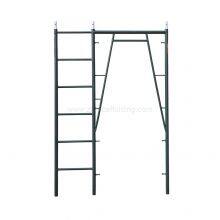
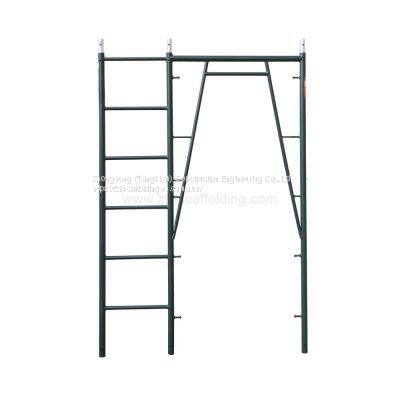
Scaffold With Ladder


Related Products
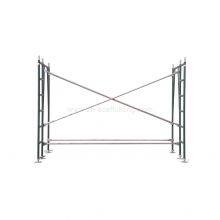
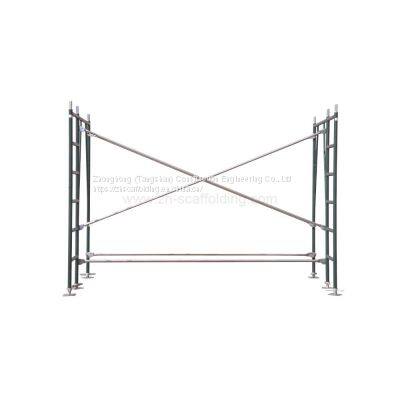
Scaffold with Ladder
Color: Red, blue, green, yellow, customizable
Minimum Quantity: 1*20GP
Product Delivered Quantity: 500
Construction, Engineering
Material: Q235 Steel, Q355 steel
Surface Treatment: Flame Plating/ Electro galvanized
Accessories
Connecting Rod
Adjustable Base
Tie Rods
Connection Method
Product Size
Dia*wall thickness |
Size(mm)=length*width |
KG |
φ41.3*2.3 |
1371*2032 |
24.5 |
φ41.3*2.3 |
1371*2641 |
31.4 |
φ41.3*2.3 |
1371*3251 |
36.2 |
Ladder frame is a universal scaffold, compared with the ordinary frame, more convenient to use, often used for residential contractors, painters, etc., can also be superimposed, used for large construction work with versatility, economy and ease of use.
FAQ of steel scaffolding
Steel is the most commonly used material for scaffolding. Steel scaffolding is extremely durable with high strength and is comparable to other scaffolding materials such as aluminium and wood.
Scaffolding is a temporary structure that is used in various areas of construction, maintenance and repair work. This is because it provides access to work in locations that are high and/ or remote. Predominantly, it is made from steel, bamboo or timber. The main purpose of erecting scaffolding is to provide a platform for a worker to work at different heights, or to lift materials for immediate use.
What are the main types of scaffolds?
There are several main types of scaffolding: single scaffolding, double scaffolding, steel scaffolding and cantilever scaffolding.
Steel scaffoldingSteel scaffolding, otherwise known as ‘tubular scaffolding’, has a similar structure to double and single scaffolding. The difference lies in the material used. Unlike single and double scaffolding, steel scaffolding uses steel tubing rather than timber, and instead of rope lashing, it uses steel couples. The standards are fixed into the ground using a base plate.
Single scaffoldingSingle scaffolding is commonly made from bamboo or timbers and features a series of vertical standards firmly fixed into the ground in a row and parallel to the construction or building wall. Rope lashing is used to tie the standards with horizontal ledgers.
Double scaffoldingDouble scaffolding is commonly used in stone masonry as it is stronger than single scaffolding. Unlike single scaffolding, double scaffolding has two rows of standards that are fixed into the ground. The first row is fixed close to the wall, and the second is fixed 1.5m away from the first row.
Cantilever scaffoldingCantilever scaffolding is used when it’s not possible to fix standard into the ground, or if construction work is being carried out on the side of a busy road or street, or if it’s being carried out at a high level on a tall building.
What are the advantages of using steel?
Steel scaffolding has a higher carrying capacity and provides a firm steady standing structure. It can remain strong even during intense weather conditions such as wind and heavy rain.
Compared to other materials, steel is durable and more economical in the long run. It also has more fire-resisting capacity and is far more suitable and safe for those working at height. It is also widely used in the construction industry because it offers the greatest safety for workers.
This type of scaffolding can also be erected and dismantled quickly in comparison to timber scaffolding, which helps save construction time.
The order of erection
Foundation preparation → Placement of matting → Placement of base → Vertical two-bay single piece gantry → Installation of cross bars → Installation of scaffolding boards → Repeat the process of installing gantry, cross bars and scaffolding boards on this basis.
Safety requirements
(1) All materials used in the erection of high-rise scaffolding must meet the quality requirements.
(2) The foundation of high-rise scaffolding must be solid, calculated before erection to meet the load requirements, and erected according to the construction specifications, and drainage measures.
(3) The technical requirements for scaffold erection should be in accordance with the relevant specifications.
(4) Great importance must be attached to various construction measures: scissor bracing, tie points, etc. should be set up as required.
(5) Horizontal closure: should be from the first step, every step or two steps, full laying scaffolding board or scaffolding fence, scaffolding board along the long direction of laying, joints should overlap resting on the small horizontal bar, forbidden to appear empty head board. And in the wall between the pole and the wall every four steps to lay a unified long safety bottom fence.
(6) Vertical closure: from the second step to the fifth step, each step is required to set up 1.00m high protective kind of railing and foot barrier or set up a net on the inside of the outer row of poles, and the protective poles (net) are fastened with the poles; above the fifth step, in addition to setting up protective blocking poles, all safety fences or safety nets should be set up; in the street or densely populated areas, all safety fences or safety nets should be set up on the outside from the second step.
(7) Scaffolding should be erected more than 1.5m above the top of the building or the operating surface and be enclosed.
(8) The steel pipes, fasteners, scaffolding plates and connection points on the erected scaffolding shall not be removed at will. If necessary during construction, they must be agreed by the person in charge of the site and effective measures must be taken to restore them immediately after the process is completed.
(9) Before the scaffolding is used, it should be checked and accepted by the person in charge of the site, and only after it has passed the inspection and filled in the delivery sheet can it be used. During the construction process there should be professional management, inspection and warranty, and regular subsidence observation, abnormalities should be found in time to take reinforcement measures.
(10) When dismantling scaffolding, check the connection with the building first, and clear the scaffolding of stored materials, debris, etc., from top to bottom, according to the order of first installed and then dismantled, after installed and then dismantled, the dismantled materials should be uniformly passed down or lifted to the ground, step by step. No step demolition method is allowed, it is strictly forbidden to throw down or use the push (pull) down method of demolition.
For more information on steel scaffolding, or to learn more about any of our steel products, please contact our staff today.

Send Inquiry to This Supplier


You May Also Like
-
 Scaffold Frame | 3'X6'8" | WALK THRU Hot SaleNegotiableMOQ: 1 Twenty-Foot Container
 -
Mason Scaffold Frame Set for SaleNegotiableMOQ: 1 Twenty-Foot Container
-
Scaffold Frame| 3'X6'8" | WALK THRU Walk Through Scaffolding SupplierNegotiableMOQ: 1 Twenty-Foot Container
-
Wholesale Scaffold Frame SetNegotiableMOQ: 1 Twenty-Foot Container
-
Kwikstage Scaffolding System SupplierNegotiableMOQ: 1 Twenty-Foot Container
-
ADTO Manufacture Ladder / h and Door Frame Scaffolding / Scaffold Ladder Type WholesaleUS$ 8 - 20MOQ: 2000 Pieces
-
Steel Scaffolding Steel Ladder Staircase for Ringlock Cuplock Platform SystemUS$ 2 - 18MOQ: 1000 Pieces
-
Scaffold With LadderNegotiableMOQ: 200 Sets
-
Scaffolding LadderUS$ 20 - 30MOQ: 100 Pieces
-
6*2 Step Ladder Flame Scaffolding Scaffold Ladder Agility LadderUS$ 35 - 42MOQ: 200 Pieces


