








 Contact Platform Support
 Help Center
Megatro Electrical Power Distribution
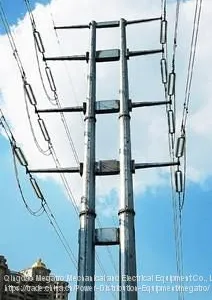
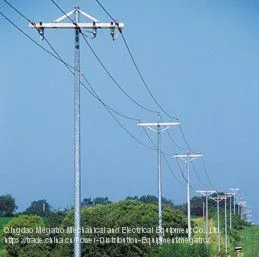
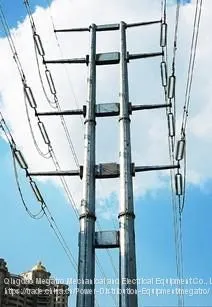
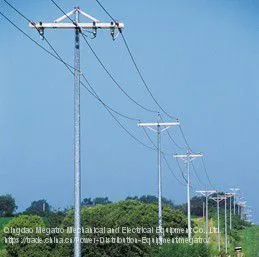



Related Products
-
 Megatro Tagent TowerUS$ 920 - 960MOQ: 1 Ton
 -
Megatro Transmission Tagent PolesUS$ 920 - 960MOQ: 1 Ton
-
Megatro Tension TowerUS$ 920 - 960MOQ: 1 Ton
-
Megatro Terminal and Angle TowerUS$ 920 - 960MOQ: 1 Ton
-
Megatro Tubular Lattice Steel Tower for Power Transmission Line ProjectUS$ 920 - 960MOQ: 1 Ton
Electric power distribution
Simplified diagram of AC electricity distribution from generation stations to consumers. Transmission system elements are shown in blue, distribution system elements are in green.
In the early days of electricity distribution, direct current (DC) generators were connected to loads at the same voltage. The generation, transmission and loads had to be of the same voltage because there was no way of changing DC voltage levels, other than inefficient motor-generator sets. Low DC voltages (around 100 volts) were used since that was a practical voltage for incandescent lamps, which were the primary electrical load. Low voltage also required less insulation for safe distribution within buildings. The loss in a cable is proportional to the square of the current, and the resistance of the cable. A higher transmission voltage would reduce the copper size to transmit a given quantity of power, but no efficient method existed to change the voltage of DC power circuits. To keep losses to an economically practical level the Edison DC system needed thick cables and local generators. Early DC generating plants needed to be within about 1.5 miles (2.4 km) of the farthest customer to avoid excessively large and expensive conductors.
Introduction of alternating current
General layout of electricity networks
The competition between the direct current (DC) and alternating current (AC) (in the U.S. backed by Thomas Edison and George Westinghouse respectively[2]) was known as the War of Currents. At the conclusion of their campaigning, AC became the dominant form of transmission of power. Power transformers, installed at power stations, could be used to raise the voltage from the generators, and transformers at local substations could reduce voltage to supply loads. Increasing the voltage reduced the current in the transmission and distribution lines and hence the size of conductors and distribution losses. This made it more economical to distribute power over long distances. Generators (such as hydroelectric sites) could be located far from the loads.

Send Inquiry to This Supplier

You May Also Like
-
Megatro Turning TowerUS$ 920 - 960MOQ: 1 Ton
-
Megatro 25FT Distribution TowerUS$ 920 - 960MOQ: 1 Ton
-
Megatro Suspension Angle TowerUS$ 920 - 960MOQ: 1 Ton
-
Megatro 400KV Y-Frame Steel TowerUS$ 920 - 960MOQ: 1 Ton
-
MEGATRO 1000V 10A1 ZMJ Angle and Tension Transmission TowerUS$ 920 - 960MOQ: 1 Ton
-
MEGATRO 1000KV 10GB1-SZ4 Double Circuit Transmission TowerUS$ 920 - 960MOQ: 1 Ton
-
MEGATRO 1000V 10A2 JC3 MCS Tension Transmission TowerUS$ 920 - 960MOQ: 1 Ton
-
MEGATRO 1000V 10A2 JC2 Tension Transmission TowerUS$ 920 - 960MOQ: 1 Ton
-
MEGATRO 1000KV 10GB1 SJ3 Double Circuit Tension Transmission TowerUS$ 920 - 960MOQ: 1 Ton
-
MEGATRO 110KV SJ45°DC Angle Transmission TowerUS$ 920 - 960MOQ: 1 Ton


