








 Contact Platform Support
 Help Center
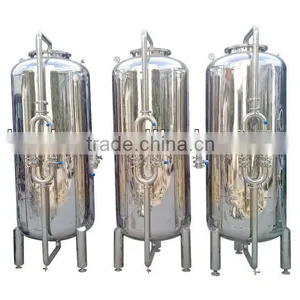
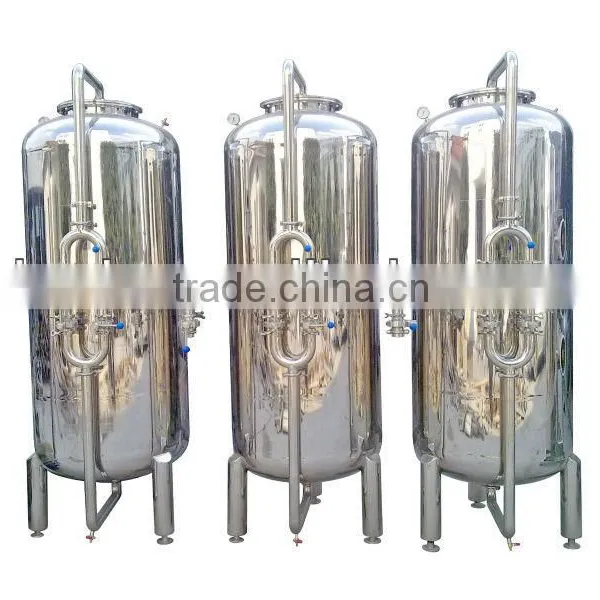
Stainless Steel Sand Filter


Related Products
-
 Sand Filter for Water TreatmentUS$ 2,000 - 20,000MOQ: 1 Unit
 -
7000l Water Treatment SystemUS$ 3,000 - 30,000MOQ: 1 Unit
-
10000l Water Pretreatment EquipmentUS$ 10,000 - 100,000MOQ: 1 Unit
-
Pharmaceutical Water Treatment Reverse Osmosis (ro) PlantsUS$ 2,000 - 100,000MOQ: 1 Unit
-
Tubular Liquid Solid Centrifuge SeparatorUS$ 1,000 - 100,000MOQ: 1 Piece
Specifications
1.Material:SS304 or SS316L2.ISO9001
3.Mirror polished or linging
4.Custom made
5.Factory price
Stainless steel Sand Filter
Sand filters are most effective at removing , , and (VOCs) from water. They are not effective at removing , , and dissolved inorganic compounds.
Typical particle sizes that can be removed by carbon filters range from 0.5 to 50 . The particle size will be used as part of the filter description. The efficacy of a carbon filter is also based upon the flow rate regulation. When the water is allowed to flow through the filter at a slower rate, the contaminants are exposed to the filter media for a longer amount of time.
For small scale water purifiers are installed to prevent formation of minerals on the surface of the electrodes and to remove organics and chlorine from utility water. First the water passes through a 20 micrometer interference ( or ) filter to remove sand and dust particles, second, a charcoal filter () to remove organics and , third stage, a to remove metallic ions.[] A test can be done before and after the filter for proper functioning on , , , , and
Uses in water treatment
All of these methods are used extensively in the water industry throughout the world. The first three in the list above require the use of flocculant chemicals to work effectively whilst slow sand filters can produce very high quality water free from pathogens, taste and odour without the need for chemical aids.
Passing flocculated water through a rapid gravity sand filter strains out the floc and the particles trapped within it reducing numbers of bacteria and removing most of the solids. The medium of the filter is sand of varying grades. Where taste and odour may be a problem (organoleptic impacts), the sand filter may include a layer ofactivated carbon to remove such taste and odour.
Sand filters become clogged with floc after a period in use and they are then backwashed or pressure washed to remove the floc. This backwash water is run into settling tanks so that the floc can settle out and it is then disposed of as waste material. The supernatant water is then run back into the treatment process or disposed of as a waste-water stream. In some countries the sludge may be used as a soil conditioner. Inadequate filter maintenance has been the cause of occasional drinking water contamination.
Sand filters are occasionally used in the treatment of sewage as a final polishing stage (see Sewage treatment). In these filters the sand traps residual suspended material and bacteria and provides a physical matrix for bacterial decomposition of nitrogenous material, including ammonia and nitrates, into nitrogen gas.

Send Inquiry to This Supplier

You May Also Like
-
SMC Septic Tank With 5-Year Warranty, Factory Direct, Mill Test Report Available, 24/7 SupportNegotiableMOQ: 300 Units
-
Modular GRP FRP Water Storage Tank for Water Treatment and PurificationNegotiableMOQ: 1 Piece
-
Water Bath SterilizerNegotiableMOQ: 1 Set
-
220V Electric Composting Equipment for Organic Waste ProcessingNegotiableMOQ: 1 Piece
-
Equipo de Cremación Humana de Alto Volumen Horno de Cremación Estilo Americano Equipo de Crematorio Horno Para CremaciónNegotiableMOQ: 1 Set
-
Wound Filter Cartridge for Water Treatment, 5 Micron, 10 Inch, Effective Sediment RemovalNegotiableMOQ: 1 Piece
-
Environmental Solid Waste Disposal Rubbish to Energy Plant Leather Waste Industrial Processor Compress Recycling and Control EPCUS$ 39000 - 68000MOQ: 1 Set
-
PPS Needle Felt Filter Cloth for Thermal Power Plants for Boiler Gas PurifyNegotiableMOQ: 1 Piece
-
Waste Treatment EquipmentNegotiableMOQ: 2500 Sets
-
Household Items Sorting Machine Domestic Waste Sorting PlantUS$ 23500 - 68500MOQ: 1 Set


